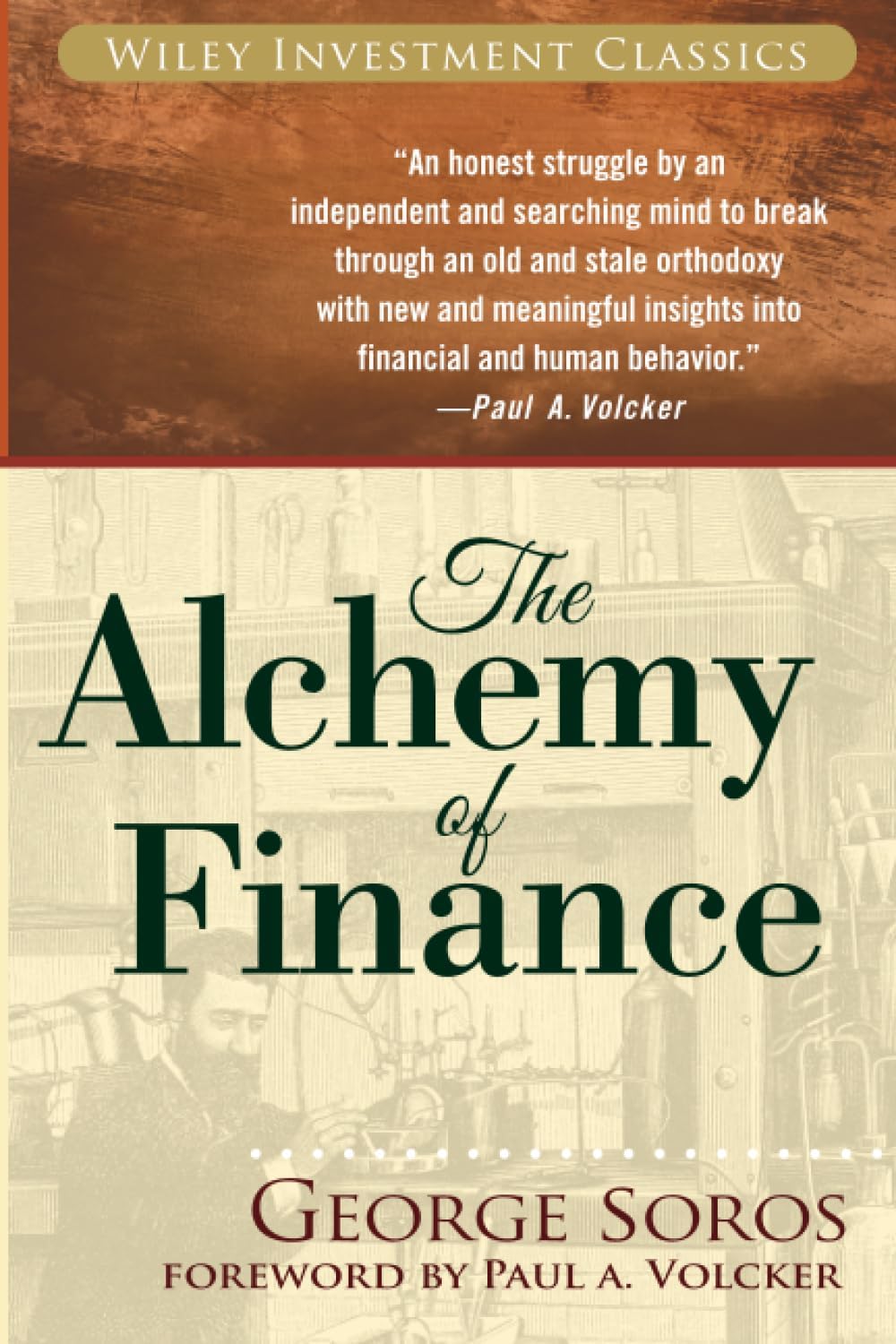
The Alchemy of Finance (Wiley Investment Classics)
Product ID: 8875636
Buy anything from 5,000+ international stores. One checkout price. No surprise fees. Join 2M+ shoppers on Desertcart.
Desertcart purchases this item on your behalf and handles shipping, customs, and support to British Virgin Islands.
New chapter by Soros on the secrets to his success along with a new Preface and Introduction. New Foreword by renowned economist Paul Volcker "An extraordinary . . . inside look into the decision-making process of the most successful money manager of our time. Fantastic." ― The Wall Street Journal George Soros is unquestionably one of the most powerful and profitable investors in the world today. Dubbed by BusinessWeek as "the Man who Moves Markets," Soros made a fortune competing with the British pound and remains active today in the global financial community. Now, in this special edition of the classic investment book, The Alchemy of Finance, Soros presents a theoretical and practical account of current financial trends and a new paradigm by which to understand the financial market today. This edition's expanded and revised Introduction details Soros's innovative investment practices along with his views of the world and world order. He also describes a new paradigm for the "theory of reflexivity" which underlies his unique investment strategies. Filled with expert advice and valuable business lessons, The Alchemy of Finance reveals the timeless principles of an investing legend. This special edition will feature a new chapter by Soros on the secrets of his success and a new Foreword by the Honorable Paul Volcker, former Chairman of the Federal Reserve. George Soros (New York, NY) is President of Soros Fund Management and Chief Investment Advisor to Quantum Fund N.V., a $12 billion international investment fund. Besides his numerous ventures in finance, Soros is also extremely active in the worlds of education, culture, and economic aid and development through his Open Society Fund and the Soros Foundation. Review: I would recommend to anyone who wanted to peer inside the Palindromes ... - One of the most powerful yet underrated books on finance and economics ever. The book has not received its due praise primarily because the writing tends to be a little muddled and distracting, and the main idea offered in the book is revolutionary and definitely runs contrary to the popular held beliefs of efficient market theory- and this is why the book is so valuable. I would recommend to anyone who wanted to peer inside the Palindromes mind to go and first read "Soros on Soros" which is a kind of brief overview of the ideas offered in this book but done in an interview style so the writing is much more cogent and readable. But, once you have finished that I would definitely recommend reading "Alchemy..." The ideas and information offered inside are powerful and game changing to those who can understand them- which certainly doesn't take a PHD, just an open mind and bit of thought. In fact, it was after reading this book that the young Stanley Drunkenmiller sought out George Soros and asked to work with him, and Paul Tudor Jones, made it a requirement to read and understand this book before joining his fund. If that is not enough of a referral then I don't know what is. Read this book, take notes, and internalize the lessons and ideas inside and you will much better off for it. Review: Great book on finance - Wonderful tools that any and everyone can use. This book explores the financial world in a way that is easy to understand. You don’t get lossed in financial Mumbo jumbo. This book breaks down complex concepts in an easy to digest way. I would recommend this read to all of my friends and family.
| Best Sellers Rank | #44,287 in Books ( See Top 100 in Books ) #7 in Accounting (Books) #19 in Business Finance #22 in Business Investments |
| Customer Reviews | 4.3 out of 5 stars 736 Reviews |
A**.
I would recommend to anyone who wanted to peer inside the Palindromes ...
One of the most powerful yet underrated books on finance and economics ever. The book has not received its due praise primarily because the writing tends to be a little muddled and distracting, and the main idea offered in the book is revolutionary and definitely runs contrary to the popular held beliefs of efficient market theory- and this is why the book is so valuable. I would recommend to anyone who wanted to peer inside the Palindromes mind to go and first read "Soros on Soros" which is a kind of brief overview of the ideas offered in this book but done in an interview style so the writing is much more cogent and readable. But, once you have finished that I would definitely recommend reading "Alchemy..." The ideas and information offered inside are powerful and game changing to those who can understand them- which certainly doesn't take a PHD, just an open mind and bit of thought. In fact, it was after reading this book that the young Stanley Drunkenmiller sought out George Soros and asked to work with him, and Paul Tudor Jones, made it a requirement to read and understand this book before joining his fund. If that is not enough of a referral then I don't know what is. Read this book, take notes, and internalize the lessons and ideas inside and you will much better off for it.
J**Y
Great book on finance
Wonderful tools that any and everyone can use. This book explores the financial world in a way that is easy to understand. You don’t get lossed in financial Mumbo jumbo. This book breaks down complex concepts in an easy to digest way. I would recommend this read to all of my friends and family.
M**Y
Soros's uncertainty principle is a vague form of Keynesian Uncertainty,not Heisenberg uncertainty
Soros has written a thoughtful and interesting book.However,there is nothing that is new theoretically.It was all said in a much more detailed and specific form in Keynes's A Treatise on Probability(TP;1921),where uncertainty(Soros's uncertainty principle-see pp.6-10,40) was analyzed mathematically using the variable called the weight of the evidence,w, in chapter 26( the weight of the argument in chapter 6 provided the logical analysis).Keynes used the term uncertainty in the GT to denote the same basic phenomenon applied to decision making involving a significant lack of knowledge and information on (a) investment in long lived durable capital goods subject to technological innovation over time(Daniel Ellsberg's nearly identical concept of ambiguity improves on Keynes's completely original formulation),(b)financial markets, and (c)liquidity preference decisions concerning the amount of liquid assets to hold for speculative purposes.Keynesian expectations are liable to sudden changes because they are not representable by the normal distributions's standard deviation(Risk),which is the basic foundation of E Fama's Efficient Market Hypothesis,Milton Friedman's Monetarism,Robert Lucas's rational expectations,and Prescott and Kydland's real business cycle theory,etc.Keynes's analysis appears in chapter 12,pp.239-241 of chapter 17, and in pp.314-320 of the General Theory(1936;GT).It is interesting to note that Soros's own method of dealing with uncertainty,by using one's instinct and intuition ,is identical to the manner in which it was handled by Keynes. Practically all of the examples from the financial markets used by Soros to show how his uncertainty principle(the reference to Heisenberg's uncertainty principle is defective since the probability distributions are known.What Heisenberg meant by uncertainty was risk.Only one of the two hypothesized probability distributions in Heisenberg's example can exist at any one moment of time) is operationalized could just as easily have been mistaken for Keynes's chapter 12 analysis in the GT.The value in Soros's book is that it provides a more modern set of examples that updates Keynes's chapter 12 analysis of how uncertainty impacts decision making.Risk is a very special case that occurs when there is no uncertainty about the future.Uncertainty automatically makes probability estimates indeterminate.They become intervals. Soros will have to be much more specific in the future about his uncertainty principle(reflexivity) so that a reader will be able to differentiate what Soros has done from what Keynes did(one must also mention Frank Knight's and Joseph Schumpeter's contributions in this area,although they are not nearly as specific and technical as the contributions of Keynes and Ellsberg). Soros needs to be devote much more time to reading and digesting Keynes's works.The few one liners that refer to Keynes in this book illustrate that Soros has not done all of his homework yet.A clear cut comparison -contrast between Keynes and Soros would allow a reader to decide what is original in Soros's approach and what is merely a variation on Keynes's theme of uncertainty impacting many of the most important financial and investment decisions that will determine the future.
K**.
Can you read between the lines?
Have read a lot of reviews about this book. Some complain that it rambles on. It does, and thats what I liked so much about it. Like Mr. Soros's explanation of reflexivity you really have to contemplate this book with "reflexivity". In other words, if you come to this tome thinking you are going to learn some of his billionaire secrets, forget about it. He is too smart for that. He is not going to spell it out for you. Hoewever if you can read between the lines and learn by doing so, then that is where your free education from Mr.Soros appears. A lot can be learned from words and patterns of speech, and to hear his perceptions of life and market conditions, one can walk away with valuable info about how to time the market and life correctly. Wanted to listen to this book since hearing Mr O'Reilly (with whom I respect) harp about Soros so much nightly. If nothing else just want to hear the "fair and balanced" sake of the dispute. If you like listening to things that are somewhat abstract, I recommend this book. If your trying to get detailed info about how Mr. Soros made billions in hopes of repeating his success, start by studying Finance and Economics at your local community college. His words are like a beautiful Operatic Aria. His Political schemes a perk of success. And, you have to admire his freedom to do that. "That which does not destroy us, only makes us stronger.
I**G
Enlightening
May I say I have read but 40 pages and concur that this book definitely provides insight casually overlooked by those hotheaded enough to dismiss things as this or that. Perhaps Mr. Soros is stating at protracted length by the girth of the book but he stocks it with many examples which I find helpful (I read out of order so my 40 pgs are all over the book). Reflexivity seems to be some aftermath of relativity and/or a socialized version of Newton's 3rd law, where the reaction is not reciprocated 180 degrees or of equal momentum, but at a variant angle at a sensible force. I read along and in reading this I am complementing my Bergson "Matter and Memory" which lends great weight to the textual stretches Soros regales in. George Soros has quite credibly depicted the details of empirical business to a degree most ignore and operate off of with heuristic reaction. A man who spells out what everyone is just saying can profit from the faults of cadence and dis equanimity of many people's interpretation. This basically continues Marx's reductive division between singular and plural, as necessitated by communicable mediums, and results in asymmetry. Trends are social and crest and waver, but formed in certain mediums as are waves in an ocean and by shifts in the air current and to the land/gravity one can gauge to some modicum of satisfaction the tides to come. Nothing is 100 percent due or endogenously self-directing or regulating as we are members of a system and therefore produce tremors in our actions which disrupt or affect our observations (very Heisenberg indeed).
M**N
Long-Winded Book from George Soros
George Soros is a legend but I must admit this book is flawed. While I love the old classics like Supermoney, Art of the Deal and One Up on Wall Street this doesn't match up in terms of insights or interest. The first few chapters are good but the book eventually rambles along and includes way too much historical information that isn't particularly useful now. There is an abundance of charts in the text. Even as an investment advisor I found the info was good but much of it is explained better elsewhere. Soros is holding back almost all of his secrets in this book. Investors in 2013 and beyond aren't going to learn much in the way of practical information but do get some philosophical questions to consider. You can learn from the mistakes of others by reading this. History is doomed to repeat (or at least rhyme) so you can learn from this investment legend's perspective. The title is intriguing but the book is very complicated and doesn't do a great job of explaining things throughout.
E**A
Good book
Good read, book arrived quickly and in great condition
J**E
Must have for personal investors.
We learn about the future through the past. While this book won't teach you about Crypto, NFTs, or EFTs, it will shed light on the philosophy of trading before the computer. I am not a fan of George Soros as a person, he does have some valuable wisdom to share in this book. It is a must have for anyone doing their own investments and more valuable than any youtube video.
L**8
very good
the audiobook was ok, I think that is necessary to read this book or listen the audiobook (I've both) if you want to now something about the excellent mind (about trading, not even about the man..) of Mr. Soros.
S**I
finans dünyası
oğlum istedi memnun kaldı ,finans ilgi gösterenlere tavsiye ederim,amazon teşekkür ederim
C**C
A foundational book that had helped me think clearly about so much. A better title: The Alchemy of Everything
Short review: Hard work, but deep. A better title would be "The Alchemy of How Everything Works". Long review: Nominally, “The Alchemy of Finance” is about understanding markets and making better investing decisions. If that is all one learned it would be a crying shame, because the book is actually about understanding reality and making better decisions. To restrict it to the markets is a serious mistake and not one Soros makes. One of the most important steps to understanding reality is understanding the feedback loops that operate. These can be self-sustaining for some time and often lead to exponential change, but are ultimately, necessarily, self-defeating. A fission bomb is one example. A Uranium atom splits and releases two neutrons. Each of those can cause another atom to split. An enormous amount of energy is released, but quickly there will be no more Uranium left to split and the chain reaction will end. The same mechanism underpins financial markets, leading to booms and busts. Considering the dynamic created by feedback loops is important when making almost any kind of decision, as is its implication: Complex systems (markets, diplomacy, reality) are historic processes which can be uniquely explained post facto but which have many possible outcomes ex ante. Building on this, “reflexivity” is the term Soros uses to describe the feedback loop which runs between reality and the participants’ understanding of reality, and vice versa. Traditionally, we think only of the causal arrow from reality to our thinking. FooCorp has grown its market share by 25%, therefore we think it is better than its competitors. Reflexively, the arrow also runs the other way. For whatever reason, the bank thinkg FooCorp is better than its competitors so they loan them money. As a result, FooCorp becomes more competitive. Reflexivity occurs in economics, politics, dyadic interpersonal relationships and drives the Jobsian “reality dysfunction field”. Economic supply and demand curves are an interesting example of reflexivity. Typically, they are independently given and assumed not to interact. Instead, their intersection should simply determine the price at which the market clears. However, trivial examples of reflexive interaction between the two abound. High supply versus demand in a commodity (and therefore low prices) stimulate new and innnovative uses for it, in turn creating new demand. Higher demand increases prices, which in turn increases supply. Prices do not stay at equilibrium but instead move dynamically, in a historic process. Reflexivity also introduces unpredictability into the historic process that is reality. In part this is beacause participants are seeking to understand reality but also affect reality. These goals can conflict with each other. Additionally, what needs to be a fact to make prediction possible is itself contingent on participants’ view of the situation, an unknowable which changes if it is learned. Whether or not Bob Smith stands for leadership of the Bar Party depends on what he thinks everyone else thinks about his standing for leadership. What does this mean for the existential goal that is predicting the future? On the one hand, acknowledging reflexivity and its implications forces us to acknowledge that perfect prediction is impossible. On the other hand, perfect prediction is not necessary and incorporating it in our analysis allows us to do better. Classically, participants’ opinions are not causally potent, first class citizens in any model. They are statements about the model, not facts in the model. By explicitly including them we gain greater predictive power. That is what we can do. How? That depends.
A**R
Five Stars
best ever book in my life
A**R
Brilliant ... a perfect companion for the intelligent investor
Ben Graham describes Mr. Market as an insane business partner who constantly quotes changing prices on businesses. Soros takes this notion and overlays the concept of Boom and Bust ...describing how good ideas become asset bubbles that follow a pattern ... During the Boom Nothing can go wrong and the crowd takes even bad news as good... once the bubble bursts the crowd takes the opposite view and even good news becomes part of the downdraft ... by recognizing this behavior one can take a position to protect yourself of profit from the dynamics ... also Read The Intelligent Investor, by Benjamin Graham
Trustpilot
2 weeks ago
2 months ago