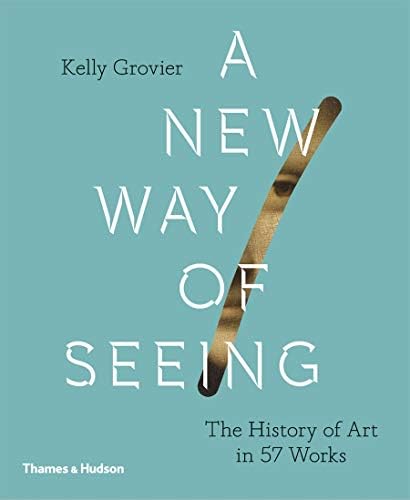
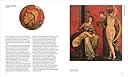
A New Way of Seeing: The History of Art in 57 Works
Product ID: 82043988
Buy anything from 5,000+ international stores. One checkout price. No surprise fees. Join 2M+ shoppers on Desertcart.
Desertcart purchases this item on your behalf and handles shipping, customs, and support to British Virgin Islands.
A New Way of Seeing: The History of Art in 57 Works
L**L
Good book
Great pictures
A**B
An intriguing proposition - to look more closely at what we think we know.
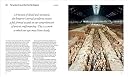
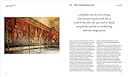
This is a book with a clever premise – to look again at works of art with which nearly everyone is familiar – or thinks he/she is familiar, and so its appeal to the general reader is immediate. Its 57 subjects are all acknowledged masterpieces, from the classical sculpture Laocoon through Leonardo to Velasquez and Vermeer, to Klimt, Munch and Dahli, Kahlo and Jackson Pollock. But Kelly Grovier’s intention is to make us look much more closely, and to focus not on the overall effect of the image but on a particular detail or ‘eyehook’ – something which he thinks has given it its unique and abiding character. His thesis – and it’s hard not to agree – is that greatness, is in the unexpected, the ‘force of strangeness’ as discussed in the introduction, rather than the predictable and familiar.And so Grovier makes us look very closely indeed at his chosen works so that we see, perhaps for the first time, the inkwell in Raphael’s populous School of Athens, the small and wrinkled citron in the Van Eyck altarpiece of Ghent, even the lack of an actual earring in Vermeer’s famous Girl.Some of his choices of eyehook are obvious focal points – like the window in Fra Angelico’s Annunciation or the egg in Bosch’s Garden of Earthly Delights and have been hit on by later artists who retell or adapt the original. I loved Grovier’s observations on the sewn needle piercing Harold’s eye in the Bayeux Tapestry as bring together, art, artist and viewer. Others I found less convincing – the Mona Lisa’s right index finger doesn’t draw my eye even if its meaning is of interest – and there were others where I felt the author was making an interesting cultural or philosophical observation without it bringing something new to my appreciation. These eyehooks by the way aren't always very evident in the illustartions of the work as a whole, but the actual detail is always illustrated separately. Of course all art appreciation is subjective and there is still huge interest in following the sight lines of this particular author adn in the knowledge he brings. Considering the etching in the background to ‘Whistler’s Mother’ adds a great deal to the picture as a whole.Another aspect I greatly enjoyed is the comparison of these 57 works with subsequent – or sometimes previous – artists - and although the topic of how great art inspires other art is not the main tenet of the book, for me there were some wonderful revelations, like placing Cindy Sherman alongside Catherina van Hemessen, or to catch Dutch artist Rineke Dijkstra’s echo (conscious or otherwise) of Botticelli.So even if I don’t agree with all of Grovier’s answers to the question of which detail makes a painting great, it’s a very good question to ask and encourages us to look much more closely at paintings which are so etched on our psyche we may have stopped looking at them at all. And a reminder that if we are lucky enough to see the originals, to look purposefully and take in those telling details, rather than to stand and stare in unthinking awe.
F**Q
This book is a joke
Pseudy! He makes great play of trivial details. For example, the repositioned finger in the Mona Lisa is supposed to be of great significance, forgetting the fact that even great artists like Da Vinci had problems occasionally when painting fingers and hands!. Botticelli’s Venus has a curl of hair on her right shoulder which is supposed to hint at a logarithmic spiral, which was not recognised by mathematicians for another 150 years! Hildegard of Bingen in 1165 is supposed to have some pre-knowledge of quantum physics! I wish I hadn’t wasted my money buying this book, because to anyone who knows anything about art, this book is laughable
G**H
Imaginative, speculative and stimulating criticism
This is a work of imaginative and stimulating criticism. Mr Grovier locates the artist in his own time but also with reference to our own intellectual world - sometimes this results in unlikely conjunctions as is noted elsewhere here (and less positively). But why not have some speculative fun? The results are sometimes profound, sometimes thrilling, sometimes outlandish but always deeply interesting. The book also happens to be beautifully written. A signpost and also a landmark.
A**R
A truly wonderful book
A truly wonderful book , not only wonderful illustrations. But obviously made with love . Mr Grovier knows his subject well , the publisher should be congratulated on commissioning him . In an over saturated market , this Art book is a must - full of fascinating new information on the works the world loves. Its worth noting Kelly Grovier is also a well respected poet , hence he’s made every word count and every word sing .
Y**O
Absolutely compelling, most enjoyable book
Certainly a book worth owning, not only richly illustrated, but the texts that accompany the images are compelling. Here Grovier is at his best as the self styled secret sharer.He's also generous with his knowledge sending the reader in a manageable way spinning off in all directions. It is indeed A New Way Of Seeing.
D**S
A book for any collection
Originally bought as a birthday gift for my art loving partner, I decided to add to my collection instead. I bought her gin instead....
Trustpilot
2 days ago
2 weeks ago