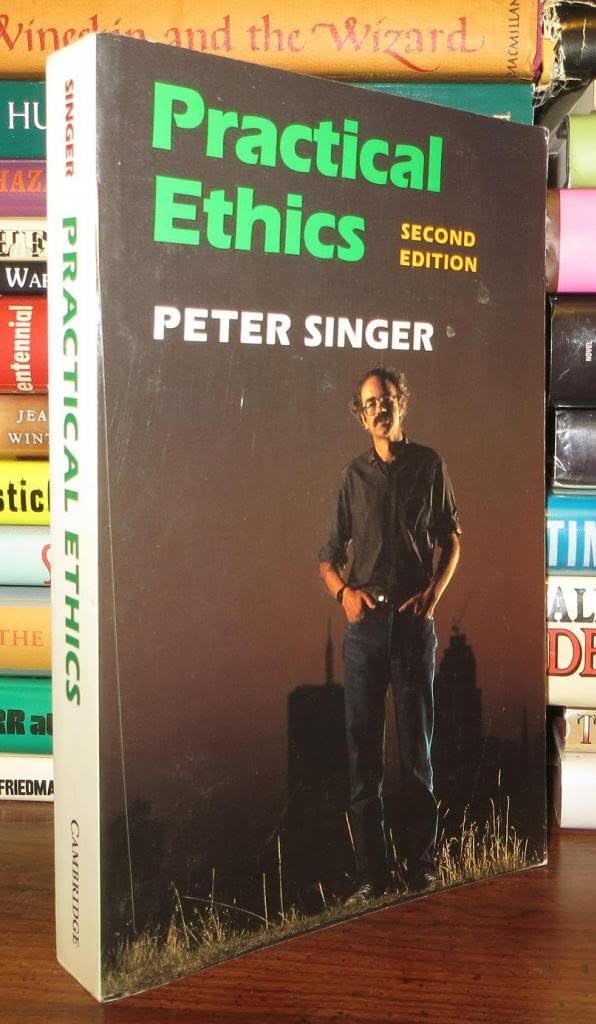
Practical Ethics
Product ID: 78087668
Buy anything from 5,000+ international stores. One checkout price. No surprise fees. Join 2M+ shoppers on Desertcart.
Desertcart purchases this item on your behalf and handles shipping, customs, and support to British Virgin Islands.
Buy Practical Ethics by Singer, Peter (ISBN: 9780521439718) from desertcart's Book Store. Free UK delivery on eligible orders. Review: Provocative, at least as in thought provoking - Singer deals with some difficult issues from a utilitarian perspective; abortion, euthanasia etc. The only missing part, as I remember, is the question concerning when/if the utilitarian approach is not admissible - are there certain things one shouldn't do? Review: Five Stars - A very easy to read and thought provoking book.
| Best Sellers Rank | 575,842 in Books ( See Top 100 in Books ) 701 in Academic Philosophy 14,791 in Philosophy (Books) |
| Customer reviews | 4.5 4.5 out of 5 stars (64) |
| Dimensions | 14.61 x 2.54 x 22.23 cm |
| Edition | 2nd |
| ISBN-10 | 052143971X |
| ISBN-13 | 978-0521439718 |
| Item weight | 482 g |
| Language | English |
| Print length | 396 pages |
| Publication date | 29 Jan. 1993 |
| Publisher | Cambridge University Press |
A**N
Provocative, at least as in thought provoking
Singer deals with some difficult issues from a utilitarian perspective; abortion, euthanasia etc. The only missing part, as I remember, is the question concerning when/if the utilitarian approach is not admissible - are there certain things one shouldn't do?
C**T
Five Stars
A very easy to read and thought provoking book.
C**N
Rational Ethics
A magnificently written and argued Book on the meaning,value and application of the Philosophy of Morality without a preordained paradigm...a timeless analysis of the most important branch of human Philosophy!!
M**S
Five Stars
Good delivery time. Sold as advertised. Just the book my son wanted for his A Level course.
K**L
Five Stars
this man should rule the world he's so bloody clever.
A**E
Great
Just getting into ethics. Great book
R**N
A not entirely practical set of ethics
I read this as an undergraduate in philosophy over 30 years ago and returned to it as research for my own book of ethics 'Natural Ethics'. There is a lot to be said for the humane aspects of the ethics propounded is this book, but the inherent inhumanity of utilitarianism raises questions as to how 'practical' Singer's ethics are when human beings are not on the whole given to rational responses to moral situations. It makes sense to adopt such ethics if one ignores the emotional and psychologically subjective responses to moral choices that human beings are on the whole naturally disposed to make. Even after 30 years I found it easy read, again, and it's well written and logically 'bolted together' as one would expect from such a deservedly eminent modern philosopher.
L**Y
Five Stars
Fantastic book. It was so exciting. I couldn't put it down
C**G
Peter Singer delves in to some of the most controversial and relevant ethical dilemmas in our day with a strong clarity and simplicity of prose. His writing style is that of a man who tinkers with ideas, going down a path to see what comes out. The reader will find that when you follow this path, the results can be fascinating, unsettling and sometimes contradictory. For example, his unassailable logic leads him to presume that it is less just to kill an animal for meat than it is to kill a fetus. Many critics have responded to these contradictions but his logic as outlined in this book is difficult to deny. Because he focuses on 'practical ethics' he discusses only topics on which there is still honest debate, or in which there are emerging ethical problems such as euthanasia and abortion. I bought this book to read the words of an intelligent philosopher and possibly have a better justification for my 'political views' on these topics but I never though they would directly apply to me (except the meat-eating portions). But shortly after reading this book I was faced with some ethical problems brought on by modern advancements in medical technology. The thought-processes that this book stimulated in my mind allowed me to more clearly make some important decisions that one doesn't face in everyday life without worrying about meaningless objections. That is one of the biggest compliments that a book like this can generate, is that is useful. This book clearly dismantles some of the historical baggage we have in our decision making based on debunked ways of looking at the world. It is amazing that in our modern, educated world we haven't moved past these biases towards things that are unsettling, or icky for no logical reason. I include myself in that previous sentence. More specifically, the author removes the barriers towards general and widespread acceptance of culturally sensitive topics like euthanasia and abortion. When you remove the debunked religious notion of a soul, then some of the main drivers of ethics are suffering and consciousness. The author uses utilitarian philosophical techniques to analyze the suffering related to our modern decision-making. This weighting of suffering and level of consciousness is then used to aid in decision making. For instance, this is how the author concludes that it is less just to kill an animal for meat than a fetus because of the animals greater level of consciousness and possibility of suffering. While this finding may be surprising it is likely true that fetuses don't have a high level of consciousness. This is a topic that I found myself adjusting my views slightly on due to this book although I considered legalization of euthanasia a no-brainer before reading this book. While I didn't agree with the authors conclusions for every topic within the book, I realize that many of the critics are not seriously analyzing his conclusions and are often quote-mining things out of context. There is enough stuff in this book that is controversial to paleo-christians that they don't need to quote infanticide passages out of context to claim Mr Singer is a nazi. Please engage him on the issues, your preliterate shepherding worldview has enough contrast with this mans advanced thinking without lying for Jesus.
M**N
Peter Singer is not new under the sun but as an ethicist, he's still one of the most pragmatic. Of course, that would be because he's a utilitarian and I suppose that goes together. He is known equally well, if not more, for his book Animal Liberation which shed light on ethics as it applies to all animals. His arguments are not just intuitive, they are good which is the idea of an argument, that and being convincing of course. I became a vegan after AL because I realized how inconsistent I was being with my ethical arguments. Practical ethics talks about better ways to feed the world, end starvation, abortion, personhood, etc. A good read.
G**W
It's a good read and understandable for a normal person with no prior schooling in philosophy. interesting concepts, definitely gives you food for thought.
T**.
Quality book in fine condition delivered in a timely way. Thanks.
J**N
Philosophers of all stripes agree that the essence of ethics is that they are universal. For example, the Golden Rule grants other people the same ethical status that you give yourself. Immanuel Kant's categorical imperative is similar. In 'Practical Ethics' Peter Singer claims that preference utilitarianism does a better job of capturing the universal nature of ethics than these other approaches. His reasoning begins with the observation that ethics demands considering more than one's own self-interest. Therefore a truly universal system of ethics demands that we give equal consideration to everyone's interests. This principle of equal consideration of interests is the heart of Singer's preference utilitarianism. That sounds reasonable but the result is a deeply flawed and frankly immoral system of ethics. ----------------------------------------------- Objection #1: Expensive (and cheap) Preferences ----------------------------------------------- Utilitarianism upholds a moral duty to the poor based on the principle of declining marginal utility. That basically means that the more stuff you have the less value you will get from having even more. Another way of putting it is that the poor get more utility from money than the rich. Declining marginal utility can be modeled mathematically. A very simple utility function is the square root. If you have a million dollars then you will get one thousand utility points from it (the square root of a million is one thousand). But if you have two million dollars then you will only have a total of about 1414 utility (the square root of two million). In other words, you get 1000 utility from the first million but only 414 utility from the second million. Now suppose the government took that second million dollars away from you and gave it to someone who didn't have any money. Then you would each have 1000 utility. The total utility would be increased from 1414 to 2000. A socialist-style of income redistribution maximizes utility. Got all that? Good. Now let's make it more complicated. Utility is simply a matter of personal opinion. Not everyone has the same utility function. Someone humble like Tiny Tim will be very happy with very few things and a thin gruel to eat. Someone like Paris Hilton will demand large mansions and expensive luxury goods to be equally happy. (You can model this mathematically but you really need exponential utility functions to do this so it is complicated). The upshot is that utilitarianism can create an unequal distribution of wealth, but not based on hard work and talent, but based on how much you crave luxury goods and social status. Utilitarianism forces the Tiny Tims to pay taxes to support Paris Hilton's opulent lifestyle. Robert Nozick famously dubbed people like Hilton utility monsters because they devour utility from the rest of us like monsters. ------------------------------ Objection #2: Evil Preferences ------------------------------ Utilitarianism does not distinguish between the slave owner's desire to own a slave and the slave's desire to be free. Now, the principle of declining marginal utility does come into play. The slave gets a lot more utility from his freedom than the slave owner would get from his labor. In practice extreme acts of oppression are usually blocked. But they remain theoretically possible. Utilitarians often dodge this question by arguing that slavery would lead to widespread fear throughout the population, thus lowering overall utility, but this is not true if we are talking about the enslavement of a minority ethnic group. I agree that slavery is unlikely in practice but other acts of oppression are not. Consider the case of racist laws. Suppose that whites outnumber blacks ten to one. Let's also suppose that whites get 100 points of utility from oppressing blacks. Then laws which reduce the liberties of blacks such that blacks lose 1000 utility or less would, overall, maximize utility (the ten whites who each get 100 points, more than the 1000 points that the black person loses). Alternately, let's consider a racist version of Phillipa Foot's famous thought experiment: transplant. In the original case of transplant a healthy man is killed by his doctor so that his organs can be given to five healthy people. Foot used this as an argument against utilitarianism. Now let's strengthen it by supposing that a white person is dying. A black person is killed and his organs are given to the white person. Either way one person lives and one person dies so these preferences can be assumed to cancel out. Thus the racist majority tips the balance in the white man's favor. Utilitarianism can readily turn ethnic minorities into living, breathing organ farms. And lest you argue that the minority group would have a stronger preference to live, realize that the balance would actually tilt the other way. John Elster has shown that adaptive preferences - cases where people internalize the belief that they deserve their bad situation - are well supported in the literature (Elster, 1982). ---------------------------------------------------------------- Objection #3: Incentives and the Lack of Personal Responsibility ---------------------------------------------------------------- Utilitarianism does not include personal responsibility. In fact, the history of secular progressive political philosophy has been an evolution away from utilitarianism and towards more robust theories that at least marginally account for personal responsibility (Utilitarianism to John Rawls to Ronald Dworkin to John Roemer). Here is the point. Suppose I quit my job and watch TV all day while you work hard. Then utilitarianism says that you have to give me half your money (or more or less, depending on how Paris Hilton-like or Tiny Tim-like our preferences are). It doesn't matter that you earned your money and I didn't. In his entertaining book 'Reinventing the Bazaar' John McMillan points out that China basically put this socialist theory into practice. They abolished private property and had their peasants work the field collectively. They each got an equal share of the harvest, regardless of whether or not they worked hard or shirked on the job. Needless to say, people started to shirk. The Anhung province was once known as the granary of China but the people were forced to go begging on the streets for food. (For those readers who are familiar with the basic criticisms of free markets, this is a case of the tragedy of the commons). Eventually people from one village met in secret and agreed to divide the commune into individual lots. Output soared and soon the last commune was abolished. --------------------------------------------- Objection #4: Government House Utilitarianism --------------------------------------------- Many utilitarians such as John Stuart Mill, Henry Sidgewick, RM Hare, and Peter Singer take refuge from these objections by splitting utilitarianism into two levels. The "critical" or direct level of utilitarianism is as we've described it. The "intuitive" or indirect level consists of simple, easy-to-follow rules for the common masses to obey. Philosopher-kings like Peter Singer (and you! this book is an admittance to the club!) will pontificate from on high and create rules for the common masses. Just like in Plato's totalitarian Republic, the common masses will be told a Nobel Lie to keep them in their place. The lie is that we all have unalienable human rights. Peter Singer writes "The language of rights is a convenient political shorthand. It is even more valuable in the era of thirty second TV news clips." (Animal Liberation, p.8) Bernard Williams calls this government house utilitarianism, after the British colonies in India. The British elites who governed India did not believe in human rights, but they spread the word of them to the common masses because utilitarianism is too complicated to trust the plain folk. (Discuss amongst yourself: do we have government house utilitarianism in America today?) Government house utilitarianism clearly solves some of the problems of utilitarianism. You couldn't have Chinese communes with them. Instead you'd need rules that enforce private property. But it doesn't fix other problems. If society is racist then it is the job of the philosopher-kings at the critical level to create racist laws. I suspect that it is only a matter of time before government house utilitarianism falls to the problem of expensive preferences. Advances in neuroeconomics (basically scanning people's brains under a PET scanner while they make choices) could tell us honestly whether or not people have expensive preferences like Paris Hilton or cheap preferences like Tiny Tim. The philosopher-kings should then redistribute income from Tiny Tim to Paris Hilton. Another problem with government house utilitarianism is that utilitarians incoherently switch back and forth between the critical and intuitive levels. They point to the critical level to argue that utilitarianism has stronger moral duties than Judeo-Christian morality, and that it enforces a wider circle of moral consciousness [I'll bracket the abortion debate because this review is already getting long]. For example, utilitarians will argue that they support a stronger moral duty to help the poor in Africa. By contrast, rights-based forms of morality do not have a robust of a duty to the poor, it is argued. But when you (or Philippa Foot) point out the failures and unintended consequences of aid to Africa they take refuge in government house utilitarianism. By contrast, the Judeo-Christian influenced morality of natural rights is not incoherent. Instead it relies on the doctrine of acts and omissions to determine whether or not we have utilitarian-style moral duties to the others. Singer attempts to criticism the doctrine of acts and omissions here, but he does so poorly by cherry picking cases where there is no moral difference between an act and a corresponding omission. --------------- Further Reading --------------- Here is a short introduction to political philosophy in order of increasing levels of sophistication. I strongly recommend starting with the first book. Political Philosophy: A Beginners' Guide for Students and Politicians Contemporary Political Philosophy: An Introduction Theories of Justice: A Treatise on Social Justice, Vol. 1 (A Treatise on Social Justice; Vol. 1) (v. 1) Theories of Distributive Justice (this one is heavy on math but has a great survey of the literature sprinkled in). Those books are all from an essentially secular and progressive viewpoint. For a defense of rights-based morality from a traditional Christian perspective then check out: Moral Theory: A Non-Consequentialist Approach
Trustpilot
4 days ago
3 weeks ago