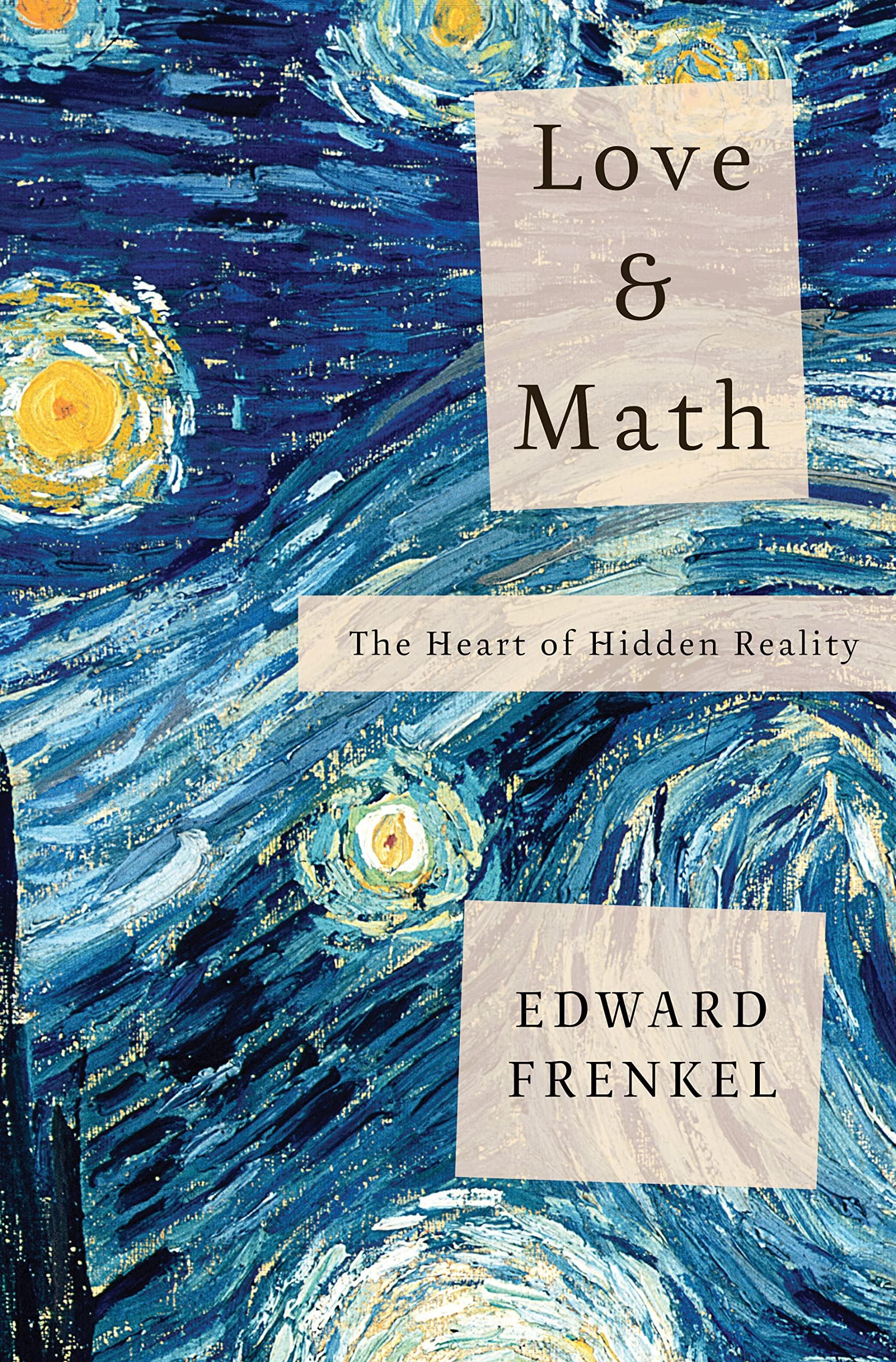


Love and Math: The Heart of Hidden Reality
Product ID: 65866236
Buy anything from 5,000+ international stores. One checkout price. No surprise fees. Join 2M+ shoppers on Desertcart.
Desertcart purchases this item on your behalf and handles shipping, customs, and support to British Virgin Islands.
Buy Love and Math: The Heart of Hidden Reality by Frenkel, Edward (ISBN: 9780465050741) from desertcart's Book Store. Everyday low prices and free delivery on eligible orders. Review: I read Love and Maths alongside Hacking’s “Why is there a Philosophy ... - Frenkel’s book deserves a much wider audience this side of the Atlantic than it currently has. I read Love and Maths alongside Hacking’s “Why is there a Philosophy of Maths at all”, and at least in the first few days, I persevered with the dual task until I eventually focused on Frenkel almost exclusively. I’ve now read the book twice and must admit to having been moved from being merely entertained to being seriously impressed. The title and the first few largely biographical chapters are, in truth, slightly misleading. Once Frenkel gets going, however, he impresses as a serious writer with no quarter given for the less than serious reader. But the “cost”, as can happen so often, is not clarity of accessibility. This last point is interesting. The way that Frenkel ensures no compromise is by providing, in the main body of the book, a fairly low lying terrain. Think of this as a strenuous but ultimately achievable trek up Kilamanjaro. Yes, you have to be able to breath the thin air, but there are no serious 5:5 stretches. You don’t need your climbing rope and crampons or ice pick. However, laced, literally page by page, are footnotes that are more like the diversion to K2. And what an amazing diversion. You can (if you want) be seriously addressed with credible mathematical discourses, and yet stay the course if you feel threatened. Its a smart way of delivering a superb read. Leaving aside this very clever mechanism, the heart of the book brings together a beautifully crafted exposition of the importance of the Langlands programme with a topical weft and weave of contemporary maths. A few months after I read the book a second time I had the chance to meet Frenkel very briefly. He is a disarming and charming man with a steely eyed determination to convey his feelings. The book is the same. Don’t be fooled by the title, and don’t give up in the foothills. The peaks are what count. You will be infected by the love of the subject that so many of us wish we could share with loads more people. I just hope the book gets more of an audience in Britain. Frenkel also wrote the obit for Grothendieck in the NY Times. Well worth the read for those who dont know a mathematician who may well deserve the title of the 20th century's greatest (and yes, I include Godel, Hilbert and Weyl et al in that comparison). Review: Why do people love maths? - I enjoyed the book as it includes a mix of social history and mathematical concepts. I personally found that Edward was assuming that my understading of 'basic' concepts should be higher than it is in reality, and so maybe some ideas were too challenging for the average reader.
| Best Sellers Rank | 638,973 in Books ( See Top 100 in Books ) 17 in Algebra (Books) 21 in Popular Mathematical Theory 38 in Applied Mathematics (Books) |
| Customer reviews | 4.3 4.3 out of 5 stars (818) |
| Dimensions | 16.51 x 3.18 x 24.13 cm |
| ISBN-10 | 0465050743 |
| ISBN-13 | 978-0465050741 |
| Item weight | 522 g |
| Language | English |
| Print length | 304 pages |
| Publication date | 1 Oct. 2013 |
| Publisher | Basic Books |
W**G
I read Love and Maths alongside Hacking’s “Why is there a Philosophy ...
Frenkel’s book deserves a much wider audience this side of the Atlantic than it currently has. I read Love and Maths alongside Hacking’s “Why is there a Philosophy of Maths at all”, and at least in the first few days, I persevered with the dual task until I eventually focused on Frenkel almost exclusively. I’ve now read the book twice and must admit to having been moved from being merely entertained to being seriously impressed. The title and the first few largely biographical chapters are, in truth, slightly misleading. Once Frenkel gets going, however, he impresses as a serious writer with no quarter given for the less than serious reader. But the “cost”, as can happen so often, is not clarity of accessibility. This last point is interesting. The way that Frenkel ensures no compromise is by providing, in the main body of the book, a fairly low lying terrain. Think of this as a strenuous but ultimately achievable trek up Kilamanjaro. Yes, you have to be able to breath the thin air, but there are no serious 5:5 stretches. You don’t need your climbing rope and crampons or ice pick. However, laced, literally page by page, are footnotes that are more like the diversion to K2. And what an amazing diversion. You can (if you want) be seriously addressed with credible mathematical discourses, and yet stay the course if you feel threatened. Its a smart way of delivering a superb read. Leaving aside this very clever mechanism, the heart of the book brings together a beautifully crafted exposition of the importance of the Langlands programme with a topical weft and weave of contemporary maths. A few months after I read the book a second time I had the chance to meet Frenkel very briefly. He is a disarming and charming man with a steely eyed determination to convey his feelings. The book is the same. Don’t be fooled by the title, and don’t give up in the foothills. The peaks are what count. You will be infected by the love of the subject that so many of us wish we could share with loads more people. I just hope the book gets more of an audience in Britain. Frenkel also wrote the obit for Grothendieck in the NY Times. Well worth the read for those who dont know a mathematician who may well deserve the title of the 20th century's greatest (and yes, I include Godel, Hilbert and Weyl et al in that comparison).
M**E
Why do people love maths?
I enjoyed the book as it includes a mix of social history and mathematical concepts. I personally found that Edward was assuming that my understading of 'basic' concepts should be higher than it is in reality, and so maybe some ideas were too challenging for the average reader.
A**N
A trip
This is, comfortably, the best popular math book I’ve ever had the fortune to lay my eyes on. I have a couple degrees in the subject. One in applied math, that I studied in college, and one in pure math that I got twelve years later. Indeed, I coincided with the author at Harvard, and his description of the Math department in the Science Center, the ping pong table and that hidden gem of a library brought back memories of my first semester in college, which was largely spent poring over impossible math assignments. (It also reminded me of the rather poor personal hygiene of some of the guys there, which goes unmentioned in the book!) This is now my favorite popular math book. I don’t know math anymore, but I regardless LOVED LOVED LOVED reading this. The man has an unbelievable gift for explaining stuff and flattering you into thinking you understand it too. I can probably now blag about SO(3) and SU(2) and SU(3) and fibres and sheaves and fundamental groups with the best of them and I feel like I own the material (which of course I don’t.) For three days of my life I did math with Grothendieck and Gelfand, Drinfeld and Kac, basically, I sat there at the table with them. It was a massive high! A couple months ago, to resolve a dispute with an almost equally spent former mathematician, I wasted hours scouring the Internet to remind myself what the real meaning of the cross product is, to no avail. Frenkel slips the answer en passant on page 121: the tangent space to the unity element of a Lie group is a simpler construct called a Lie algebra. The Lie algebra of an n-dimensional Lie group is a vector space of dimension n, basically. Well, the operation under which 3D space is such an algebra is the cross product. Cool, eh? And so on. You close your eyes and you follow this boy, who grew up as a little dreamer in a city two hours out of Moscow and just wanted to know how the universe works. And you meet his teachers and take part in his search as he tries to solve the problem that consumed Einstein in the last 20 years of his life, that of coming up with a single theory that can reach beyond the “standard model” and also cover gravitation. You start with his first ever big triumph (something to do with the “knot groups,” which are explained beautifully) and you move on from there to the most intuitive ever explanation of Galois’ insight regarding the solution of polynomials (basically drawing an analogy between irrational numbers and imaginary numbers I wish somebody had told me about 30 years ago) and eventually you make it to the “Langlands problem” which I must admit went 101% over my head. But I had enough there to cheer the author on, all the way. The bit about the “equation of love” was beyond weird, of course, but I’m alright with it. Nobody forced me to read it. It was a bit as if somebody cooks you the best meal in history and then offers you the option of flamingo feather pie as desert: you don’t have to eat it. It did not undo the amazing first 228 pages, or that phenomenal set of notes in the back. Also, the guy loves math. It’s so evident, it’s infectious. And he gives you a very long warning that you cannot judge math from the abject crap that passes for math in the world’s high school curricula. He hated that too, despite the fact that he could do it. Math is the amazing construct that, whether we like it or not, surrounds us, underpins the physical world and is waiting for us to go, discover it and get the answers we seek. Chris Isham aside (who does not know me from Adam, but I once took his class), this is the most a man has ever inspired me to read math, and he did it from a book. What can I say? I’m not sure I’ve had more fun reading a book, frankly. Did not really learn anything, it would be beyond presumptuous to say so, but It flattered me so hard, I got a proper high. Thank you, Bernard, for suggesting this!
J**A
What I REALLY like about this book is that Frenkel talks about real math without talking down to the reader. I don't follow it all, since I did not read it as carefully as it needs to be read, but I will take another pass at it soon. This is in contrast to textbooks, which 1. I wouldn't be able to follow at all since I don't have the background nor will I spend the time to get it, and 2. I would probably never re-read a math textbook. Come on, really? Nope. I read "My Brain is Open" about Paul Erdos a few years ago, and loaned it out, so I can't remember for sure how it compares to this one, but I think I was left a little frustrated. Paul Erdos collaborated in many mathematical ventures, but as I remember, it is assumed the reader couldn't possibly follow what they were. Edward Frenkel makes the attempt. I am flattered and delighted. He is skillful enough in this so that I want to rise to the occasion. In addition, he tells the story of his own life and career in an engaging way. One of the things that I find remarkable in Frenkel's account is the view into a mostly-male field that isn't about soldiering or something similarly physical. As a woman, I did take four years of math in college but didn't continue. It wasn't because I didn't like it - I loved it! It was because of the toxic posturing that accompanies the field, or at least, in my college it seemed to. We students were subtly and not-so-subtly evaluated by our professors and classmates to see if we had "what it takes" to be a great mathematician. One of my professors actually called the other female student in my year to his office and told her that, while she would never be a first-tier mathematician, she had what it took to become a second-tier thinker and she should consider going into math as a career. When she told me about this, she was crying. She did math because she liked to do it, and it had not occurred to her that such rankings were part of the winnowing process. I, of course, was also devastated because clearly I was not even going to be second-tier. Neither of us continued in the field, though, looking back, I think that we should have. Female brains are different than male brains, and we both frequently noted that we found some classes hard and others easy, and that seemed to be in inverse relationship to what our male classmates found. If we had gone on in the "difficult" fields that we thought were easy, who knows where it might have led? With what we know now about the relationship between focused practice and achievement, it seems insane to worry so much about what minds look like in the moment. If my friend had wanted to become a first-tier mathematician, she ought to have been advised to do what Frenkel does, that is, think about math all the time and poke around in the literature and talk to other mathematicians and think about it some more and talk with colleagues some more and do that with passion and verve. I personally work very well in collaboration, but collaboration, while Frenkel talks about it a LOT, was not encouraged in my college. It was too important to evaluate how brilliant people were as they stood alone. The one time I did hang out with a mathematician who was in a class further on than mine, I did so well in the class that we had been talking about, that I went to the professor and confessed that I had an unfair advantage. He said that cheating was frowned upon but he would let it pass this time. I certainly never made the mistake of cheating by talking to another mathematician again! And now, as I read Frenkel, I see how crucial that is. Of course.
C**N
Es interesante como narra los retos, dificultadas que impone la vida, el esfuerzo que debe imprimirse para sobreponerse a ellas, y en el viaje cuenta como su pasión y el amor por las matemáticas lo guían a desarrollarse como persona y profesionista. Excelente libro, muy inspirador !!!
Á**O
O livro toca em temas extrenamente complexos, o que pode desmotivar os leitores mais para o final. Contudo parece-me que é isso mesmo que se quer ser transmitido que fazer matemática é complexo e apaixonante, mesmo que não se perceba os promenores essas ideias de mais alto nível é que devem passar ao leitor.
J**S
This is a great book, it stimulated me to brush up on my maths. It's addictive, but to understand it I had to read every chapter multiple times and I had a few sessions on chatgpt on group theory, modular forms. In the end I am begging to really understand what modern maths is about, the grand unification seems to be a possibility. There are some great YouTube videos by the author that help a lot with some of the difficult ideas.
M**S
I'm a theoretical physicist with little exposition to the Langlands program and I felt very inspired by these ideas presented in a very simple way.
Trustpilot
1 day ago
2 months ago