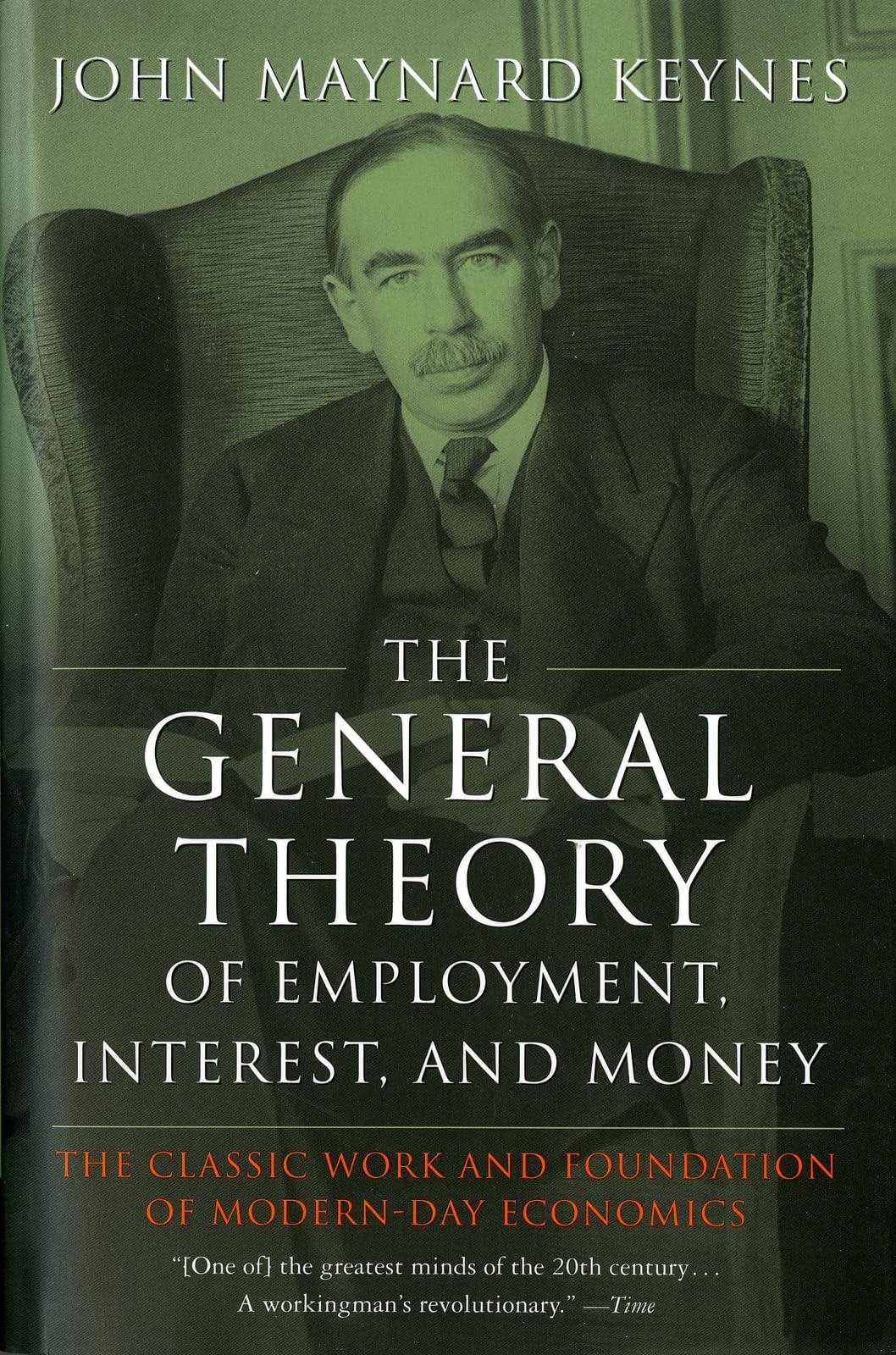
The General Theory of Employment, Interest, and Money
Product ID: 4377519
Buy anything from 5,000+ international stores. One checkout price. No surprise fees. Join 2M+ shoppers on Desertcart.
Desertcart purchases this item on your behalf and handles shipping, customs, and support to British Virgin Islands.
One of Time's 100 Most Important People of the Twentieth Century, John Maynard Keynes revolutionized economic thinking with The General Theory of Employment, Interest, and Money.Published following the Great Depression, this classic challenged the established classical economics, particularly the proposition that a market economy tends naturally to restore itself to full employment on its own. More relevant than ever in the twenty-first century, the principles of the "Keynesian Revolution" continue to be debated in a world ravaged by inequitable economic circumstances. "[Keynes's] radical idea that governments should spend money they don't have may have saved capitalism."—Time Review: Neoclassical Economics is a Special Case - I'm an undergrad economics student, and I was always puzzled by the "Keynesian" economics they taught me. I couldn't see how it fit in with the market clearing story they were also telling me. So I decided to give this book a shot. After reading it, I was surprised at how simple the main concept is. I didn't find it difficult to read at all, or badly organized (but maybe that's because I'm used to reading philosophy). Basically, just like they teach you in Principles of Macroeconomics, the heart of the theory is the Keynesian Cross (which is a rough approximation of Keynes' D-Z model in this book). The consumption function leaves a gap between income and expenditures, which must be filled by planned investment, or the economy will move to a lower equilibrium via the multiplier. Classical economics, in effect, just assumes that gap is always filled by planned investment (where the economy is at full employment, no less) without even making an argument for it. In the classical model, any decrease in planned investment is matched by an increase in consumption, or vice versa. But there is no good reason to think that will be the case, generally. If you hoard your money today, businessmen do not have a magic crystal ball that allows them to determine what you will spend it on in 5 years. Thus they do not invest. A decrease in consumption is not matched by an increase in planned investment. The economy will move to a new, lower equilibrium via the Keynesian Cross, in which income equals expenditures (i.e. no hoarding any more). The one thing I did find confusing in the book, though, was Keynes' assertion that saving always equals investment, by defintion. I determined that this results from an incorrect definition of saving. While on an individual level, saving is income minus consumption, the same is not true for the economy as a whole. It is more accurate to say that saving in the aggregate is always zero, because an individual act of saving is always matched by an equal amount of dissaving by someone else (the saving deprives them of their income, unless the the savings are invested, in which case they are no longer savings). The gap between income and consumption, in the aggregate, is always investment. Its just the form of investment that changes. If the gap between income and consumption isn't filled by planned investment, it will be filled up by "unplanned" investment (i.e. inventories build up). In macroeconomic equilibrium, there is no unplanned investment. Thus, Y = Ip (planned investment) + C. Classical economics assumes that Y - C always equals Ip, and at the point of full employment. Keynes's theory is the more general case when Y - C could equal Iu (unplanned investment). In that case, the economy moves to a below optimal equilibrium that does not correspond to full employment. I would definitely recommend this book if you're an economist, or if you have anything to do with public policy. Or even if you're just curious. Don't be frightened off by the people who tell you its "unreadable" or "a mess." They just can't handle a real scholar who writes precisely and clearly. Review: Reality is forced upon poor Robinson's isle. - The goal of the GT was to revolutionize the discipline of economics itself. Keynes' presentation was formal - however the real conflict was not with definitions of economic categories, nor with any economic-theoretic concepts as such, but instead with the entire shape which the 'science' of economics had espoused and its real world limitations. What else does 'revolution' mean but a complete upheaval of what was formerly the word of truth and order. It is the goal of this review to put lay the grounds of the theoretical conflict Keynes waged on conventional thought and unveil the essence of Keynes' disagreement. I The opening chapter of 'The General Theory of Employment, Interest, and Money' is titled 'The Postulates of the Classical Economics'. This is because Keynes himself believed that his challenge was to the theoretical core of what was then the entirety of developed economic theory - apparently the economic-theoretic tradition ranging from Ricardo through Marshall. He called this the 'classical tradition' and identified its inception with the classical political economists as such. In reality Keynes' criticisms had nothing to do with what was classical political economy, but instead with micro-oriented marginalist tradition which had emerged and transformed this study into 'Economics'. Hence they had nothing to do with Ricardo, whom he believed to be his main adversary. The mainstream, epitomized in Keynes' mentor at Cambridge, Alfred Marshall, had long since lost any connection with 'classical' theory as represented by classical political economy - what was being challenged in 'The General Theory' was not classical economy at all, but instead the embryonic form of the now dominant neoclassical economics. Classical economy did not argue, for example, that real wages or prices were fundamentally determined by marginal utilities and disutilities in exchange; thus it was not argued that market prices tended toward a unique full employment equilibrium - central, as we shall see, to Keynes' criticism of the limitations of 'classical theory'. This became theoretically fundamental only after Ricardo's death, with the abandonment of the labor embodied theory of value by the mainstream of economics. The topic of the disconnect Keynes had between the body of economic theory he believed he was critiquing and that body of thought he actually was critiquing is important not for the pleasure of questioning Keynes' erudition. This topic is important because it is actually the key to understanding Keynes' developments in 'The General Theory' itself . Keynes had ultimately linked what are fundamental assumptions and methods which form the bedrock of neoclassical theory with classical political economy, and most especially Ricardo as the height of classical theory, simply because they had an existence within classical theory. Saying something exists is saying nothing of how or why it exists, however, and in the case of classical theory these concepts existed only as assumptions which had direct relation to the particular method the classicists employed. These assumptions were not fundamental to the operation of their entire framework. For classical political economy, market prices were simply spot relations with no fundamental importance in regards to the essential features of the continued reproduction of capitalist production. If there was a drought, corn prices would increase; if there was a good harvest, corn prices would decrease. There was nothing fundamental to be found in markets themselves which explained the uniqueness of capitalism as a mode of production or its tendential movements. As any non-essential feature or friction is abstracted from in order to analyze a system in its purity, in classical political economy it was market relations - supply and demand - which were abstracted from to gain an understanding of the production relations which underpinned capitalist production. This is the root of Keynes' misunderstanding. To say that 'market relations' are abstracted from amounts to the same thing as postulating that markets are in equilibrium. A unique equilibrium, in the sense of full employment of resources, was postulated by classical theory not to explain everything but in order to abstract from what could not explain anything. Even Marx, the critic of classical political economy, makes this abstraction in postulating equal organic compositions of capital in Capital Vol. I. Marx clearly did not believe that there ever existed even proximate to this harmonious equilibrium of supply and demand. Keynes' lack of an understanding of classical theory essentially caused him to equate what was irrelevant for classical theory with what is essential to neoclassical theory. These concepts did have their birth during the last and most developed period of classical political economy; and this period should be identified with Ricardo and the theoretical construct he established - however from these two essentially correct identifications it does not follow that classical economy 'stands or falls' with the validity of either of these concepts. It is neoclassical economics which does. This is no simple coincidence. We have noted that neoclassical economics was in an embryonic form of development at this point in time. It was even fashionable within the discipline of economics at this time, per the influential work of Samuel Hollander, to view the development of economic theory as progressing along the same lines from the time of Smith to its time; being unable to fully grasp the true laws of the market as they were in such early stages of developing them . Thus we have such confused notions straight from Marshall himself that classical theory focused 'almost elusively on the supply side', and Jevons along with the marginalists focused 'almost exclusively on the demand side', whereas it was the relationship between the two that gave us the entire picture. It was only later, with the work of Piero Sraffa, that this view of a linear progression of thought underwent drastic changes. Today, the question of what precisely the classical theorists were developing is largely moot within the discipline of economics - we have before us the truth, why bother arguing trivialities of who said what? If, as this work shall argue, this 'truth' is found to be lacking, it is my suggestion that economists begin to familiarize themselves with their own history. It is only within these 'trivialities' which a proper understanding of the development of economic theory, hence its current shape and its limitations, is to be found. I suggest that Adam Smith and David Ricardo be read and understood, as they are also central to understanding Keynes. II It is the postulates of neoclassical theory which Keynes directly addresses in the 'General Theory'. There is a point at which classical and neoclassical theory have a common base, however this is outside of the realm of economic categories. As such, there is no place for a discussion of the relationship between Keynes and classical theory in an elucidation of what is written within the 'General Theory'. The General Theory is ultimately Keynes' conflict with the postulates of neoclassical theory, which he defines as given in their terms by three interconnected propositions: 1) The real wage is equal to the marginal disutility of existing employment; 2) There is no such thing as involuntary unemployment; 3) Supply creates its own demand. These three propositions are interconnected in the sense that if one is to hold then the other two must necessarily be assumed. For example, if we claim that supply creates its own demand we must already take as given that there is no such thing as involuntary unemployment and that the real wage is equal to the marginal disutility of labor. This is because the assumption that supply creates its own demand is conditional: production in this scenario must be carried out for use, and therefore nothing is produced wherein the goods produced are not destined for final consumption. As the employment of resources is required for the production of goods, and the production of goods is the production of definite use values, then the employment of resources moves parallel to the movement of use value. This means that the production of goods continues to increase, hence the employment of resources continues to increase, until there is no use for them in terms of their specific cost and hence no demand. Any unemployment of labor that exists thus must be voluntary because the 'return' to the factor employed, in this case labor, is not being accepted by that factor - that factor could employ itself at a lower price,hence a lower cost would be attached to the good in question and it would once again find a use and an impetus for being produced. Therefore, what is 'really' not being accepted is in fact the social valuation of the employment of a resource - labor in this case - in producing a specific good. The burden of unemployment in this case falls directly on the unemployed and their unwillingness to work for the price at which society values their effort. Seeing, however, as everyone must produce to consume, it is not an option to withdrawal ones labor without withdrawing ones means of consumption. The market thus regulates societies willingness to employ resources with the actual employment of those resources, and from this it follows that the real wage must be absolutely equal to the marginal disutility of existing employment for supply to create its own demand. We abstract, of course, from 'frictions', i.e., the working of the market mechanism after some external change in environment, or 'interventions' into the mechanism itself, i.e., state regulations, subsidization, or monopoly/monopsony power. These three postulates are more commonly known as one term which defines any and all of them, 'Say's Law'. Say's Law is for Keynes a fiction from which it is difficult to escape. On the one hand it is convenient in that it simplifies what is the problem of the determination of economic categories into a single problem of defining individual choice. The economic-theoretic problem becomes an analytical task performed by taking a specific set of social and institutional factors as given as opposed to an investigation of actual society and its institutions by stripping individuals of their social bond and, in turn, simply assuming a 'base' set of characteristics of these individuals when they partake in exchange relations. It should be noted that already there is a contradiction between the need to abstract from social relations in order to define this individual and on the other hand assume a specific set of social relations in order for individuals to interact. On the other hand, the postulation of Say's Law in appearance seems to be a way to answer problems related to the interaction of individuals in society. Unfortunately, these answers rest upon the fact that in postulating Say's Law we are actually abstracting from social relations in general and thus harmonizing them. In this harmony there exist no social relations binding individuals choices in any way nor does there exist any dynamic tendencies within the way human beings structure their mode of production which determine the production and distribution of social product between individuals. Each is an independent producer and consumer which enters daily into production and exchange to subsist. Exchange becomes a process of normalization of aggregated choices; if a butcher wishes to consume two pounds of meat and a barrel of ale, and if a pound of meat exchanges for half a barrel of ale, then this butcher will produce daily four pounds of meet - two for his own consumption and two to exchange for his ale. Through exchange preferences are revealed, and through exchange the production of goods to meet these preferences becomes normalized. Every individual receives a part of the social product equivalent to the amount of sacrifice which that individual contributed to its materialization. If this construction actually did describe reality, I find it hard to imagine a reason that anyone with the problems of social organization in mind would be opposed to structuring society in a way to yield such results. III The real world does not conform to this harmonic vision. Economic theory has for quite some time been uninterested in conceiving of this problem as one which has its roots in their own methods and assumptions. The question which has been posed by economists is not why has this theory failed to describe reality, but why has reality not behaved as this theory claims it should; what practical factors infringe on the realization of this analytic harmony? The question which Keynes posed was very different. In the midst of the Great Depression, wherein the rift between theory and reality was no longer an academic curiosity, Keynes was concerned with addressing why this analytic construct failed to adequately capture, and thus adequately explain, reality through its own limitations - not why reality failed to 'behave' properly according to a theory. The conclusions drawn by Keynes are that the neoclassical framework simply does not describe reality because it instead focuses its efforts on describing a fictional world which it is believed reality should conform to. The problem with attempting to transplant the requirements of this world onto the real world, that is the problem of its application to reality, stems from the essential features of reality it ignores: time does not matter, accumulation does not occur, and money does not exist. The neoclassical framework describes a barter economy wherein all wants are satisfied by current production and temporal decision making is nonexistent. It does not describe an actually existing monetary economy; it does not address issues which can only be given meaning in an analysis of a capitalist economy. The question posed by Keynes is ultimately one of whether an analysis of a barter economy captures the essential features of what is in reality a monetary economy, and, if not, in what ways does a monetary economy function differently. By distinguishing between a monetary and barter economy, Keynes central criticism revolves around the problems which accumulation and time have for neoclassical theory. Present production need not only serve immediate consumption but instead may be withdrawn from circulation completely in its money form. Not only may it be withdrawn, but it must be withdrawn if production is to be carried out on an expanded scale,. There is thus no longer a harmonic state of simple reproduction where all needs are satisfied indefinitely; wherein a butcher or brewer who, having no use for their surplus good but to exchange it for another, produce and exchange goods which they themselves shall not consume for other immediate consumption needs. Instead, production is now carried out with the necessary goal of maintaining and expanding a given surplus. The decision to accumulate a surplus, however, is a decision made through time; and decisions made through time are decisions made with a consideration to the past and speculation of the future. Ultimately, Say's Law amounts to the notion that all production which does not serve immediate consumption must be production for given consumption in the future. Production must therefore not only be carried out for what is presently useful, but for what is 'known' to be useful in the future. Keynes believed this to be the central premise of 'classical theory', what he called its "...axiom of parallels...(from which) all the rest follows - the social advantage of private and national thrift, the traditional attitude towards the rate of interest the classical theory theory of employment, the quantity theory of money, the unqualified advantages of laissez-faire...". This 'axiom of parallels' is essentially a modified form of the 'classical postulates'; modified that is, for an economy which accumulates and thus has a complex web of interrelations through time. These interrelations and the macroeconomic effects which they have were largely ignored by the mainstream of economic theory through their acceptance of what Keynes thought was standard Ricardian doctrine 8. Ultimately, in Ricardo's framework money entered as a factor that could not influence the relative prices of commodities. This is because Ricardo's framework was concerned with analyzing the "laws which govern the distribution of wealth between the classes which concur in its formation" - that is, it was a theory of value and distribution. Nevertheless, Keynes identified Ricardo as the creator of the doctrine of money neutrality which came to be known 'The Quantity Theory of Money'. It was this doctrine which Keynes believed tied together the entire fiction of Says Law and made it seem as if it were applicable to an analysis of a monetary economy. This is because in order to claim generality, money must enter the barter economy apparatus as a convenient 'middle man' in the exchange of commodities which has no affect whatsoever on levels of production and employment of resources. The relative value of commodities must be determined by the relative utilities and disutilities of producing and consuming them, and money must only nominally affect them in terms of their absolute price levels - not their exchange ratios. Thus, in order to disconnect the Quantity Theory from Says Law, it must be shown that the introduction of money is not simply a convenience which does away with 'coincidence of wants', but instead something which has appreciable affects on output and employment as a whole. It is precisely this which Keynes does by linking the functions of money to the distinctions which arose in the change from analyzing a barter economy to analyzing a monetary economy. Money is not simply a means of exchange but also a means of payment and a store of value. As a means of payment the role money plays in time takes precedence over its other functions, and the need to establish cash flows from assets and to validate debts on assets becomes central to the continued existence of both capitals and households. As a store of value, the role of money in the process of accumulation, speculation, and security in conditions of uncertainty takes precedence and with it the need to withdrawal money from the realm of circulation into either industrial surpluses or the hoarding functions of liquidity preference. The entire notion of supply being equal to demand is meaningless in this context, as it is clear that money is withdrawn from circulation both in terms of the continued need to establish cash flows or validate debts when money serves as a means of payment and for the simple yet capitalistically essential need to accumulate present wealth and speculate on future wealth when money serves as a store of value. The expansion and contraction of the money supply thus becomes an internal phenomena, and as such its causes and effects are no longer able to be abstracted from. Say's Law is applicable only to an economy which does not reproduce itself on an expanded scale - a static, or steady state. In this state, the entire problem of social demand is done away with a priori by the equivocation of the fact that aggregate returns to all factors equals the aggregate value of commodities produced by those factors with the assumption that the aggregate costs of this output are met by social demand - that is, by aggregate consumption 10 This requires that the entire product of a factor, or the whole of the returns to factors, enters circulation for consumption. To make this the center of an analysis is to make not a capitalist economy which expands and contracts production internally but a static economy in which all consumption, and thus production, is met ad infinitum at current quantitative and qualitative schedules of output a general 'model' of an economy. IV Having established that the postulates of 'classical theory' are not general in the context of a monetary economy, Keynes proceeded to abolish once and for all the principle of neoclassical economic theory which gave the entire framework consistency. As we have noted, The Quantity Theory of Money essentially makes the claim that money is 'neutral' in the sense that its introduction into exchange relations has no affect on the determination of relative prices or the levels of output and employment as a whole. The neutrality of money, however, is the assumption of an external money supply which only changes when the good which serves as money becomes more or less scarce. When money becomes specie, or fiat, this assumption is the assumption of an external money supply which only changes by the state apparatus expanding or contracting the money supply. External in this context means that money is created not within or due to the functioning of the system, but by an external force - be it nature for the classicists or the state for the neoclassicists. As its change in this sense represents a realignment of 'supply', its effects on all economic variables is strictly nominal - markets adjust absolute prices, the denomination of prices in terms of the money commodity, to the new price level while the relative value of commodities, or the exchange ratios of commodities, remains the same. The price level is determined by the product of the money supply and the velocity of money. It has been shown that the distinction between a barter and a monetary economy bring forth the issues of accumulation and time which have their parallel in new roles of money as a store of value and means of payment. Keynes' challenge to the Quantity Theory of Money is simply that money is not a mystical entity which is created externally and having no affect on relative prices, but instead is bound in the macroeconomic web with every other man made device. Money is created internally due to the requirements of the continued existence of capitalist production itself. This is because to produce on an expanded scale there must first exist a means in which to finance this expansion. Furthermore, if we introduce the liquidity preference - that is the need to hold money due to conditions of uncertainty or the desire to hold money as a means to speculate (interest) - a dilemma arises in that industrial financing requires an amount of money which is simply not there to reproduce itself. It is mathematically impossible for the amount of money derived from a given stock of capital in circulation to replenish a given stock of capital, i.e., to reproduce it, if any amount of this money is taken out of the fund which replenishes this stock. Not only will the amount of money required to reproduce the value of existing stock be insufficient, but the amount of money required to reproduce it on an expanded scale will by definition not exist. The problem this poses for the neoclassical framework is that its fundamental determinant - individual choice under heroic assumptions and given conditions - loses all significance in the determination of the real economic variables in question. The problem is one of a limiting force on the available means of financing expanded reproduction. After spending so much time reproaching the unrealistic assumption of production for use in a monetary economy, Keynes makes the topic itself irrelevant in light of the fact that a gap between consumption expenditure and the aggregate of production must be filled by some other source for capital to reproduce itself. How, then, is capitalism to function if there is no way to continue the accumulation of capital? The answer, that is the 'means' to finance expanded reproduction, is the internal creation of money through the creation of debt. Money is created internally because capitalist production requires it. Any specific set of use values which this production was meant to meet under the 'classical postulates' becomes lost in a future of uncertainty; accumulation becoming a means to an end. The fact that production takes place through uncertain time creates a liquidity preference - money as a store of value; the fact that the economy is an economy that accumulates in time necessitates financing of production on higher levels than circulating capital allows - money as a means of payment. Both of these functions of money lead to the internal creation of money; the internal creation of money is inconsistent with the neutrality of money posited by the Quantity Theory, and the affects which the liquidity preference and expanded accumulation have on determining the level of employed resources invalidates the conclusion of the Quantity Theory in that the ratio of exchange is necessarily affected through determining the mass of commodities which are produced. Thus, if by nominal it is meant that money is not real, that is it may be created out of thin air with no connection to the actual utility of a commodity, Keynes agrees. Not only does Keynes agree, but for Keynes this is precisely the reason why a monetary economy does not operate on the basis of Says Law. It is once again the attempt of neoclassical theory to squeeze from one truth another which assumes too much - simply because money exists alongside commodities with no seeming connection to their actual use values does not mean that money acting as exchange value cannot affect the way in which these commodities are produced. To assume this is to assume Say's Law; to assume Say's Law is to assume away money. We have, I hope, left far behind the time in which 'scientific truths' are verified by assuming their initial conditions. V The critique of the neoclassical postulates defined in terms of Say's Law unveiled that what has been accepted as the general determinant of economic variables and the movement of the economy as a whole is untenable. What this critique revealed was that once the economy is analyzed in terms of a monetary economy it becomes necessary to incorporate aspects of production and consumption through time and the accumulation of capital. The incorporation of these phenomena pose a problem for existing theory because it has no method of resolving them short of assuming that they do not exist. This is because within the neoclassical framework all production serves immediate consumption - money in this scenario need only function as a medium of exchange. As such, the economy is analyzed as a barter economy wherein the level of present consumption is at a point were all schedules of use value, utility, are exhausted. It is implicit within this framework that production is carried out for use. As the role of money is limited to this single function, the only aspects of the economy which are seen are those which pertain to this specific function of money. Once it is admitted that money also serves the role of a means of payment and a store of value, the need for a new paradigm which is capable of explaining how the process of expansion and contraction in a capitalist economy is created internally is necessary. Keynes' methodological departure - in actuality a return to the method employed by Ricardo and the classicists - represents a strong shift in this direction. His claim is not that the continuing expansion of the money supply allows for the financing of individual capitals, but that it allows for the aggregate of available circulating money to meet the needs of capital as a whole to expand itself. Individual capitals may or may not have trouble financing their own expansion with a given mass of finance because an individual capital can affect the relative distribution of this mass between capitals. As soon as we realize, however, that the problem is not one of the distribution of surpluses between individual capitals, the determination of which supply and demand on the market play a pivotal role, but the mass of available value to be distributed itself, we are at the point where we can see that the resolution of this issue cannot possibly occur within the market mechanism. This is because when the mass of available money to finance past accumulation fails to reproduce it, or fails to validate it, capitals must liquidate. As capitals liquidate, or simply go out of business, this necessarily involves the unemployment of labor. But it is precisely this labor the return to which forms the substance of consumption, and it is precisely this liquidated capital on which they were formerly employed. How is it then that there can exist a labor market in which marginal utilities and disutilities meet to determine a unique level of employment if in the first place the total mass of labor that can be employed at any time is bounded by the amount of investment in fixed capital? The answer is that the interaction of marginal utilities and disutilities do not determine a unique level of employment consistent with, or tending toward, a full employment of resources, but instead they determine a level of employment consistent with a current level of investment. Competition in the labor market is competition not for the determination of the level of employment but for the relative distribution of the mass of existing value. In this way, Keynes maintains marginalist theory but reduces its role to one of a determination of the relative distribution of existing value.
| Best Sellers Rank | #87,478 in Books ( See Top 100 in Books ) #35 in Macroeconomics (Books) #58 in Theory of Economics #190 in Economic History (Books) |
| Customer Reviews | 4.1 out of 5 stars 1,179 Reviews |
M**H
Neoclassical Economics is a Special Case
I'm an undergrad economics student, and I was always puzzled by the "Keynesian" economics they taught me. I couldn't see how it fit in with the market clearing story they were also telling me. So I decided to give this book a shot. After reading it, I was surprised at how simple the main concept is. I didn't find it difficult to read at all, or badly organized (but maybe that's because I'm used to reading philosophy). Basically, just like they teach you in Principles of Macroeconomics, the heart of the theory is the Keynesian Cross (which is a rough approximation of Keynes' D-Z model in this book). The consumption function leaves a gap between income and expenditures, which must be filled by planned investment, or the economy will move to a lower equilibrium via the multiplier. Classical economics, in effect, just assumes that gap is always filled by planned investment (where the economy is at full employment, no less) without even making an argument for it. In the classical model, any decrease in planned investment is matched by an increase in consumption, or vice versa. But there is no good reason to think that will be the case, generally. If you hoard your money today, businessmen do not have a magic crystal ball that allows them to determine what you will spend it on in 5 years. Thus they do not invest. A decrease in consumption is not matched by an increase in planned investment. The economy will move to a new, lower equilibrium via the Keynesian Cross, in which income equals expenditures (i.e. no hoarding any more). The one thing I did find confusing in the book, though, was Keynes' assertion that saving always equals investment, by defintion. I determined that this results from an incorrect definition of saving. While on an individual level, saving is income minus consumption, the same is not true for the economy as a whole. It is more accurate to say that saving in the aggregate is always zero, because an individual act of saving is always matched by an equal amount of dissaving by someone else (the saving deprives them of their income, unless the the savings are invested, in which case they are no longer savings). The gap between income and consumption, in the aggregate, is always investment. Its just the form of investment that changes. If the gap between income and consumption isn't filled by planned investment, it will be filled up by "unplanned" investment (i.e. inventories build up). In macroeconomic equilibrium, there is no unplanned investment. Thus, Y = Ip (planned investment) + C. Classical economics assumes that Y - C always equals Ip, and at the point of full employment. Keynes's theory is the more general case when Y - C could equal Iu (unplanned investment). In that case, the economy moves to a below optimal equilibrium that does not correspond to full employment. I would definitely recommend this book if you're an economist, or if you have anything to do with public policy. Or even if you're just curious. Don't be frightened off by the people who tell you its "unreadable" or "a mess." They just can't handle a real scholar who writes precisely and clearly.
T**S
Reality is forced upon poor Robinson's isle.
The goal of the GT was to revolutionize the discipline of economics itself. Keynes' presentation was formal - however the real conflict was not with definitions of economic categories, nor with any economic-theoretic concepts as such, but instead with the entire shape which the 'science' of economics had espoused and its real world limitations. What else does 'revolution' mean but a complete upheaval of what was formerly the word of truth and order. It is the goal of this review to put lay the grounds of the theoretical conflict Keynes waged on conventional thought and unveil the essence of Keynes' disagreement. I The opening chapter of 'The General Theory of Employment, Interest, and Money' is titled 'The Postulates of the Classical Economics'. This is because Keynes himself believed that his challenge was to the theoretical core of what was then the entirety of developed economic theory - apparently the economic-theoretic tradition ranging from Ricardo through Marshall. He called this the 'classical tradition' and identified its inception with the classical political economists as such. In reality Keynes' criticisms had nothing to do with what was classical political economy, but instead with micro-oriented marginalist tradition which had emerged and transformed this study into 'Economics'. Hence they had nothing to do with Ricardo, whom he believed to be his main adversary. The mainstream, epitomized in Keynes' mentor at Cambridge, Alfred Marshall, had long since lost any connection with 'classical' theory as represented by classical political economy - what was being challenged in 'The General Theory' was not classical economy at all, but instead the embryonic form of the now dominant neoclassical economics. Classical economy did not argue, for example, that real wages or prices were fundamentally determined by marginal utilities and disutilities in exchange; thus it was not argued that market prices tended toward a unique full employment equilibrium - central, as we shall see, to Keynes' criticism of the limitations of 'classical theory'. This became theoretically fundamental only after Ricardo's death, with the abandonment of the labor embodied theory of value by the mainstream of economics. The topic of the disconnect Keynes had between the body of economic theory he believed he was critiquing and that body of thought he actually was critiquing is important not for the pleasure of questioning Keynes' erudition. This topic is important because it is actually the key to understanding Keynes' developments in 'The General Theory' itself . Keynes had ultimately linked what are fundamental assumptions and methods which form the bedrock of neoclassical theory with classical political economy, and most especially Ricardo as the height of classical theory, simply because they had an existence within classical theory. Saying something exists is saying nothing of how or why it exists, however, and in the case of classical theory these concepts existed only as assumptions which had direct relation to the particular method the classicists employed. These assumptions were not fundamental to the operation of their entire framework. For classical political economy, market prices were simply spot relations with no fundamental importance in regards to the essential features of the continued reproduction of capitalist production. If there was a drought, corn prices would increase; if there was a good harvest, corn prices would decrease. There was nothing fundamental to be found in markets themselves which explained the uniqueness of capitalism as a mode of production or its tendential movements. As any non-essential feature or friction is abstracted from in order to analyze a system in its purity, in classical political economy it was market relations - supply and demand - which were abstracted from to gain an understanding of the production relations which underpinned capitalist production. This is the root of Keynes' misunderstanding. To say that 'market relations' are abstracted from amounts to the same thing as postulating that markets are in equilibrium. A unique equilibrium, in the sense of full employment of resources, was postulated by classical theory not to explain everything but in order to abstract from what could not explain anything. Even Marx, the critic of classical political economy, makes this abstraction in postulating equal organic compositions of capital in Capital Vol. I. Marx clearly did not believe that there ever existed even proximate to this harmonious equilibrium of supply and demand. Keynes' lack of an understanding of classical theory essentially caused him to equate what was irrelevant for classical theory with what is essential to neoclassical theory. These concepts did have their birth during the last and most developed period of classical political economy; and this period should be identified with Ricardo and the theoretical construct he established - however from these two essentially correct identifications it does not follow that classical economy 'stands or falls' with the validity of either of these concepts. It is neoclassical economics which does. This is no simple coincidence. We have noted that neoclassical economics was in an embryonic form of development at this point in time. It was even fashionable within the discipline of economics at this time, per the influential work of Samuel Hollander, to view the development of economic theory as progressing along the same lines from the time of Smith to its time; being unable to fully grasp the true laws of the market as they were in such early stages of developing them . Thus we have such confused notions straight from Marshall himself that classical theory focused 'almost elusively on the supply side', and Jevons along with the marginalists focused 'almost exclusively on the demand side', whereas it was the relationship between the two that gave us the entire picture. It was only later, with the work of Piero Sraffa, that this view of a linear progression of thought underwent drastic changes. Today, the question of what precisely the classical theorists were developing is largely moot within the discipline of economics - we have before us the truth, why bother arguing trivialities of who said what? If, as this work shall argue, this 'truth' is found to be lacking, it is my suggestion that economists begin to familiarize themselves with their own history. It is only within these 'trivialities' which a proper understanding of the development of economic theory, hence its current shape and its limitations, is to be found. I suggest that Adam Smith and David Ricardo be read and understood, as they are also central to understanding Keynes. II It is the postulates of neoclassical theory which Keynes directly addresses in the 'General Theory'. There is a point at which classical and neoclassical theory have a common base, however this is outside of the realm of economic categories. As such, there is no place for a discussion of the relationship between Keynes and classical theory in an elucidation of what is written within the 'General Theory'. The General Theory is ultimately Keynes' conflict with the postulates of neoclassical theory, which he defines as given in their terms by three interconnected propositions: 1) The real wage is equal to the marginal disutility of existing employment; 2) There is no such thing as involuntary unemployment; 3) Supply creates its own demand. These three propositions are interconnected in the sense that if one is to hold then the other two must necessarily be assumed. For example, if we claim that supply creates its own demand we must already take as given that there is no such thing as involuntary unemployment and that the real wage is equal to the marginal disutility of labor. This is because the assumption that supply creates its own demand is conditional: production in this scenario must be carried out for use, and therefore nothing is produced wherein the goods produced are not destined for final consumption. As the employment of resources is required for the production of goods, and the production of goods is the production of definite use values, then the employment of resources moves parallel to the movement of use value. This means that the production of goods continues to increase, hence the employment of resources continues to increase, until there is no use for them in terms of their specific cost and hence no demand. Any unemployment of labor that exists thus must be voluntary because the 'return' to the factor employed, in this case labor, is not being accepted by that factor - that factor could employ itself at a lower price,hence a lower cost would be attached to the good in question and it would once again find a use and an impetus for being produced. Therefore, what is 'really' not being accepted is in fact the social valuation of the employment of a resource - labor in this case - in producing a specific good. The burden of unemployment in this case falls directly on the unemployed and their unwillingness to work for the price at which society values their effort. Seeing, however, as everyone must produce to consume, it is not an option to withdrawal ones labor without withdrawing ones means of consumption. The market thus regulates societies willingness to employ resources with the actual employment of those resources, and from this it follows that the real wage must be absolutely equal to the marginal disutility of existing employment for supply to create its own demand. We abstract, of course, from 'frictions', i.e., the working of the market mechanism after some external change in environment, or 'interventions' into the mechanism itself, i.e., state regulations, subsidization, or monopoly/monopsony power. These three postulates are more commonly known as one term which defines any and all of them, 'Say's Law'. Say's Law is for Keynes a fiction from which it is difficult to escape. On the one hand it is convenient in that it simplifies what is the problem of the determination of economic categories into a single problem of defining individual choice. The economic-theoretic problem becomes an analytical task performed by taking a specific set of social and institutional factors as given as opposed to an investigation of actual society and its institutions by stripping individuals of their social bond and, in turn, simply assuming a 'base' set of characteristics of these individuals when they partake in exchange relations. It should be noted that already there is a contradiction between the need to abstract from social relations in order to define this individual and on the other hand assume a specific set of social relations in order for individuals to interact. On the other hand, the postulation of Say's Law in appearance seems to be a way to answer problems related to the interaction of individuals in society. Unfortunately, these answers rest upon the fact that in postulating Say's Law we are actually abstracting from social relations in general and thus harmonizing them. In this harmony there exist no social relations binding individuals choices in any way nor does there exist any dynamic tendencies within the way human beings structure their mode of production which determine the production and distribution of social product between individuals. Each is an independent producer and consumer which enters daily into production and exchange to subsist. Exchange becomes a process of normalization of aggregated choices; if a butcher wishes to consume two pounds of meat and a barrel of ale, and if a pound of meat exchanges for half a barrel of ale, then this butcher will produce daily four pounds of meet - two for his own consumption and two to exchange for his ale. Through exchange preferences are revealed, and through exchange the production of goods to meet these preferences becomes normalized. Every individual receives a part of the social product equivalent to the amount of sacrifice which that individual contributed to its materialization. If this construction actually did describe reality, I find it hard to imagine a reason that anyone with the problems of social organization in mind would be opposed to structuring society in a way to yield such results. III The real world does not conform to this harmonic vision. Economic theory has for quite some time been uninterested in conceiving of this problem as one which has its roots in their own methods and assumptions. The question which has been posed by economists is not why has this theory failed to describe reality, but why has reality not behaved as this theory claims it should; what practical factors infringe on the realization of this analytic harmony? The question which Keynes posed was very different. In the midst of the Great Depression, wherein the rift between theory and reality was no longer an academic curiosity, Keynes was concerned with addressing why this analytic construct failed to adequately capture, and thus adequately explain, reality through its own limitations - not why reality failed to 'behave' properly according to a theory. The conclusions drawn by Keynes are that the neoclassical framework simply does not describe reality because it instead focuses its efforts on describing a fictional world which it is believed reality should conform to. The problem with attempting to transplant the requirements of this world onto the real world, that is the problem of its application to reality, stems from the essential features of reality it ignores: time does not matter, accumulation does not occur, and money does not exist. The neoclassical framework describes a barter economy wherein all wants are satisfied by current production and temporal decision making is nonexistent. It does not describe an actually existing monetary economy; it does not address issues which can only be given meaning in an analysis of a capitalist economy. The question posed by Keynes is ultimately one of whether an analysis of a barter economy captures the essential features of what is in reality a monetary economy, and, if not, in what ways does a monetary economy function differently. By distinguishing between a monetary and barter economy, Keynes central criticism revolves around the problems which accumulation and time have for neoclassical theory. Present production need not only serve immediate consumption but instead may be withdrawn from circulation completely in its money form. Not only may it be withdrawn, but it must be withdrawn if production is to be carried out on an expanded scale,. There is thus no longer a harmonic state of simple reproduction where all needs are satisfied indefinitely; wherein a butcher or brewer who, having no use for their surplus good but to exchange it for another, produce and exchange goods which they themselves shall not consume for other immediate consumption needs. Instead, production is now carried out with the necessary goal of maintaining and expanding a given surplus. The decision to accumulate a surplus, however, is a decision made through time; and decisions made through time are decisions made with a consideration to the past and speculation of the future. Ultimately, Say's Law amounts to the notion that all production which does not serve immediate consumption must be production for given consumption in the future. Production must therefore not only be carried out for what is presently useful, but for what is 'known' to be useful in the future. Keynes believed this to be the central premise of 'classical theory', what he called its "...axiom of parallels...(from which) all the rest follows - the social advantage of private and national thrift, the traditional attitude towards the rate of interest the classical theory theory of employment, the quantity theory of money, the unqualified advantages of laissez-faire...". This 'axiom of parallels' is essentially a modified form of the 'classical postulates'; modified that is, for an economy which accumulates and thus has a complex web of interrelations through time. These interrelations and the macroeconomic effects which they have were largely ignored by the mainstream of economic theory through their acceptance of what Keynes thought was standard Ricardian doctrine 8. Ultimately, in Ricardo's framework money entered as a factor that could not influence the relative prices of commodities. This is because Ricardo's framework was concerned with analyzing the "laws which govern the distribution of wealth between the classes which concur in its formation" - that is, it was a theory of value and distribution. Nevertheless, Keynes identified Ricardo as the creator of the doctrine of money neutrality which came to be known 'The Quantity Theory of Money'. It was this doctrine which Keynes believed tied together the entire fiction of Says Law and made it seem as if it were applicable to an analysis of a monetary economy. This is because in order to claim generality, money must enter the barter economy apparatus as a convenient 'middle man' in the exchange of commodities which has no affect whatsoever on levels of production and employment of resources. The relative value of commodities must be determined by the relative utilities and disutilities of producing and consuming them, and money must only nominally affect them in terms of their absolute price levels - not their exchange ratios. Thus, in order to disconnect the Quantity Theory from Says Law, it must be shown that the introduction of money is not simply a convenience which does away with 'coincidence of wants', but instead something which has appreciable affects on output and employment as a whole. It is precisely this which Keynes does by linking the functions of money to the distinctions which arose in the change from analyzing a barter economy to analyzing a monetary economy. Money is not simply a means of exchange but also a means of payment and a store of value. As a means of payment the role money plays in time takes precedence over its other functions, and the need to establish cash flows from assets and to validate debts on assets becomes central to the continued existence of both capitals and households. As a store of value, the role of money in the process of accumulation, speculation, and security in conditions of uncertainty takes precedence and with it the need to withdrawal money from the realm of circulation into either industrial surpluses or the hoarding functions of liquidity preference. The entire notion of supply being equal to demand is meaningless in this context, as it is clear that money is withdrawn from circulation both in terms of the continued need to establish cash flows or validate debts when money serves as a means of payment and for the simple yet capitalistically essential need to accumulate present wealth and speculate on future wealth when money serves as a store of value. The expansion and contraction of the money supply thus becomes an internal phenomena, and as such its causes and effects are no longer able to be abstracted from. Say's Law is applicable only to an economy which does not reproduce itself on an expanded scale - a static, or steady state. In this state, the entire problem of social demand is done away with a priori by the equivocation of the fact that aggregate returns to all factors equals the aggregate value of commodities produced by those factors with the assumption that the aggregate costs of this output are met by social demand - that is, by aggregate consumption 10 This requires that the entire product of a factor, or the whole of the returns to factors, enters circulation for consumption. To make this the center of an analysis is to make not a capitalist economy which expands and contracts production internally but a static economy in which all consumption, and thus production, is met ad infinitum at current quantitative and qualitative schedules of output a general 'model' of an economy. IV Having established that the postulates of 'classical theory' are not general in the context of a monetary economy, Keynes proceeded to abolish once and for all the principle of neoclassical economic theory which gave the entire framework consistency. As we have noted, The Quantity Theory of Money essentially makes the claim that money is 'neutral' in the sense that its introduction into exchange relations has no affect on the determination of relative prices or the levels of output and employment as a whole. The neutrality of money, however, is the assumption of an external money supply which only changes when the good which serves as money becomes more or less scarce. When money becomes specie, or fiat, this assumption is the assumption of an external money supply which only changes by the state apparatus expanding or contracting the money supply. External in this context means that money is created not within or due to the functioning of the system, but by an external force - be it nature for the classicists or the state for the neoclassicists. As its change in this sense represents a realignment of 'supply', its effects on all economic variables is strictly nominal - markets adjust absolute prices, the denomination of prices in terms of the money commodity, to the new price level while the relative value of commodities, or the exchange ratios of commodities, remains the same. The price level is determined by the product of the money supply and the velocity of money. It has been shown that the distinction between a barter and a monetary economy bring forth the issues of accumulation and time which have their parallel in new roles of money as a store of value and means of payment. Keynes' challenge to the Quantity Theory of Money is simply that money is not a mystical entity which is created externally and having no affect on relative prices, but instead is bound in the macroeconomic web with every other man made device. Money is created internally due to the requirements of the continued existence of capitalist production itself. This is because to produce on an expanded scale there must first exist a means in which to finance this expansion. Furthermore, if we introduce the liquidity preference - that is the need to hold money due to conditions of uncertainty or the desire to hold money as a means to speculate (interest) - a dilemma arises in that industrial financing requires an amount of money which is simply not there to reproduce itself. It is mathematically impossible for the amount of money derived from a given stock of capital in circulation to replenish a given stock of capital, i.e., to reproduce it, if any amount of this money is taken out of the fund which replenishes this stock. Not only will the amount of money required to reproduce the value of existing stock be insufficient, but the amount of money required to reproduce it on an expanded scale will by definition not exist. The problem this poses for the neoclassical framework is that its fundamental determinant - individual choice under heroic assumptions and given conditions - loses all significance in the determination of the real economic variables in question. The problem is one of a limiting force on the available means of financing expanded reproduction. After spending so much time reproaching the unrealistic assumption of production for use in a monetary economy, Keynes makes the topic itself irrelevant in light of the fact that a gap between consumption expenditure and the aggregate of production must be filled by some other source for capital to reproduce itself. How, then, is capitalism to function if there is no way to continue the accumulation of capital? The answer, that is the 'means' to finance expanded reproduction, is the internal creation of money through the creation of debt. Money is created internally because capitalist production requires it. Any specific set of use values which this production was meant to meet under the 'classical postulates' becomes lost in a future of uncertainty; accumulation becoming a means to an end. The fact that production takes place through uncertain time creates a liquidity preference - money as a store of value; the fact that the economy is an economy that accumulates in time necessitates financing of production on higher levels than circulating capital allows - money as a means of payment. Both of these functions of money lead to the internal creation of money; the internal creation of money is inconsistent with the neutrality of money posited by the Quantity Theory, and the affects which the liquidity preference and expanded accumulation have on determining the level of employed resources invalidates the conclusion of the Quantity Theory in that the ratio of exchange is necessarily affected through determining the mass of commodities which are produced. Thus, if by nominal it is meant that money is not real, that is it may be created out of thin air with no connection to the actual utility of a commodity, Keynes agrees. Not only does Keynes agree, but for Keynes this is precisely the reason why a monetary economy does not operate on the basis of Says Law. It is once again the attempt of neoclassical theory to squeeze from one truth another which assumes too much - simply because money exists alongside commodities with no seeming connection to their actual use values does not mean that money acting as exchange value cannot affect the way in which these commodities are produced. To assume this is to assume Say's Law; to assume Say's Law is to assume away money. We have, I hope, left far behind the time in which 'scientific truths' are verified by assuming their initial conditions. V The critique of the neoclassical postulates defined in terms of Say's Law unveiled that what has been accepted as the general determinant of economic variables and the movement of the economy as a whole is untenable. What this critique revealed was that once the economy is analyzed in terms of a monetary economy it becomes necessary to incorporate aspects of production and consumption through time and the accumulation of capital. The incorporation of these phenomena pose a problem for existing theory because it has no method of resolving them short of assuming that they do not exist. This is because within the neoclassical framework all production serves immediate consumption - money in this scenario need only function as a medium of exchange. As such, the economy is analyzed as a barter economy wherein the level of present consumption is at a point were all schedules of use value, utility, are exhausted. It is implicit within this framework that production is carried out for use. As the role of money is limited to this single function, the only aspects of the economy which are seen are those which pertain to this specific function of money. Once it is admitted that money also serves the role of a means of payment and a store of value, the need for a new paradigm which is capable of explaining how the process of expansion and contraction in a capitalist economy is created internally is necessary. Keynes' methodological departure - in actuality a return to the method employed by Ricardo and the classicists - represents a strong shift in this direction. His claim is not that the continuing expansion of the money supply allows for the financing of individual capitals, but that it allows for the aggregate of available circulating money to meet the needs of capital as a whole to expand itself. Individual capitals may or may not have trouble financing their own expansion with a given mass of finance because an individual capital can affect the relative distribution of this mass between capitals. As soon as we realize, however, that the problem is not one of the distribution of surpluses between individual capitals, the determination of which supply and demand on the market play a pivotal role, but the mass of available value to be distributed itself, we are at the point where we can see that the resolution of this issue cannot possibly occur within the market mechanism. This is because when the mass of available money to finance past accumulation fails to reproduce it, or fails to validate it, capitals must liquidate. As capitals liquidate, or simply go out of business, this necessarily involves the unemployment of labor. But it is precisely this labor the return to which forms the substance of consumption, and it is precisely this liquidated capital on which they were formerly employed. How is it then that there can exist a labor market in which marginal utilities and disutilities meet to determine a unique level of employment if in the first place the total mass of labor that can be employed at any time is bounded by the amount of investment in fixed capital? The answer is that the interaction of marginal utilities and disutilities do not determine a unique level of employment consistent with, or tending toward, a full employment of resources, but instead they determine a level of employment consistent with a current level of investment. Competition in the labor market is competition not for the determination of the level of employment but for the relative distribution of the mass of existing value. In this way, Keynes maintains marginalist theory but reduces its role to one of a determination of the relative distribution of existing value.
D**N
complex, deep, and sophisticated
In spite of Keynes' caveat in the preface ("This book is chiefly addressed to my fellow economists. I hope that it will be intelligible to others.") I owed it to myself to give it a read. _The General Theory_ is dense reading. Fortunately, Keynes is clear in his exposition, his positions well articulated. As a non-economist, I was struck by several things. First was Keynes' demolition of "classical" economic theory on the means of increasing employment, political economy, and the relationship of supply to demand. (Think Say, Malthus, and especially Ricardo and Pigou.) This was totally unexpected, but given the revolutionary nature of his argument, entirely understandable. Second, I was stuck by the way in which Keynes structures his theory - it was much more reminiscent of philosophy than economics, as the terms Keynes uses are first clearly defined and deliniated before the relationship between ideas (and his postulates on the cause and effect between them) is discussed. Lastly, I was pleasantly suprised by the wit and cleverness of his writing. That said, I found it difficult reading, primarily because I am not fluent with many of the concepts Keynes discusses (the "elaasticity of effective demand" as it relates to the Quantity Theory of Money for example). WIth patience, plenty of revisiting the definitions of economic terms and careful deliberate thought, I was able to follow the gist of Keynes' General Theory. It made for slow going. Whether you agree (or not) with Keynes' theories have become as much a political exercise as an economic one, and are waters I'd rather not wade into here. In terms of the merits of the book, for the lay reader, you really have to want it to wade through it - it may be suprising at how poorly represented Keynes' ideas are represented in the popular imagination (for example, that Keynes supported deficit finance). That alone an incentive for giving _The General Theory_ a try.
M**Y
Keynes's General Theory versus the classical-neo. theory
First,let's write down the core of the classical and/or neoclassical theory Keynes criticized in the General Theory.Let p equal the price level,w equal the money wage,MPL equal the marginal product of labor,mpc equal the marginal propensity to spend on consumption goods,mpi equal the marginal propensity to spend on investment goods(capital or producer goods like machinery,equipment or factories)and mps equal the marginal propensity to save .For the classical- neoclassical theory,the economy is at an optimal state on the boundary of both the static and dynamic production possibilities frontiers if the following equilibrium condition holds for the aggregate labor market:w/p=MPL.For Keynes the condition is w/p=MPL/(mpc+mpi).neoclassical theory is a special case where mpc+mpi=1.Keynes's GT is mpc+mpi<or=1[mpc+mpi is <or= to mpc+mps=1].neoclassical theory is the special case of an econony always operating on the boundaries of both PPF's under resource scarcity so that there is an inverse relationship between consumption goods and investment goods.Only in this special case will classical/neoclassical theory be operational.In a statistical sense,classical/neo. theory assumes that on average the economy is on its boundary.The business cycle would consist of minor inflationary/deflationary gaps which would be self correcting through business inventory adjustment alone.None of this is operational if the economy is operating in the interior of either PPF's.Given the stability of the consumption function, Keynes came to the conclusion that the problem was insufficient long run investment due to a highly volatile and unstable mpi in the private sector.The result is an investment gap.Keynes's solution is not deficit finance but having the public sector borrow the inactive private financial funds at existing very low rates of interest to spend as a special capital account on a continuing series of infrastructure projects which will more than pay for themselves over time.If this policy is opposed then Keynes would be willing to copy the wasteful policy of the Egyptian pharaohs and build a series of pyramids over time.Although wasteful,such a policy would close the investment gap and lead back to the boundary of the static and/or dynamic production possibilities frontier.classical/neo. theory would then be operational as long as the mpi's unstable behavior was continually offset by increased public sector/public goods/infrastructure spending. Keynes presented a generalization of neoclassical theory.Keynes starts the GT in chapter 2 where he analyzes the neoclassical theory of the labor market.He notes that the most advanced technical treatmant was presented by Pigou in his 1933 book,The Theory of Unemployment.Keynes demonstrates in the appendix to chapter 19 that Pigou's model of his theory is a special case of Keynes's general model developed in chapters 20 and 21.The primary result of neoclassical theory is that an optimum result (full employment)is obtained in the aggregate labor market if the aggregated real wage(w/p) equals the marginal product of labor(mpl) derived from an aggregated production function(O= phi(N)).This is expressed as w/p=mpl,where w is the money wage,p is the price level,and mpl is the aggregated marginal product of labor.In chapters 20 and 21 Keynes presented his mathematical analysis.This leads to his generalization of the quantity theory's equation of exchange,MV=PO,to incorporate uncertainty and the speculative demand for money besides risk and the transactions demand for money.There are two such generalizations.Chapter 20 analyzes the labor market and the commodity market.Mathematically,there are two ways of expressing Keynes's first generalization in chapter 20-w/p=mpl/ep or the more convenient w/p=mpl/(mpc+mpi).Unless the elasticity ep=1(ep can range from 0 to 1) or the mpc + mpi=<1,the RHS of both equations will rise .This requires that the money wage also rise.Neoclassical theory requires that the money wage fall.The condition that the elasticity ep equal 1 means the economy is operating on the boundary of the aggregate production possibilities function curve because the labor market clearing condition,w/p=mpl, is an economically efficient outcome.It is thus allocatively efficient and productively efficient. In chapter 21,Keynes presents his generalization of the neoclassical equation of exchange with the money market added to the labor and commodity markets.The mathematical generalization now becomes w/p=mpl/e,where e is the elasticity that"... measures the response of money prices to the quantity of money in an aggregated economy"(GT,p.305-306).Unless e=1,where e can range between 0 and 1 ,as implicitly assumed by neoclassical economists,the RHS of the above equation will rise and it will be impossible for labor,in the aggregate, to cut its money wage as claimed by neoclassical theory in order to reduce unemployment.Again,the money wage will have to rise. The final point that needs to be cleared up is that Keynes's aggregate supply function is correctly specified and analyzed mathematically in chapter 20 on p.283 and in a footnote on pp.55-56 of the GT.The reader must be able to apply simple integration to Keynes's derivatives.I give the steps below: Go to footnote 1 on p.283 of the GT.Keynes defined P to be expected economic profit.The second line from the bottom of this footnote reads as " = delta P ", which is the same as" = dP".That should actually be " = delta P w subscript" due to either (a) a typographical error made by the printer in the GT or (b) because Keynes felt that it was obvious,since he divided D=Z through by w,to get Dw subscript = Zw subscript,which means that you must divide P by w.P is AUTOMATICALLY DEFINED IN TERMS OF WAGE UNITS.Pw subscript is equal to Dw subscript-N.Thus dP(or dPw subscript)=d(Dw subscript - N) =dDw subscript -dN.Simple integration gives the following result- Pw subscript=Dw subscript-N .Divide through by w and you obtain P=D-wN.Add wN to both sides.You get P+wN=D=pO or Z =D.Z=P+wN.w is the money wage.N is aggregate employment.p is the expected price level.O is real output,which is a function of N.D,the expected aggregate demand function,is thus equal to expected total revenue.Z,the expected aggregate supply function,is equal to total variable cost plus expected economic profit. The same analysis and result is contained in footnote 2 on pp.55-56 of the GT.Keynes defines the derivative dZw subscript/dN=dphi(N)/dN =phi'(N)=1,where you use "d" instead of " delta " notation used by Keynes.Integrate to obtain Z=wN + C,where C is a constant of integration,after you divide through by w.We know that D=Z by definition and that D=pO from chapter 20.We get wN +C=pO or C=pO-wN once we subtract wN from both sides.By definition,C must be equal to actual profit if p is an actual price and expected profit if p is an expected price.Of course,if P=0,then you get Z=wN = total variable cost.(This is the case of constant returns to labor.Note that Keynes covered this case explicitly at the top of p.284, as well as on p.306 of the GT ,in chapter 21.)This,of course is the mistake that Don Patinkin made continuously from 1976-1989 in 3 books and 5 articles-failing to consider that Z is linear in both the diminishing returns and constant returns to labor cases.Of course,in the case of constant returns to labor,you would get a linear 45 degree cross representing the aggregate supply curve.The same mistake is made by all Post Keynesian economists like Sydney Weintraub, Paul Davidson,Douglas Vickers,Jan Kregel, Victoria Chick,Nevile,Skott and Dutt,etc.They fail to consider that Keynes worked with both cases, diminishing returns to labor as well as constant returns to labor,in his microeconomic analysis contained in chapters 20 and 21 of the GT.It is not surprising that the Post Keynesians can not deal with the technical analysis contained in chapters 20 and 21 of the GT and expressed by Keynes in the form of elasticities.Instead,they build their analysis on the claims of a mathematically illiterate economist named Dennis Robertson.It was Robertson who claimed that Keynes's theory of effective demand(D-Z analysis)was contained in chapter 3 of the GT.All Post Keynesians base their work on the assumption that Robertson was correct.Post Keynesians also confuse the D=Z locus,the aggregate supply curve,with Z,the aggregate supply function.All of these errors can be traced back to the original errors made by Dennis Robertson in correspondence with Keynes in Feb.-Mar.,1935 about the first 17 chapters of the GT.Keynes told Robertson very clearly that the analysis of his D-Z model was in a chapter called the Employment Function.Chapter 20 of the GT is titled," The Employment Function ".After seventy years it is time for economists to read this chapter upon which KEYNES SAID EVERYTHING DEPENDS. The reason why ed <1 ep <1,e <1, and mpc+mpi<=1 is that the decision to invest in long lived durable capital goods ,within an economic environment of technological and financial change,advance,and innovation,thus creating the problem of technological obsolescence,is made under conditions of Keynesian uncertainty or Ellsbergian ambiguity.Neoclassical theory postulates that there is no uncertainty or ambiguity,only risk ,which is universally represented as the standard deviation of a normal probability distribution.This means that aggregate investment expenditure will not be erratic,unstable,and insufficient over time.Involuntary unemployment can't result Keynes argues,as does Daniel Ellsberg implicitly,that the assumption of normality is a special case.Hence ,Keynes's generalization that covers ambiguity and/or uncertainty.This means that aggregate investment will be erratic,unstable,unpredictable,and insufficient over time.Involuntary unemployment will result.
R**T
Avoid
No functional table of contents . The the name Keynes misspelled on the first page , it’s hard to take it seriously . I deleted it immediately .
A**A
030 Corner stone of modern macroeconomics
Today this masterpiece of John Maynard Keynes hits the head of the nail as accurately as it did 80 years ago despite of so complete changes both in the pane, nail and hammer. But the changes are valid only in the appearance. The essential forces behind the economic process remain the same: supply and demand. How these universal elements get reconciled? That is and was the question. Keynes takes the bold grip and proposes not less than a General Theory as the solution of this big question. So pretending in Economics the position of Einstein with his Theory of Relativity. Not without comparable success. Einstein's Relativity and Keynes's General are perhaps not the very ultimate truths, but they are at least not easily repudiable hypotheses, anyway. The crux of the General Theory is unemployment, the moment of friction between supply and demand. Easily defined, but everything else, but easily suppressed. In his General Theory Keynes concentrates above all to the role of interest and investment as the tools of restoring full employment. Despite of these factors being mentioned in the heading of the General theory and being discussed extensively in the text with rich and remarkably polite references to contemporary and recent colleagues they are not considered the main levers to full employment. The central role is played by the propensity to consume. This is made clear in several passages of the text. "It is no new thing, however, to ascribe the evils of unemployment to the insufficiency of the other constituent, namely, the insufficiency of the propensity to consume." "(Mandeville concludes:) The great art to make a nation happy, and what we call flourishing, consists in giving everybody an opportunity of being employed; which to compass, let a Government's first care be to promote as great a variety of Manufactures, Arts and holdings of money..," "Thus, since the expectation of consumption is the only raison d'être of employment, there should be nothing paradoxical in the conclusion that a diminished propensity to consume has cet.par. a depressing effect on employment." And further, referring to the other giant of the field: "Adam Smith has stated that capitals are increased by parsimony, that every frugal man is a public benefactor, and that the increase of wealth depends upon the balance of produce above consumption." We are thus brought to the conclusion that the basis on which all economic teaching since Adam Smith has stood, viz. that the quantity annually produced is determined by the aggregates of Natural Agents, Capital, and Labour available, is erroneous, and that, on the contrary, the quantity produced, while it can never exceed the limits imposed by these aggregates, may be, and actually is, reduced far below this maximum by the check that undue saving and the consequent accumulation of over-supply exerts on production; i.e. that in the normal state of modern industrial Communities, consumption limits production and not production consumption. Finally he notices the bearing of his theory on the validity of the orthodox Free Trade arguments: "We also note that the charge of commercial imbecility, so freely launched by orthodox economists against our American cousins and other Protectionist Communities, can no longer be maintained by any of the Free Trade arguments hitherto adduced, since all these are based on the assumption that over-supply is impossible." His most succulent and most relevant remarks from the point of view of our time Keynes presents in the last chapter of his book when discussing business cycles and international trade. - Five stars most respectfully. Keynes, John Maynard (2014-08-28). The General Theory of Employment, Interest, and Money. David Rehak. Kindle Edition.
G**R
Strongly Recommend Book, But Not Edition
This is a foundational book for anyone interested in the development of economics, particularly macroeconomics. This book, and Keynes more generally, was hugely influential on many of the policy decisions in the US and Britain during the first half the 20th century, and it (and he) continues to be influential today in a variety of forms. So-- good stuff, despite some of its more difficult sections. This edition is bunk, though. I think it's one of those quick-print versions where a publishing company takes a text available through public domain and prints you a copy when you order it. That's probably fine in itself, but this one is missing all of the footnotes, where (I hear!) Keynes conducts a lot of his argument with his contemporary economists. Page 81 even references them: "My running comments on the above [topic] have been made in the footnotes." But no footnotes! This particular edition is also large (~7.5"x10") with fairly small print, making a less than ideal physical reading experience. It's skinny, too, squeezing more than 400 pages worth of material into 167 pages. I don't know about you, but I really like being able to turn the pages more often than I can here. Turning makes me feel like I'm making progress. There is ample room in the margins and other white space for your own notes, though, which is a plus.
D**.
The most important book in economics with implications on investing
Keynes concerns with income disparity and unemployment get most of the press, including a distorted focus on government intervention. In reality, Keynes was first and foremost concerned with free trade, free thought and how individualism could be "the most powerful instrument to better the future." His ideas revolved around protecting and promoting a healthy individualism. Importantly, Keynes was an amazing investor. We would all do well to model our thought process after Keynes the best we can to better understand the economy and our own investing. Everyone with a concern about the economy or your own portfolio should read this book.
D**D
Content is good, but the book isnt
Bought this book in 2022. It's very hard to read when so many pages literally fall out. I posted a picture of just one of the many pages that have literally just fallen out. The book printer is terrible. Would not recommend buying this version.
J**S
Fantastic book. It is indeed a fantastic book.
Fantastic book. It is indeed a fantastic book. Fantastic book. It is indeed a fantastic book. Amazing, amazing, amazing, wow wow wow wow wow wow wow wow
W**O
Feedback
Fast delivery but surprisingly small font.
M**A
Perfeito
Chegou dentro do prazo em perfeitas condições
D**A
Best
Good book in this segment
Trustpilot
1 month ago
1 month ago