Myths from Mesopotamia: Creation, the Flood, Gilgamesh, and Others (Oxford World's Classics)
Product ID: 3719085
Buy anything from 5,000+ international stores. One checkout price. No surprise fees. Join 2M+ shoppers on Desertcart.
Desertcart purchases this item on your behalf and handles shipping, customs, and support to British Virgin Islands.
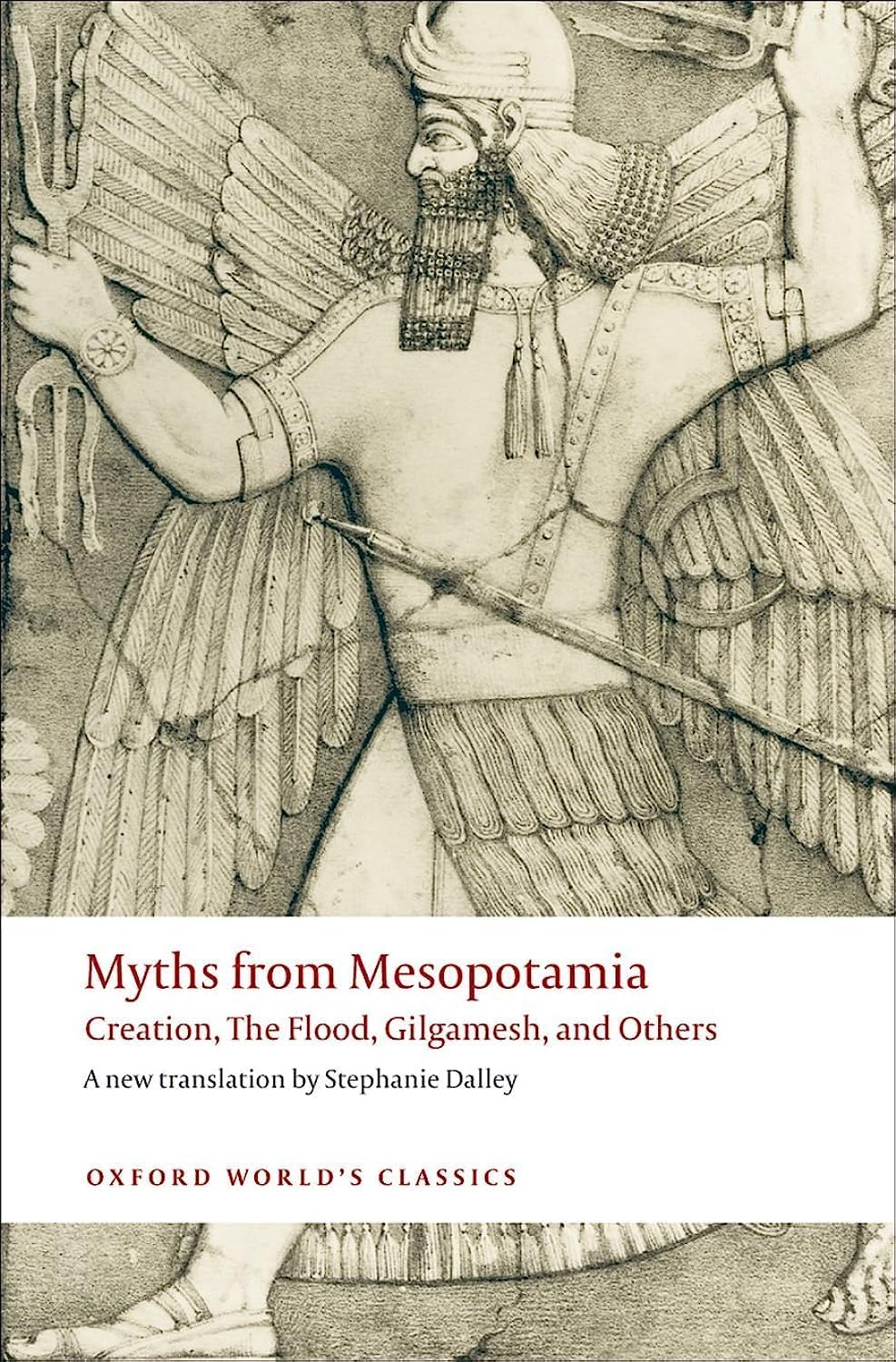
The ancient civilization of Mesopotamia thrived between the rivers Tigris and Euphrates over 4,000 years ago. The myths collected here, originally written in cuneiform on clay tablets, include parallels with the biblical stories of the Creation and the Flood, and the famous Epic of Gilgamesh , the tale of a man of great strength, whose heroic quest for immortality is dashed through one moment of weakness. Recent developments in Akkadian grammar and lexicography mean that this new translation--complete with notes, a glossary of deities, place-names, and key terms, and illustrations of the mythical monsters featured in the text--will replace all other versions. About the Series: For over 100 years Oxford World's Classics has made available the broadest spectrum of literature from around the globe. Each affordable volume reflects Oxford's commitment to scholarship, providing the most accurate text plus a wealth of other valuable features, including expert introductions by leading authorities, voluminous notes to clarify the text, up-to-date bibliographies for further study, and much more. Review: A distant echo of our true history ? - MYTHS FROM MESOPOTAMIA : Creation, the Flood, Gilgamesh, and Others. Edited and translated with an Introduction and Notes by STEPHANIE DALLEY. 337 pp. Oxford World's Classics. Oxford University Press, 1998 (1989). ISBN 0-19-283589-0 (pbk.) Today we have the movies. It seems perfectly natural to us that time, energy, skills, and enormous resources should be devoted to the manufacture of an endless flood of 'stories,' stories which bear little if any relation to reality, and most of which are mere entertainment and utterly without any sort of meaning or significance. Think, for example, 007 or Indiana Jones. Think rubbish. What we fail to realize is that ancient peoples would have viewed us and our art with absolute horror. Having far more limited resources than us, and being fundamentally much more serious and in closer contact with reality, an art such as ours that lacked significance would have immediately been seen as the degenerate thing it is. True art for the ancients, in other words, meant deep significance. Look now at the title of the present book. What effect does the use of the word "Myths" have on your thoughts before you even open the book? One of the senses of this word today is "lies" or "falsehoods." The word is also commonly used of the stories that were told and cherished and handed down by ancient peoples. These were serious people, and their 'stories' held deep meaning and significance for them, though we no longer require our own to have much meaning. But the title of Dalley's book flicks a switch in our mind and readies us for a bunch of mere stories, tales dreamed up out of thin air in idle moments. Personally, I remain unconvinced. I don't think that the ancients were as ready to waste their time and resources on mere entertainment as we are. Neither do I think that their stories were pure products of imagination about an imagined class of beings that (since it's safer) our scholars have agreed to call "gods." I think these stories are distant echoes of actual historical events involving real persons, and so does scholar and linguist Zechariah Sitchin, whose books on Ancient Mesopotamia you ought to read as they will help rescue you from the paradigm paralysis of the Official World. The story of Ancient Mesopotamia, of its various peoples and languages, its amazing civilization, its fantastic cuneiform writing system, and of the exciting discovery of hundreds of thousands of baked clay tablets, in various states of preservation, and their patient decipherment by dedicated scholars over the last hundred years or so, is a fascinating story but far too complex to go into here. All I can do is refer you to my Listmania List, 'Sumer for Beginners,' for some suggested reading. Assyriologist Stephanie Dalley, who has taught Akkadian (the Semitic language of the conquerors of Sumer), is one such scholar, and although I'm not a specialist myself but merely an enthusiastic Sumerophile, I think she would agree that knowledge of Sumerian and Akkadian is still in a highly imperfect state, and that 'definitions' of words in these languages should not be seen as fixed and more or less final, as they are in languages such as Latin or Greek, but rather as currently fashionable educated guesses by specialists, guesses which may turn out to be wrong. Personally I doubt very much that her use, for example, of the word "gods," accurately reflects what the ancients really meant. Once again, I think that we are dealing not with 'myth' but with history. Although Professor Dalley's book was designed for the general reader, it's quite a scholarly production nevertheless. After a brief Preface and Introduction, she gives us brisk, clear, vigorous and wonderfully readable translations of the following important texts : Atrahasis (the Flood Story); two versions of The Epic of Gilgamesh; The Descent of Ishtar to the Underworld (The Journey of Ishtar to Africa ?); two versions of Nergal and Ereshkigal; Apapa; Etana; two versions of Anzu; The Epic of Creation; the Theogony (sic) of Dunnu; Era and Ishum. All of these texts have been provided with their own brief introductions, and all gaps and losses of text in the original tablets have been indicated in the translations. In addition, all texts have occasionally helpful endnotes which in most cases total a page or two, although Gilgamesh has over 10 pages. The book also includes a Chronological Chart (in a miniscule font); a Map of the Near East showing places named in the 'myths' (which would have been more useful if it hadn't been so tiny); a page of line drawings illustrating 'Mythical monsters (sic) referred to in the translations;' a detailed 14-page Glossary; and a 6-page Selected Bibliography which should prove useful to polyglots who have access to an excellent university library collection of Ancient Near Eastern materials. The book is clearly and excellently printed on strong paper in a smallish but readable font, and bound in a glossy wrapper, but sadly has one of those detestable glued spines that crack on opening. Here is an example of Dalley's vigorous style, chosen at random from Gilgamesh, with my obliques added to indicate line breaks: "He washed his filthy hair, he cleaned his gear, / Shook out his locks over his back, / Threw away his dirty clothes and put on fresh ones. / He clothed himself in robes and tied on a sash. / Gilgamesh put his crown on his head / And Ishtar the princess raised her eyes to the beauty of Gilgamesh. / 'Come to me, Gilgamesh, and be my lover! / Bestow on me the gift of your fruit!" (Page 77). Within its limits, Dalley's is an excellent scholarly compilation of her wonderfully readable and vigorous translations, and should be of real interest to anyone who is seriously interested in these fascinating ancient stories. But instead of allowing Professor Dalley to decide in advance for you, it might be better if you were to make up your own mind as to whether they are merely "myths," or are instead a distant echo of our true history. Review: Excellent Scholarly Edition - I’m sure this is an excellent edition for someone who really wants to read the ancient poetry, especially with all the amazing scholarship that is included. However, I couldn’t wrap my head around it, so I returned it, and will continue with the real Genesis.
| Best Sellers Rank | #28,055 in Books ( See Top 100 in Books ) #18 in Comparative Religion (Books) #30 in Folklore & Mythology Studies #1,003 in Classic Literature & Fiction |
| Customer Reviews | 4.6 out of 5 stars 1,134 Reviews |
T**I
A distant echo of our true history ?
MYTHS FROM MESOPOTAMIA : Creation, the Flood, Gilgamesh, and Others. Edited and translated with an Introduction and Notes by STEPHANIE DALLEY. 337 pp. Oxford World's Classics. Oxford University Press, 1998 (1989). ISBN 0-19-283589-0 (pbk.) Today we have the movies. It seems perfectly natural to us that time, energy, skills, and enormous resources should be devoted to the manufacture of an endless flood of 'stories,' stories which bear little if any relation to reality, and most of which are mere entertainment and utterly without any sort of meaning or significance. Think, for example, 007 or Indiana Jones. Think rubbish. What we fail to realize is that ancient peoples would have viewed us and our art with absolute horror. Having far more limited resources than us, and being fundamentally much more serious and in closer contact with reality, an art such as ours that lacked significance would have immediately been seen as the degenerate thing it is. True art for the ancients, in other words, meant deep significance. Look now at the title of the present book. What effect does the use of the word "Myths" have on your thoughts before you even open the book? One of the senses of this word today is "lies" or "falsehoods." The word is also commonly used of the stories that were told and cherished and handed down by ancient peoples. These were serious people, and their 'stories' held deep meaning and significance for them, though we no longer require our own to have much meaning. But the title of Dalley's book flicks a switch in our mind and readies us for a bunch of mere stories, tales dreamed up out of thin air in idle moments. Personally, I remain unconvinced. I don't think that the ancients were as ready to waste their time and resources on mere entertainment as we are. Neither do I think that their stories were pure products of imagination about an imagined class of beings that (since it's safer) our scholars have agreed to call "gods." I think these stories are distant echoes of actual historical events involving real persons, and so does scholar and linguist Zechariah Sitchin, whose books on Ancient Mesopotamia you ought to read as they will help rescue you from the paradigm paralysis of the Official World. The story of Ancient Mesopotamia, of its various peoples and languages, its amazing civilization, its fantastic cuneiform writing system, and of the exciting discovery of hundreds of thousands of baked clay tablets, in various states of preservation, and their patient decipherment by dedicated scholars over the last hundred years or so, is a fascinating story but far too complex to go into here. All I can do is refer you to my Listmania List, 'Sumer for Beginners,' for some suggested reading. Assyriologist Stephanie Dalley, who has taught Akkadian (the Semitic language of the conquerors of Sumer), is one such scholar, and although I'm not a specialist myself but merely an enthusiastic Sumerophile, I think she would agree that knowledge of Sumerian and Akkadian is still in a highly imperfect state, and that 'definitions' of words in these languages should not be seen as fixed and more or less final, as they are in languages such as Latin or Greek, but rather as currently fashionable educated guesses by specialists, guesses which may turn out to be wrong. Personally I doubt very much that her use, for example, of the word "gods," accurately reflects what the ancients really meant. Once again, I think that we are dealing not with 'myth' but with history. Although Professor Dalley's book was designed for the general reader, it's quite a scholarly production nevertheless. After a brief Preface and Introduction, she gives us brisk, clear, vigorous and wonderfully readable translations of the following important texts : Atrahasis (the Flood Story); two versions of The Epic of Gilgamesh; The Descent of Ishtar to the Underworld (The Journey of Ishtar to Africa ?); two versions of Nergal and Ereshkigal; Apapa; Etana; two versions of Anzu; The Epic of Creation; the Theogony (sic) of Dunnu; Era and Ishum. All of these texts have been provided with their own brief introductions, and all gaps and losses of text in the original tablets have been indicated in the translations. In addition, all texts have occasionally helpful endnotes which in most cases total a page or two, although Gilgamesh has over 10 pages. The book also includes a Chronological Chart (in a miniscule font); a Map of the Near East showing places named in the 'myths' (which would have been more useful if it hadn't been so tiny); a page of line drawings illustrating 'Mythical monsters (sic) referred to in the translations;' a detailed 14-page Glossary; and a 6-page Selected Bibliography which should prove useful to polyglots who have access to an excellent university library collection of Ancient Near Eastern materials. The book is clearly and excellently printed on strong paper in a smallish but readable font, and bound in a glossy wrapper, but sadly has one of those detestable glued spines that crack on opening. Here is an example of Dalley's vigorous style, chosen at random from Gilgamesh, with my obliques added to indicate line breaks: "He washed his filthy hair, he cleaned his gear, / Shook out his locks over his back, / Threw away his dirty clothes and put on fresh ones. / He clothed himself in robes and tied on a sash. / Gilgamesh put his crown on his head / And Ishtar the princess raised her eyes to the beauty of Gilgamesh. / 'Come to me, Gilgamesh, and be my lover! / Bestow on me the gift of your fruit!" (Page 77). Within its limits, Dalley's is an excellent scholarly compilation of her wonderfully readable and vigorous translations, and should be of real interest to anyone who is seriously interested in these fascinating ancient stories. But instead of allowing Professor Dalley to decide in advance for you, it might be better if you were to make up your own mind as to whether they are merely "myths," or are instead a distant echo of our true history.
S**O
Excellent Scholarly Edition
I’m sure this is an excellent edition for someone who really wants to read the ancient poetry, especially with all the amazing scholarship that is included. However, I couldn’t wrap my head around it, so I returned it, and will continue with the real Genesis.
C**I
Rapidez en servicios.
Recibido el articulo bien como descrito.excelente rapidez en entrega y protegido
R**S
A lot of great myths in an affordable collection
Continuing my exploration of ancient mythology I got this book, which contains most (if not all) of the major myths from Mesopotamian mythology. I am rather new to this sort of literature (save the mandatory reading of Greek myths as a high school freshman) and not a language scholar, so I can't really comment on quality of translation. However, as pure reading material, I found the Canaanite myths a little more interesting. The source material for these is also a great deal more fragmented, so there are frequent issues of comprehensibility (but not in macrocosm). The big story that probably everyone will recognize (but not necessarily have read) is 'The Epic of Gilgamesh.' It certainly was a great read, but there were other stories in here that I found more engaging. For one, the story of Atrahasis, was a good one, relating a story of creation as well as one similar to the story of Noah in Genesis. I also found the Epic of Creation to be fascinating, definitely more so than the ones found in the Bible. It was also the most intact/complete out of everything in here. The book also has different variations on Ishtar's descent into the Underworld, Nergal and Ereshkigal. However, my absolute favorite was Anzu, the bird-god who stole the Tablet of Destinies. The last story in the book, Erra and Ishum, was also interesting in that it reminded me a lot of prophecies of Israel's destruction in the second half of the Old Testament. Overall, as a collection of Mespotamian myths, there's probably not a better book than this one. There are plenty of notes on the translations as well as chapter introductions which give an overview of what you're about to read and the nature of the sources. There is also a glossary of terms and select bibliography. I can highly recommend this to anyone interested in ancient mythology.
W**B
Very great book!
Very long read and educational.
S**E
Down the rabbit hole! 🕳️🐇
Definitely have been anticipating this book 😁 Appears to be in new condition!
P**R
To the casual and curious readers of Antiquity.
If your the casual curious reader of antiquity and wish to plunge yourself into middle of writings from the times of Babylon and Assyria this is a good way to do it. But if your like most people I suspect who thought this might be more along the Sumer/Akkad trail of writings your not going to be entirely disappointed as all that Sumer/Akkad readings you may have been doing now get put to the test, however the glossary is excellent and will help you along greatly as you see how the pantheon has expanded and morphed some. Some quick notes: There is an evolution of thought going on here but your going to have to distinguish that for yourself. The author here gets you to the boat, helps you get seated, hands you the oars and then with a gentle push sets you adrift with each story. No glad handling, septic, but nice. If your an Inanna/Isthar fan, you'll see glimpses of how attempts to push her out of the picture were made, but in the last myth you'll see too it might not of been all that successful. Spoiler alert. The real treat comes with the last myth. That there truly is nothing new under the sun will be proven with this story written circa 756 BC where you should see in good style, here we are, same place, different time. Enjoy.
S**I
Perfect source for Ancient Context
I purchased this to grasp a better understanding of the ANE (ancient near east) and to deepen my understanding of the context & stories that were familiar to the Biblical writers, in order that I could better understand some of the backdrops to many of the biblical stories. After researching, this book was praised as one of the most reliable and accurately translated for the Mesopotamian material included. There is also a glossary of names/terms in the back, which is incredibly helpful when reading through the material... there's a lot of characters!
A**A
Fantastic
This was a textbook for one of my history courses. It was a fantastic resource. It was clear and easy to read
S**R
Epics, friendships, teachings and glory
A great compilation of myths that represents the world the way Sumerians and Akkadians used to live with it's fears, efforts and glory. Also a good text to comprehend things related to the old testament in the Bible.
K**3
You'll not find explanations
It's just a copy of what was found, very little comments and explanations. The author says it clearly that her role is almost absent. Most of transcripts are too similar and repeated and if the would have been referred as (idem) the book would have been with much less pages.
D**E
Interesting Read
I found this book interesting and once I started reading the notes along with the stories it made more sense and I had a broader understanding. Having said that it would have been an easier read if the notes were on the bottom of each page instead of at the end of each story. Good place to start learning our ancient heritage that was not taught to us in school.
B**E
Sitchin might not be wrong after all
Having read the negative comments about Zechariah Sitchin I wanted to read the original stories on their own with a good translation. This book is brilliant although not the easiest to read as it doesn't smooth over gaps. I prefer this as it let's me make up my own mind how to fill them. The idea of extra terrestrials having visited the earth can be easily deducted from these texts, one only needs to read the first story "Atrahasis" to get the idea "When Anu had gone up to the sky, [And the gods of] the Apsu had gone below, The Anunnaki of the sky Made the Igigi bear the workload." These gods are not portrayed in a way we like to think of gods as kind of heavenly beings but remind us of greek gods, real people but from a different place, another planet. These gods are as human as we are, they are sleeping in houses, grumble over hard work, complain and start rebellions. And like us humans, who want to ease the work-burden and use workers/slaves, so did they, they created mankind to do the work for them. They " ... clear channels, the lifelines of the land, ... They were counting the years of loads, For 3,600 years they bore the excess, Hard work, night and day. They groaned and blamed each other, Grumbled over the masses of excavated soil" The stories are all very human, have even a modern feel to it sometimes. They really make you think and wonder, who are these Anunnaki, are they really gods in a sense of how we understand gods, supernatural beings, or are they simply a kind of human from a different planet who created workers in their own image but a shorter life span. Even the process of creation as described in these stories do remind one of modern genetic engineering. After reading these stories, I believe that Sitchin might really have a point, there really might have been people from another planet who visited this planet and created us. Of course there are always other interpretations possible, but considering the style these stories are written in and how there are so many other cultures with similar stories and artefacts that still puzzle science and historians today, I think we should keep an open mind. This book is a good start to get a more 'un-biased' view about ancient cultures like the Sumerian. Let the stories speak for themselves.
Trustpilot
2 months ago
4 days ago