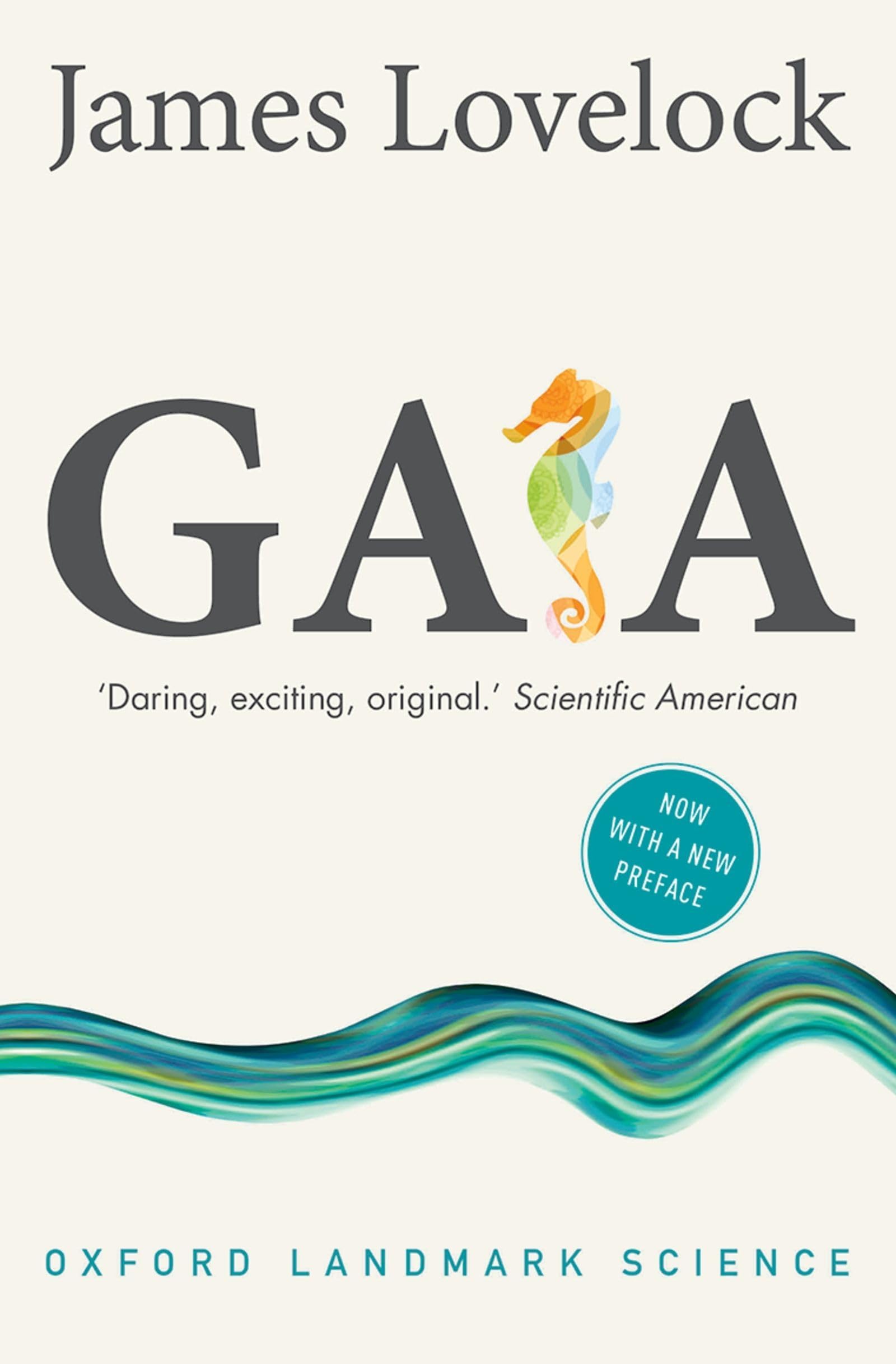
Gaia: A New Look at Life on Earth (Oxford Landmark Science)
Product ID: 36798484
Buy anything from 5,000+ international stores. One checkout price. No surprise fees. Join 2M+ shoppers on Desertcart.
Desertcart purchases this item on your behalf and handles shipping, customs, and support to British Virgin Islands.
In this classic work that continues to inspire many readers, Jim Lovelock puts forward his idea that the Earth functions as a single organism. Written for non scientists, Gaia is a journey through time and space in search of evidence in support of a radically different model of our planet. In contrast to conventional belief that life is passive in the face of threats to its existence, the book explores the hypothesis that the Earth's living matter influences air, ocean, and rock to form a complex, self regulating system that has the capacity to keep the Earth a fit place for life. Since Gaia was first published, Jim Lovelock's hypothesis has become a hotly debated topic in scientific circles. In a new Preface to this edition, he outlines his view of the present state of the debate. Oxford Landmark Science books are 'must read' classics of modern science writing which have crystallized big ideas, and shaped the way we think. Review: Still an amazing read - I read this when it first came out. Some critics made fun of Lovelock but he sure made sense to me. Now most of them are in agreement. He explains complex concepts in very clear language and some how captures the vital, dynamic, ever-changing interactive nature of all that is 'earth', all processes living in connection and response to each other. What indigenous people who live close to nature have always understood. Review: Gaia is earth and us... - Lovelock quite rightly is widely considered the originator or at the very least the primary popularizer and promotor of Gaia Theory. This book is a beautiful explanation and summary. I have believed for a long time now that his theory not only makes scientific sense but should by now in 2024 simply be Common Sense. It is all a giant living self-regulating system--this planet and all its life forms, too. We can get all caught up in arguments about what it means to say the earth is alive or has consciousness, etc. But the facts suggest it is so. Read this small book and be moved, impressed, amazed, delighted. Gaia Theory could be the Great Myth we humans live by, the great opportunity we have as sentient human beings. To honor Mother Earth and work with her instead of against her could be the answer we unconsciously seek now through religions and all the other mad human ego games and superstitions. I'm not at all sure we humans are wise enough as a species to grasp the opportunity we have but if we continue destroying the earth, she, Gaia, may very well cast us off and continue on without us. As for me, I will love her to whatever end befalls me. Get on board. There is plenty of room...
| Best Sellers Rank | #343,537 in Books ( See Top 100 in Books ) #298 in Ecology (Books) #409 in Environmental Science (Books) #553 in Environmentalism |
| Customer Reviews | 4.5 out of 5 stars 650 Reviews |
S**T
Still an amazing read
I read this when it first came out. Some critics made fun of Lovelock but he sure made sense to me. Now most of them are in agreement. He explains complex concepts in very clear language and some how captures the vital, dynamic, ever-changing interactive nature of all that is 'earth', all processes living in connection and response to each other. What indigenous people who live close to nature have always understood.
O**S
Gaia is earth and us...
Lovelock quite rightly is widely considered the originator or at the very least the primary popularizer and promotor of Gaia Theory. This book is a beautiful explanation and summary. I have believed for a long time now that his theory not only makes scientific sense but should by now in 2024 simply be Common Sense. It is all a giant living self-regulating system--this planet and all its life forms, too. We can get all caught up in arguments about what it means to say the earth is alive or has consciousness, etc. But the facts suggest it is so. Read this small book and be moved, impressed, amazed, delighted. Gaia Theory could be the Great Myth we humans live by, the great opportunity we have as sentient human beings. To honor Mother Earth and work with her instead of against her could be the answer we unconsciously seek now through religions and all the other mad human ego games and superstitions. I'm not at all sure we humans are wise enough as a species to grasp the opportunity we have but if we continue destroying the earth, she, Gaia, may very well cast us off and continue on without us. As for me, I will love her to whatever end befalls me. Get on board. There is plenty of room...
D**L
Interesting Hypothesis in Somewhat Convoluted Form
James Lovelock has created a powerful and interesting argument in this book that will keep scientists busy for centuries. He notices that there is an ability for the Earth to maintain relatively constant conditions in temperature, atmosphere, salinity and pH of the oceans, and reductions in pollutants that defies the simple observations of what "should" happen. From this, he concludes that there is a complex of physical, chemical and biological interrelationships that work like a living organism, which he defines as the Gaia Hypothesis. For defining that concept and providing some of the measurements to establish its premises, he deserves a 7 star rating. Unfortunately, the argument is expressed in overlong and convoluted fashion. He deliberately limits himself to a nonscientific explanation in this book. The scientific version of the argument is in The Ages of Gaia. Although the book is not long, it certainly could have been condensed into a longish article for Scientific American or The Atlantic Monthly. My second quibble is that the editor was nowhere in sight on the organization of the book. The key point is often buried in the third sentence of the last paragraph in a chapter. The argument in between wanders into all kinds of places where it doesn't need to go. For organization and editing, I give this book a one star rating. So the average is a 4 star rating. The writing itself is pleasant enough. Don't let the lack of organization and editing put you off, for it is worth your while to read this book. It will remind you of the benefits of the sort of sytems thinking that Peter Senge talks about in The Fifth Discipline. The other thing you will learn is the weakness of scientific work that fails to develop enough field data and to connect enough with other disciplines. I was struck by the same observations recently while visiting environmental scientists at the Smithsonian Institution. The basics in many of these areas have yet to be measured and evaluated. This book will point countless generations forward in understanding how our plant maintains its environment that permits life to flourish. Clearly, it is a stallbusting effort to replace "stalled" thinking about the history and future of the Earth. I found the key questions (such as why doesn't the ocean become more saline?) to be irresistible. I think you will, too. Enjoy and think!
P**L
Imagine an organism as big as Earth!
Reading Edward Wilson's "The Future of Life" served as the spark to pick up and read this book. And its true, good things do come in small packages. The book is all of 140 pages, and is written in a lean, but not glossed-over style. Robert Lovelock (to my knowledge) is the contemporary father of the study of the earth as a complete living system. Lovelock readily admits that the book serves more to promote the dialog about our planet as a living, breathing whole and to share key discoveries that support his concept. (He states in the Preface that his follow-on book, "The Ages of Gaia" aims to build the scientific argument to the Gaia theory.) By no means, does Lovelock detour around the science that supports his case. With the scope of the topic requiring knowledge of both physical and biological science, and the small number of pages, he manages to instruct and create a sense of awe in a short amount of time. The 3 major principles he brings to light about Gaia are: 1. Gaia exhibits a tendency to keep conditions (e.g., temperature, air quality) constant for all terrestrial life. 2. Like other living systems, Gaia has vital organs at the core, and expandable or redundant ones on the periphery. 3. Under the worse conditions, Gaia responses similar to other cybernetic systems (i.e., where time constant and loop gain are important) The material is far reaching in both its scope and in shaping our understanding of where we stand. Put in the context of Gaia, we have straddled ourselves to the largest of all known living and breathing creatures.
S**K
A valuable macro view of planet Earth
An intriguing new look at our planet. Lovelock extols the need for a more holistic approach to science after its centuries of moving towards ever more specialization and reductionism. 'Gaia' is the metaphor for his top-down look at Earth - literally - and what makes it 'tick'. He makes the reader aware of the adaptability of life to whatever conditions prevail and the consequent near-impossibility of achieving lasting equilibrium (as of a dead planet). He describes the complex interaction of atmosphere and sea as well as the impact of life thereon both from organisms on land and in the sea, and he raises interesting questions about the nature of pollution. All this leads to his hypothesis (now known as the Gaia Theory) that Earth - through the life it spawned - is itself a self regulating living system, where planetary homeostasis is achieved and maintained by living organisms. In 'Living with Gaia' he discusses two mainstream views: man as Earth's steward and man as Earth's tragedy or even its scourge, but avoids a direct answer by emphasizing the cybernetic qualities of Gaia. All he says is, that man being a part of that system, but also with the ability to influence it significantly, may play a role in it - for better or worse. In contrast to Lovelock's later books 'The Revenge of Gaia' and 'Vanishing Gaia', which are dire warnings, 'Gaia' is simply the presentation of the original hypothesis, and in a very elegant way at that, to make it accessible to the non-scientist too.
C**F
Interesting but dated
Many of the observations in this book have proven, in retrospect, to be terribly flawed. The overall concept is interesting nonetheless.
A**L
Essential Nature
This is not a new book or a new topic but the source of an essential concept. At this point, the notion that the planet Earth is a living, breathing bio-system seems obvious; but originally Lovelock's idea was not easily accepted. It took a NASA scientist exploring the possibility of intergalactic life forms to identify the mechanisms which render Earth habitable. From a planetary engineering point of view, life terraformed this planet and the biodiversity of life - from microcosmic phytoplankton to Blue whales - maintain the critical balance of the global ecosystem. Good read, easy to understand, should be required for all humans.
M**E
Brilliant hypothesis, poorly presented
In essence, Lovelock says that since evolution started eons ago, all forms of life evolved together resulting not only in balance among themselves and their surroundings, but also in such a way that they regulate the environment, controlling the atmosphere, the salinity of the seas and the temperature. This complex eco-system is presumably an inevitable consequence of the algorithm of evolution running successfully. Want to know if there is life on another planet? Easy, look at the atmosphere. This comes out in the book, but it is a bit bizarre. Lovelock seems to go from anthropomorphism (the world learning to breath and making decisions) to using scientific terms that the average non-science reader will have to look up. He presents a table on page 63 that I think is incomprehensible unless you understood the work that went into it, which is not presented. He finishes with a plea not to hunt whales, which seems like a strange non-sequester to the book as whole. As a consequence of this he seems to have appealed to crystal-swinging, horoscope-reading new age wo-wos rather than hard scientists. This is a shame, because the idea is brilliant (thus 4-stars), and could result in decades of research, added to which Gaia is a great name. It seems self-evident that we are part of and completely dependent upon the environment around us. Lovelock has such faith in the self-regulating mechanisms, he rather pooh poohs our ability to mess with it too much. However, it seems to me that evolution and balance takes time - we do things incredibly fast - our ability to warm the globe has only been for a couple of hundred years. We could easily give Gaia a fever, by overcoming her ability to make gentle regulations. If this happens, we do not know what the results will be, but we almost certainly will not benefit from them. As they say; "nature bats last". Everyone should read this book and, despite its faults, it is readable.
G**A
Bel libro
Offre buoni spunti di riflessione
T**Y
So what...
Well, isn't it fun looking back at a good book many years on. Or in the context of this book, relatively recently. So what...well for me it is as scary as seeing an orange man in charge of the blood bank when I consider the heed paid to the contents of this book and others. Thanks for a good read Jim.
N**C
A very positive take on ecology
Nice to see a book about ecology that is also positive about humanity and technology. The authors humiliy in accepting his mistakes and improving his arguments and scienxe moves ahead is also applaudable. Easy to read for anyone not of a scientific bent or training.
A**E
Well-written and full of interesting scientific facts
I read this amazing book for the first time in German and liked it. Now I ordered it in the original English and liked it even more.James Loveleock`A treasure box of good scientific explanations, in support of a holistic model of planet earth, the book demonstrates the vulnerable nature of our existence on planet earth and makes many good points for us to consider. Brlliant style, intelligent reasoning, amazing insights!
S**N
Lovelock's wonderful rendition on the subject
Lovelock's wonderful rendition on the subject. My partner and I have fallen in love with the Gaia series. We hope to meet James lovelock and discuss the books
Trustpilot
1 day ago
1 month ago