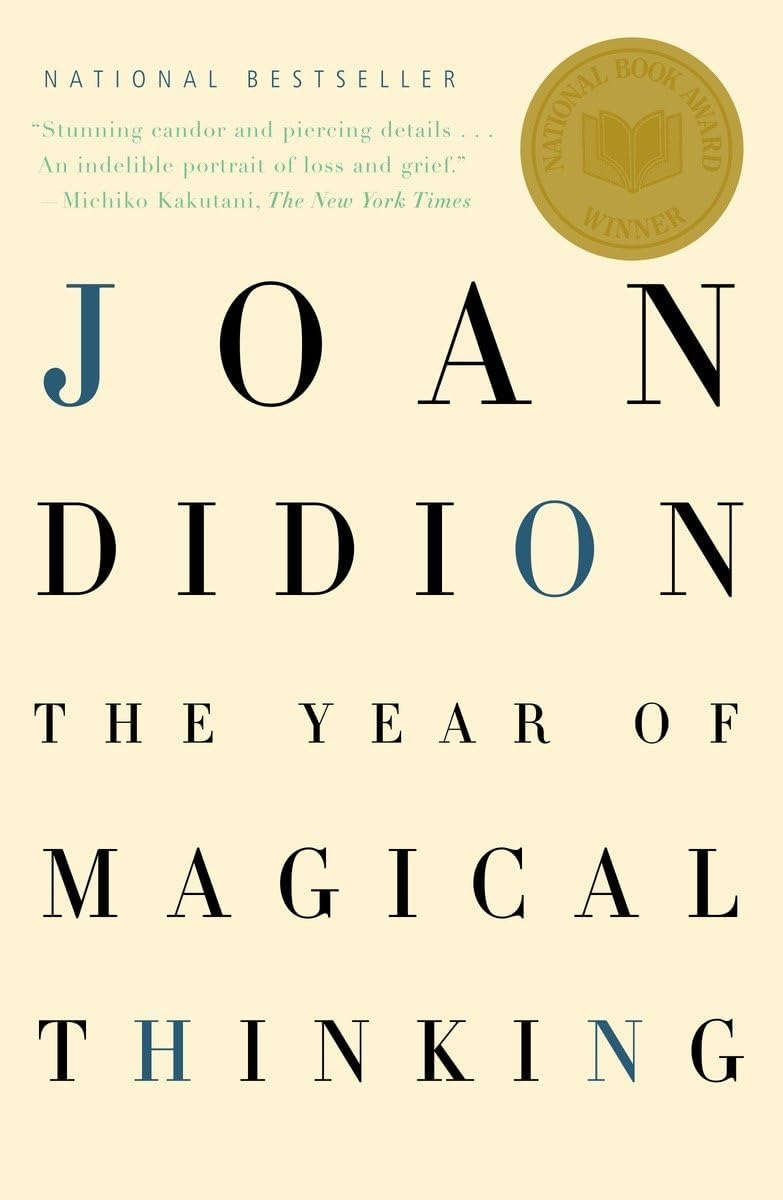
The Year of Magical Thinking: National Book Award Winner (Vintage International)
Product ID: 315966
⭐4.4/5 from 14K+ reviews
🏆National Book Award Winner
📚Top 50 Memoir Bestseller
Buy anything from 5,000+ international stores. One checkout price. No surprise fees. Join 2M+ shoppers on Desertcart.
Desertcart purchases this item on your behalf and handles shipping, customs, and support to British Virgin Islands.
📖 Experience grief like never before — raw, real, and unmissable.
The Year of Magical Thinking is Joan Didion’s National Book Award-winning memoir that candidly explores the first year after her husband’s sudden death. Praised for its raw honesty and literary mastery, this top-ranked memoir offers a profound, unvarnished look at grief, making it an essential read for anyone seeking emotional insight and connection.


| Best Sellers Rank | #2,308 in Books ( See Top 100 in Books ) #8 in Author Biographies #30 in Women's Biographies #67 in Memoirs (Books) |
| Customer Reviews | 4.4 out of 5 stars 14,694 Reviews |
P**N
Comfort for Those Grieving the Loss of a Loved One
If you've lost a long-time partner, this book may be a real comfort for you and make you feel deeply understood. I loved it when I got it after the death of my partner, and recently bought a copy for a dear friend who lost her husband. Like any book, it's probably not for everyone, but I found Joan Didion's writing amazing and even went on to read her other books.
D**N
Great grief novel
If anyone dies buy them this
D**S
Devastating, lucid, and deeply humane
The Year of Magical Thinking is a quiet, unflinching account of grief as it actually unfolds in the mind—fragmented, repetitive, and strangely rational even when reality has already shifted. Didion writes with a clarity that never slips into sentimentality. What makes the book so powerful is its precision: she tracks the small, automatic thoughts that arise after loss, especially the mind’s insistence on bargaining with what cannot be changed. The “magical thinking” is not dramatized—it is observed, almost clinically, which makes it feel even more true. There is restraint in every page, yet the emotional weight accumulates steadily. It’s not a book that pushes the reader toward catharsis so much as it allows recognition—of how grief distorts time, logic, and memory while still coexisting with daily life. A difficult but essential read. Quiet, exacting, and profoundly human in its honesty.
K**N
Deserves to become a classic memoir about grief and loss
I stayed up almost all might just to finish reading it, unable to put this down, although I confess I had to keep a box of tissues nearby. I've lost 5 people in the last few years and, just recently, another friend and so I related very strongly to this book. Didion's unflinching account of the sudden loss of her husband (which occurred while their only child was in a coma in a hospital (!)) deserves to be a classic in the genre of books written by and for those who are grieving. It is hard to find books like this, which are both honest but not overly sentimental, not resorting to the tropes which seem to surround death. She doesn't offer vague platitudes or advice. She simply relates her very personal experience, including the inevitable vulnerability, unexpected moments of being blindsided by memories and sudden tears, etc. She covers all the bases, including the kind of insanity that can seize one in the throes of grief, those moments when you forget the person is actually dead, when you turn to speak to him or her as you normally would at a certain part of the day or reach for the phone to share the latest news. The book is raw. If you're looking for religous or spiritual guidance and inspiration, this is not the book for you. As Didion herself noted, writing about the book recently, it was intentionally written "raw". I assume she didn't want to wait, to distance herself from the intensity of the experience as she wrote it down, quite unlike many other books she has written. Raw or not, it wasn't sloppy, overly sentimental or complete despairing. It was simply honest, heartwrenchingly so, and Didion doesn't deviate from communicating, in absolute striking detail, the sense of alienation and disorientation that separates mourners from those who seem to be living "normal" lives. Grief is its own territory, separate from so-called normalcy. In so many ways, it is an illness, an affliction of the spirit and not one that can be cured in any one way. An aside- the photo of Didion inside the dustjacket is haunting. No question that those are the eyes of someone who has been scraped to the core, wounded and, presumably, still recovering. There is something beautiful in that portrait and, oddly, comforting. It is the face of a survivor, however hard it might be to live as one. This book will remain on my bookshelf and I expect I'll be thumbing through it for solace time and again. Reading it was both painful and cathartic and strangely comforting, with an intensity that left me awestruck. I am still amazed that she was able to produce such a beautifully written book in the throes of so much pain.
D**N
Authentic glimpse into her life...I recommend
Joan begins this memoir of the year after the death of her husband with the following; Life changes fast. Life changes in an instant. You sit down to dinner and life as you know it ends. The question of self-pity. She then grapples with the "how" and "why" of these statements and recreates the year after her husband's sudden death at their dining room table, immediately after they had returned from visiting their daughter, Quintana, who lay in a coma in ICU. I think Didion did a wonderful job of this telling - leading us through her journey of questions - reflecting back on seemingly random conversations - and exploring her emotions and psychological struggles as she was going through them. Joan explores her grief through reading and finding out everything she can about what went wrong with her husband and by recreating and reliving that night minute by minute and the weeks and days leading up to his sudden death by heart attack. Many times she reflects the moment with a minus countdown to the date (e.g. twenty three days before life changes, etc). There were moments of raw emotion, but in some ways the memoir seemed constrained and guarded to me. I think one of the things that made it feel conflicting in this manner was the recency factor - she is writing these thoughts within the year of his passing and not reflecting back years later...but writing in the moment. She ends the memoir only a year and week after his passing. This recency factor probably kept some of the grief from entering the book, while at other times allowing it to come out in ways that would have been lost over time. I think she did an authentic job of opening up the curtains and allowing us to peer into their relationship and life. While her life is very different than mine, she was very human and the window into her life was appreciated and something I embraced. I would not have wanted her to recreate her life for the "common reader". I appreciate that she was genuine in giving us a window into her life and in doing so, we were also able to catch glimpses into her soul and who she is as a person. I especially appreciated the window into the forty year marriage she shared with John and their partnership - their always working together and the true friendship the seemed to have. From editing each other's articles and books to their travel together. Joan writes that, "marriage is memory, marriage is time." I found myself reflecting on my own marriage and how we truly have time and memory together that no one else has. We have history and this is something that can never be replaced. I've known my wife like no one else since she was eighteen and she has known me as well over the past two decades. I see her both as she was at twenty and as she is at almost forty. It's a wonderful perspective that can only truly be had through the partnership and friendship of marriage or long-term partnership. Where will we be after forty years together and will we be able to look back at a partnership and friendship such as Joan and John shared? I hope so and having shared a glimpse into their relationship I will work harder at ensuring mine lasts. In glancing at a few of the other reviews I see some are irritated by what they perceive as pretentiousness and name dropping. I disagree. Authenticity is something that I appreciate in memoirs and Joan shared from her experiences and her life. Each of us is on a different path and journey and the wonderful about memoirs is getting a glimpse into someone else's story. I think she opened up and shared her story and while it is different than yours or mine, cutting out the fact that they jetted off to Hawaii or Paris to "escape" stress or that they ate out regularly or had wonderful dinner parties with celebrities and other authors would have been attempting to censor her life and would have not been authentic to who she is as a person. Overall, the book was very well written and tightly crafted. I didn't particularly care for all of the details around her medical research, but it was her way of dealing with the grief and finding answers and I think it gave the book it's structure and context. I would have appreciated more flashbacks to their forty years together, but this wasn't a memoir of their marriage, but a memoir of the year of grief following his passing, so I think what she wrote worked well in that context. I'm looking forward to discussing this in our memoir book club next week.
E**S
A Masterpiece on Grief and Memory
A Masterpiece on Grief and Memory Joan Didion’s *The Year of Magical Thinking* is one of those rare books that lingers in your head long after you’ve closed it. She writes with unflinching clarity about the sudden loss of her husband while caring for their gravely ill daughter, capturing the strange rhythm of grief—the disbelief, the looping thoughts, the need to control what can’t be controlled. What I admire most is how unsentimental the book is. Didion’s prose is stripped down, almost clinical at times, yet that restraint makes the emotions hit harder. She describes the irrational “magical thinking” that keeps her from giving away her husband’s shoes because, on some level, she can’t accept he won’t return. That vulnerability is universally relatable for anyone who has endured sudden loss. This isn’t just a memoir of mourning; it’s also a meditation on memory, marriage, and how fragile the structures of daily life really are. Didion weaves in medical details, literature, and reflections on the mind’s coping mechanisms, which gave me not only a window into her personal grief but also a deeper understanding of my own. It’s not a light read, but it’s immensely rewarding. The honesty, the craftsmanship, and the sheer courage it took to put these experiences into words are remarkable. Bottom line: A powerful, beautifully written meditation on love, loss, and the ways we try to make sense of the unthinkable—an essential read for anyone interested in the human experience of grief.
K**R
A Journey Through Grief
This is an amazing read of an author's first year, following the very sudden death of her husband, complicated by their adopted daughter in Intensive care with an unclear prognosis. She relives very detailed memories, trying to bring him back. Sometimes she revisits past events losing cognitive awareness. There is no one to report things to, share lunch with, critique her work, ask help from - they each had their own offices in their home. If one needed to travel for work, they often travelled together and the 'extra' would work in their hotel room. So although their writings and roles were different, there was a lot of collaborative work, along with sharing of ideas, quotes, incidents etc. So they were a couple who didn't spend much time apart, often working long days and then going out for late dinners. So, the loss was magnified. How can the world not stop? John has gone! A very worthwhile read!
T**A
A good book to read if you're grieving
So insightful and raw. I couldn't help but cry during some of the chapters because it felt like I was reliving my own 911 situation
C**S
Truth and Insight from the Master Didion
Like the repetition of days, of meals taken, of drinks enjoyed over and over, Didion returns to a few ghostly lines, taken from Phillipe Aries' The Hour of Our Death to remind the reader you too. You too believe in the repetition of your daily rituals with your loved ones that you are exempt from the finger of the Reaper. You too, as I did, Didion seems to say, refuse to acknowledge the passing of time, the leaving of life in every day details: the way we hold a fork, our eyes absorbing the exact slant of afternoon light, the sight of our beloved's living breathing face. Along with this more subtle message, Didion shares a deep insight: grief is not the same as mourning. In her experience grief settled in the shattered moments following the heart attack that took her writing partner, husband and best friend within seconds. That grief, as she reports it, numbed and in a sense preserved her until she might open to the less merciful mourning, in which the daily truth of the loss, its depth and height, its width across her now empty heart expanded. No one serves language like Didion. Alone in her vast talent now, with Dunne her husband gone, still she shines the way for the rest of us, writers, people, humans who share the only truth: we too will die someday.
C**T
Adorei!
Livro tocante e muito bem escrito.
W**S
Perfect
Great book to read. Enjoyed reading it
R**A
Precioso relato
Un libro muy interesante y una historia preciosa, aunque muy trágica
A**R
If you need it, you will know
My husband died 3 months ago. Suicide rather than heart attack. This was one of the books recommended to me by Claude when I explained the bitterness I was feeling and my knowledge that I had to find a way for that bitterness to not eat me. I also let Claude know that I had not got along with Plan B. This book has helped me find calm and hope. Where I was, to where I am having read it, I could not give a more positive review of this book. If you need it, you will know. And it will help.
Trustpilot
1 month ago
2 months ago