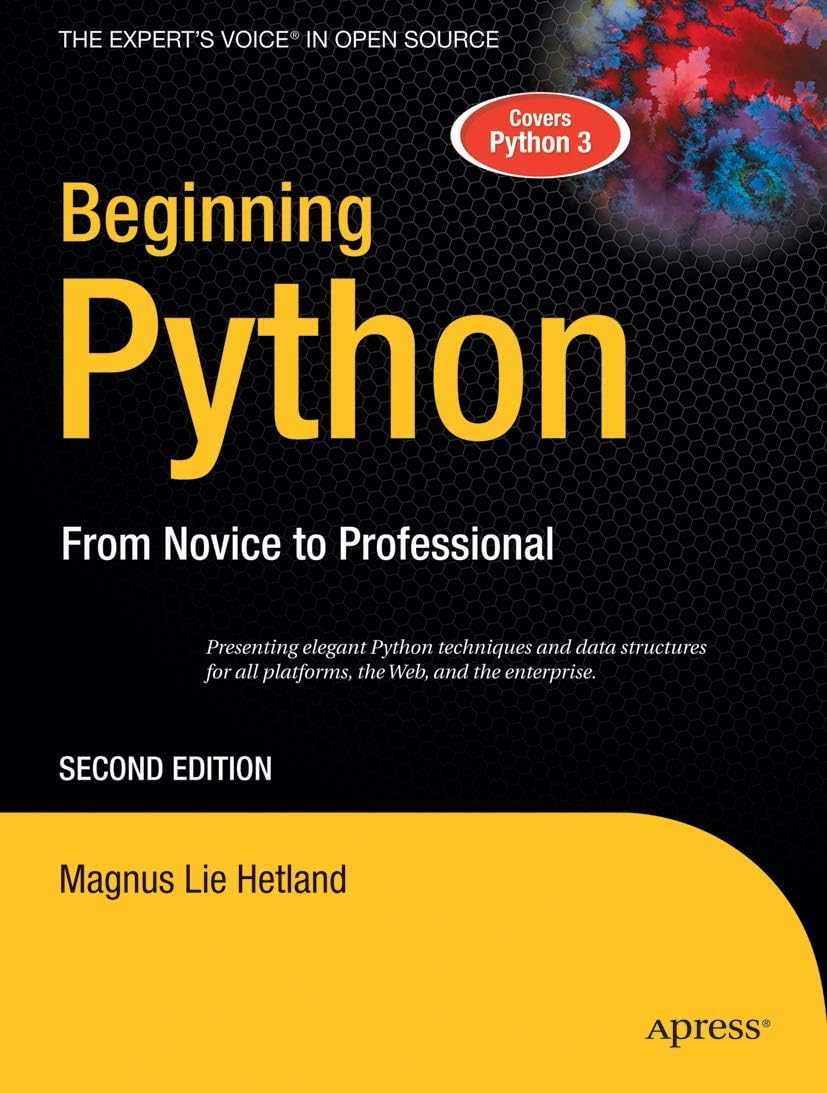
Beginning Python: From Novice to Professional, 2nd Edition (The Experts Voice in Open Source)
Product ID: 18255545
Desertcart purchases this item on your behalf and handles shipping, customs, and support to British Virgin Islands.
Gain a fundamental understanding of Python's syntax and features with the second edition of Beginning Python , an up–to–date introduction and practical reference. Covering a wide array of Python–related programming topics, including addressing language internals, database integration, network programming, and web services, you'll be guided by sound development principles. Ten accompanying projects will ensure you can get your hands dirty in no time. Updated to reflect the latest in Python programming paradigms and several of the most crucial features found in Python 3.0 (otherwise known as Python 3000), advanced topics, such as extending Python and packaging/distributing Python applications, are also covered. Review: An excellent book!! - The first book I read on Python was "A Byte of Python". You can find it on the net. It is free. That book was compact, effortless, useful, but, still, a rather basic intro. I was looking for a something, which would take me further. We had quite a few Python books scattered around the office. Long story short, I liked none of them. Then I chanced upon James Payne's book, and I cannot praise it enough!! Very well structured, very readable, actually, engaging! Full of useful, clear, elegant examples, it covers a lot of subjects, but not at the expense of basics or clarity. Every new subject, whether it is network or database access, continues to teach you the language itself. It is quite good as a reference too. It is not for absolutely clueless, but if you have even minimal experience with programming, I bet, you will find it remarkably useful. It is a book Python deserves. Review: Great book for beginners - This book is great for beginners to get them to a point where they will be comfortable learning advanced topics found in later books. I would recommend reading Python 3 Object Oriented Programming after this book to have a really through understanding of python. This book can have you ready to write your own applications, but the hardest part will be knowing how to apply what you learn in this book. The best way to see how to apply the different ways to apply the knowledge is to read the source code of an open source project, ideally one that relates to your area of interest. The book I linked above is also very good at describing how to apply the techniques taught, but requires prior knowledge of the python language.
| Best Sellers Rank | #9,409,636 in Books ( See Top 100 in Books ) #145 in Software Design & Engineering #234 in Python Programming #333 in Software Development (Books) |
| Customer Reviews | 3.6 out of 5 stars 88 Reviews |
S**T
An excellent book!!
The first book I read on Python was "A Byte of Python". You can find it on the net. It is free. That book was compact, effortless, useful, but, still, a rather basic intro. I was looking for a something, which would take me further. We had quite a few Python books scattered around the office. Long story short, I liked none of them. Then I chanced upon James Payne's book, and I cannot praise it enough!! Very well structured, very readable, actually, engaging! Full of useful, clear, elegant examples, it covers a lot of subjects, but not at the expense of basics or clarity. Every new subject, whether it is network or database access, continues to teach you the language itself. It is quite good as a reference too. It is not for absolutely clueless, but if you have even minimal experience with programming, I bet, you will find it remarkably useful. It is a book Python deserves.
R**S
Great book for beginners
This book is great for beginners to get them to a point where they will be comfortable learning advanced topics found in later books. I would recommend reading Python 3 Object Oriented Programming after this book to have a really through understanding of python. This book can have you ready to write your own applications, but the hardest part will be knowing how to apply what you learn in this book. The best way to see how to apply the different ways to apply the knowledge is to read the source code of an open source project, ideally one that relates to your area of interest. The book I linked above is also very good at describing how to apply the techniques taught, but requires prior knowledge of the python language.
A**O
Amazing
Love the book is incredibly fun. I program in a Linux computer and this books helps me a lot. It teaches you how to program in Unix systems and in Windows systems. is 20 chapters of learning and 5 chapters of projects. the projects include: -Creating a chat. -Creating video games. -Creating Share file system. -and more... However if you want to specialize in game developing I recommend the book from the same publishre "Game Programming with Python and Pygame" because this books goes over games only in the last chapter and briefly.
M**L
It's just bad and not suitable for anyone
This is just not a good book to learn Python. It's full of errors, has faulty code, and even for a 'beginning' book is incomplete in its presentation of beginner's level material of the Python language. I bought it to supplement the required textbook for Python class, I wish I hadn't have wasted my money on it. To qualify my statement I've programmed in several languages to know a good or bad book when I see it. I've programmed in C, C++, Visual Basic 6, Java, Perl, PHP, and ColdFusion, and I own at least one book on each of those languages. For most of those languages I own at least two books if not more, and spread across all of those languages some of those books are Wrox books. If you're completely new to programming then I suggest you shop around for another beginner's book and skip this one. If you've had exposure to other languages and know the fundamentals like loops, arrays, functions, conditional statements, and maybe (but not required) a thing or two about classes then I would suggest Beginning Python by Magnus Lie Hetland. And just to be clear that book is a beginner's book on learning Python only if you already know the fundamentals of computer programming. It is not a first time ever computer programmer's book. So though I also have issues with Hetland's book it's still pretty good although the material is dense, can take some time to absorb, and there aren't any exercises to test your knowledge. But all things considered for someone that has prior programming experience Hetland's book is much better than Payne's. Getting back to Payne, my number one gripe out of the several I have is chapter 5 and his presentation of functions. If I didn't already know what a function was and how they should be used then I would have never fully comprehended that material. Payne's presentation was just absolutely awful. He uses a convoluted example of making an omelet and returning the ingredients for the type of omelet you want to make. I think a far more meaningful example would have been something like writing functions to gather names, job titles, departments, and phone numbers for a phone directory and then returning the information in a neatly formatted directory. I have more gripes about this book but I'll stop with what I just wrote because a lot of those concerns are covered in some of the other poor reviews. The only redeeming quality of this book is that Payne included exercises at the end of each chapter. If you have the skills then in a meaningful way you can vastly expand on the examples presented and even make up your own which is what I did with Hetland's book.
C**Z
Really enjoying this book
I have read several other books on python, and I really found this one helpful. It gets through the basics and keeps going into basic GUI programming, web CGI programming, multithreading, everything. To top it all off, this book is more modern than other books I read through. It has sections on 2.6 but focuses on 3.1. I'd really recommend this if you want to learn USEFUL python programming.
A**X
Great introduction
I picked up this book knowing very little python and it really helped me get up to speed quickly. I don't know why but this book just clicked with me and I was able to get my head around the concepts easily. Highly recommended for beginners, it brings you up to speed with everything up to web frameworks, gui toolkits and more. Try Python Cookbook from O'Reilly for your next read or for more experienced coders.
B**O
Charging the reader for a preprint
This book is the most mistake riddled programming text I have ever come across. The mistakes are not just minor typographical errors in the prose, a common and easily negligible mistake in any book, rather the mistakes are riddled throughout the example code. Huge, large, glaring mistakes. For example, in trying to demonstrate the use of "assert" and AssertionError in python, the author shows some example code in which an AssertionError is certain to emerge. Fine. What is so shocking, in fact even comical, is that the resultant printed output doesn't show the expected AssertionError, no, it shows a NameError, indicating the author made a typo in his own code, and printed this mistake in the book as if it's the intended behavior! Don't believe me? Since this text is searchable as a preview in amazon (at now a disadvantage of the author) , do a search for 'Assertions' and look at the result on page 208. The case I am talking about is there staring you in the face. Want another? Easy. On page 198 a subroutine is defined to indicate the use of regular expression. The example code shows the definition of the subroutine, but the use of the subroutine, presumably nested in a for loop, is left out!In fact, the example code stops before the body of the for loop is even provided: Do a search for 'scan_pdf.py' and view the result on page 198 to see what I mean. How can the author or even the publisher feel justified in charging around $30 for this book? In truth, the author should be paying me, and nay you, the reader, for proofreading this thing! On a positive note, I will say the breadth of topics offered, like GUI's, using Django, and the like are appealing, but this book is not ready for print. Perhaps in a later edition then, when all these near offensive oversights are corrected one can advocate buying this book. Until then, I feel like I deserve my money back for being sold such a slapdash piece of work.
V**X
thoughful
this book is easy lays out python in a way that is easy to understand. coming from java and hacking around with php and c# (don't ask) I found this book easy to digest and you start coding early, which is a plus.
S**S
Solid first step
Got me started, and found very quickly I was able to start doing more useful things on my own, while still going back as a reference. It is a beginner book definitely, but a solid one.
A**A
Five Stars
best book for python.
P**6
Geniales Buch
Das Buch ist einfach genial. Ich kann nur die Begeisterung der anderen Rezensionen bestätigen. Ich fasse kurz zusammen, was ich am Buch besonders gut finde: - der Author ist kompetent und schreibt in einer einfachen aber prägnanten Weise, so dass das Buch gut verständlich ist. - das Lesen ist auf Grund einer klaren Strukturierung angenehm, einzelne Themen sind schnell wiederzufinden. - das Buch stammt ursprünglich aus der Zeit vor Python 3, daher werden die Syntaxregel von Python 2 zugrunde gelegt. Nichtdestotrotz sind die Unterschiede zu Python 3 syntaktisch erklärt, dazu wird meistend auch der Hintergrund der Veränderung erklärt - also man kann getrost das Buch auch für Anwendungen und Programmierung in Python 3 verwenden. - der Inhalt ist umfangreich, trotzdem sind die Themen durch zahlreiche Beispiele gut zu verdauen. Mit den ersten 10-12 Kapiteln kann man Vieles erreichen (das ist mein Fall, ich nutze Python nicht für Webprogrammierung oder mit Database, sondern für Ingenieursrechnungen). - Die letzten 10 Kapiteln konzentrieren sich auf (mehr oder weniger) komplexere Projekte - für Interessierte sicherlich eine gute Lektüre. - Besonders interessant: die Ausnahmebehandlung (exception handling) ist sehr gut beschrieben, genauso wie ihr Einsatz zum Testen von Skripten. - Ein Minuspunkt: zur Programmierung von GUIs ist wenig drinnen. Man sollte dazu zusätzliche Literatur verwenden. Zur Programmierungssprache selbst: ich bin kein Profiprogrammierer, habe aber schon einige Erfahrung mit anderen (vor allem old-style) Sprachen. Ich bin von Python richtig begeistert. Die Lesbarkeit der Skripte und die Möglichkeit, mit wenigen Zeilen viel zu erreichen, ist einfach nicht zu toppen. Zwei Tops dieser Sprache (unter Anderen) aus meiner Sicht: funktionale Programmierung und Generatoren. Vielleicht nicht auf Anhieb zu verinnerlichen, aber wenn man die beiden darauf hat, kann wirklich was Schönes rauskommen.
M**R
The Third Testament
I've read a great many introductory language books in my time, and this is far, far and away the best. Really the best computer book I've ever read - full details with walk-throughs on all the most common pitfalls, nice examples carefully built up through the course of the book. Rarely do such proficient exponents of a language show such empathy for their readership. There are chapters on every aspect of this great language - I bought this to help with writing GIMP plug-ins, and I'm hooked. I very much doubt anypne would need a second Python book after this, and for such a powerful language, that's quite something.
V**T
Very good
One of the best programming books I have ever read...If you want to learn Python buy it! Lots of useful examples too.
Trustpilot
3 weeks ago
3 weeks ago