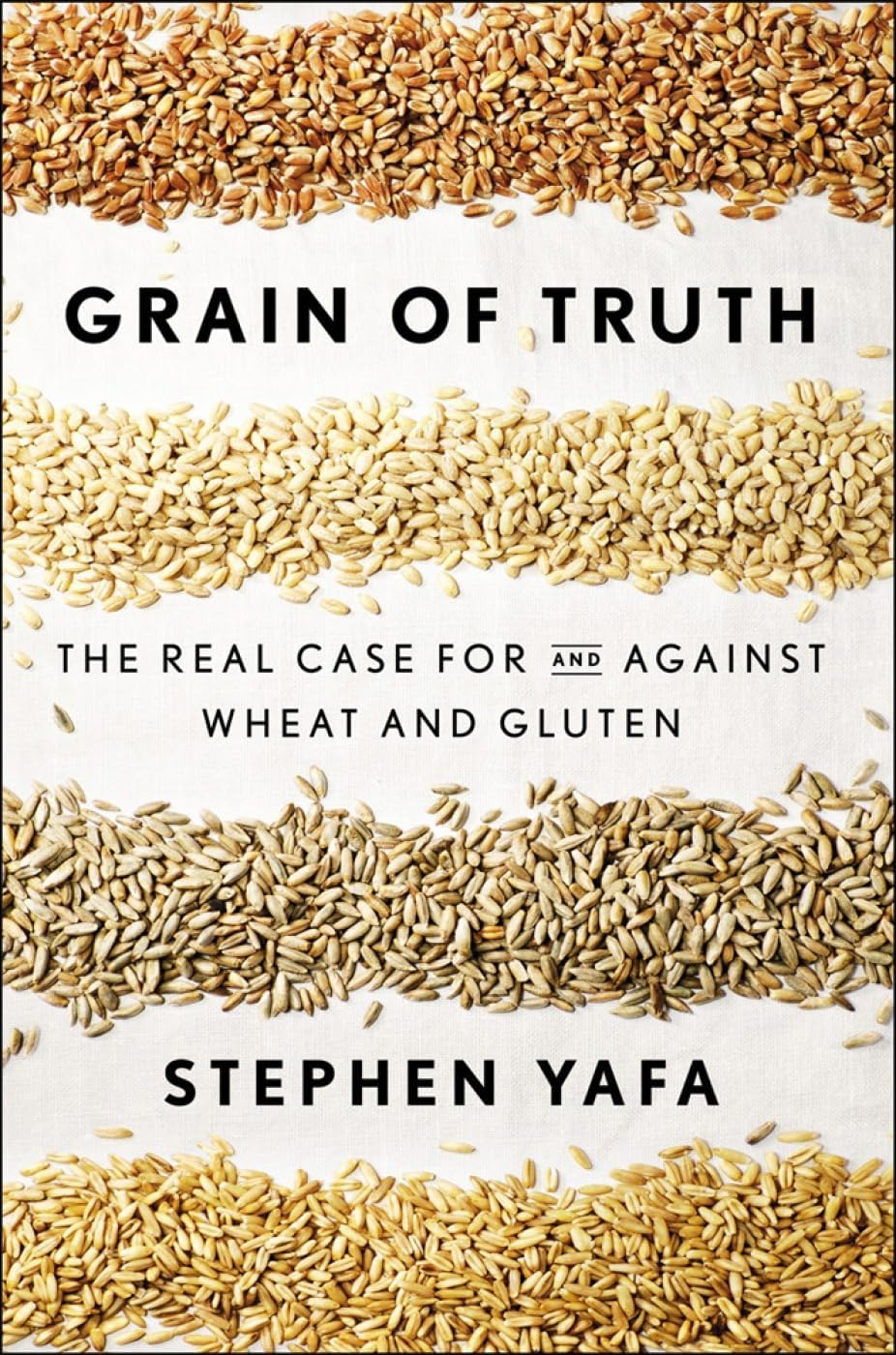
Grain of Truth: The Real Case For and Against Wheat and Gluten
Product ID: 14690348
Buy anything from 5,000+ international stores. One checkout price. No surprise fees. Join 2M+ shoppers on Desertcart.
Desertcart purchases this item on your behalf and handles shipping, customs, and support to British Virgin Islands.
A Pollan-esque look at the truth about wheat: meal or menace? No topic in nutrition is more controversial than wheat. While mega-sellers like Grain Brain and Wheat Belly suggest that wheat may be the new asbestos, Stephen Yafa finds that it has been wrongly demonized. His revealing book sets the record straight, breaking down the botany of the wheat plant we’ve hijacked for our own use, the science of nutrition and digestion, the effects of mass production on our health, and questions about gluten and fiber—all to point us toward a better, richer diet. Wheat may be the most important food in human history, reaching from ancient times to General Mills. Yafa tours commercial factories where the needs of mass production trump the primacy of nutrition, and reports on the artisan grain revolution. From a Woodstock-like Kneading Conference to nutrition labs to a boutique bakery and pasta maker’s workshop in Brooklyn, he also finds that there may in fact be a perfect source of wheat-based nutrition. Its name is sourdough. For readers of Salt Sugar Fat and The Omnivore's Dilemma , Grain of Truth smoothly blends science, history, biology, economics, and nutrition to give us back our daily bread. Review: Best book I ever read on topic of Grains / Gluten / Flour! - This is my favorite book about all-things grains. Written by an author who has a great way with words, good sense of humor, and knows his subject matter. Take away lessons about gluten and grains are memorable and important to know as you navigate your own way around bread/flour/grain options and your health! Review: Buy this book -- you won't be sorry! - If you care about the health of yourself and your family, read this book. So much misinformation about wheat and wheat products is floating around out there, and here is your chance to get it straight. Stephen Yafa has taken it upon himself to research the history and science of growing, genetically modifying, and processing of wheat over the past few hundred years or so. He gives the full picture of what has caused this once highly nourishing grain to become the nutrient-depleted carbohydrate product on our grocery shelves today.Through his interviews with scientists, he clarifies the gluten and celiac picture so you can make sense of it. Wheat is not your enemy -- the way it is processed is. Leavening of bread and bakery products plays a very large role in the total nutrition picture and Stephen covers it thoroughly -- even giving you the recipe for making your own sourdough starter and a truly wonderful loaf of bread so good you'll never want to eat that supermarket stuff again!! True WHOLE GRAIN wheat products are available out there and he tells you how to find them.
| Best Sellers Rank | #2,903,486 in Books ( See Top 100 in Books ) #131 in Wheat-Free Diet #167 in Allergies (Books) #191 in Food Allergies (Books) |
| Customer Reviews | 4.4 out of 5 stars 62 Reviews |
A**R
Best book I ever read on topic of Grains / Gluten / Flour!
This is my favorite book about all-things grains. Written by an author who has a great way with words, good sense of humor, and knows his subject matter. Take away lessons about gluten and grains are memorable and important to know as you navigate your own way around bread/flour/grain options and your health!
M**5
Buy this book -- you won't be sorry!
If you care about the health of yourself and your family, read this book. So much misinformation about wheat and wheat products is floating around out there, and here is your chance to get it straight. Stephen Yafa has taken it upon himself to research the history and science of growing, genetically modifying, and processing of wheat over the past few hundred years or so. He gives the full picture of what has caused this once highly nourishing grain to become the nutrient-depleted carbohydrate product on our grocery shelves today.Through his interviews with scientists, he clarifies the gluten and celiac picture so you can make sense of it. Wheat is not your enemy -- the way it is processed is. Leavening of bread and bakery products plays a very large role in the total nutrition picture and Stephen covers it thoroughly -- even giving you the recipe for making your own sourdough starter and a truly wonderful loaf of bread so good you'll never want to eat that supermarket stuff again!! True WHOLE GRAIN wheat products are available out there and he tells you how to find them.
C**M
Interesting facts, but a skewed viewpoint about gluten-free eating
Yada's research is extensive. I appreciate how he consulted many experts - experts on wheat production, today and historically; medical experts on celiac disease and non-celiac gluten sensitivity. The book is readable, although there is a bit of a snarky tone that I found annoying. What bothers me in this book and, frankly, in many many articles that call gluten-free eating an "expensive fad diet" is this: the writers seem to assume that most people go "gluten free" by finding gluten-free substitutes for all the unhealthy things they have stopped eating. The assumption is that people will stop eating wheat-based bread, pasta, cakes and cookies, and so forth but will instead eat gluten-free (GF) bread, pasta, cakes, and so forth. Many of these GF products are not particularly healthful (not to mention not particularly palatable, and buying these GF products (notice I don't really call it food) to the tune of $15 billion a year (or some such). However, there is a healthy way to go gluten free and plenty of people do this: The idea is to ELIMINATE gluten-rich foods from one's diet and replace them NOT with faux GF products but with whole foods that do not contain gluten. So, stop eating bread, pasta, cakes, cookies, pizza dough and eat more vegetables, fruits, nuts, non-gluten-grains (if you tolerate them), meat, fish, dairy (if you tolerate that), and so forth. It annoys me that people critiquing the gluten-free movement ignore this approach to GF living more often than not. By doing so, these critics fuel a popular disdain toward GF eaters that is unreasonable and unfair. I feel Yada has done the same thing. Still, if there are ways to incorporate a healthier wheat into the diet of non-celiacs who get sick on wheat, I'm interested.
M**R
Eye opener
This book was entertaining as well as informative. I am no expert so I cannot compare the accuracy of Yafa nor of those who are against eating gluten, but Yafa has convinced me that there is a balance and a healthy way to enjoy the staff of life, for which I am truly grateful. This guy is the real deal.
S**A
Eat Bread Again!
I LOVE this book! It is a great read through all the myths that the anti-gluten crowd has put out there, and made me love my grains and bread again! Part way through reading it a second time, and just took a break to bake a loaf of 100% whole wheat bread. Thank you so much for separating the fact from fiction in this super important nutrition topic
J**S
Thank you, I have have found my Grains Again!
Finally, an author that seeks to inform rather than persuade on how we may be duped by the latest American health obsession, gluten free everything! His clear, well researched and story telling method does just that, tell the complete compendium of how wheat, this once nutrient rich grain, our "staff of life”, has become reduced mostly a depleted and pathetic empty carbohydrate. But the story does not end there, Steve Yafa offers a factual and the Truth in counterpoint: ancient grains, artisan bakers, even his own recipe for the coveted sourdough starter and so so much more. His tales and research are extensive and provocative, well worth the read, and ever so readable!
P**N
Interesting but I got tired
The problem is very interesting ,so is the solution suggested, but it bis far too long.
J**P
Food for Thought
Who ya gonna believe? There is so much contradictory information about eating wheat right now, that it is hard to separate the wheat from the chaff, so to speak. Yafa starts out sounding like a spokesperson for the wheat industry, and someone who has had too much caffeine. I was skeptical. And I still am, but not as much. He does refute much of the popular Wheat Belly and Grain Brain claims. I was pretty skeptical about those, too. Celiac disease is very serious stuff but not common. Less serious is gluten sensitivity, and a little more common. And most common of all are the self-diagnosed gluten intolerant who seem to be the same who were hypoglycemic when that was the trend, fats-phobic or carbs-phobic when that is popular. People who jump on any bandwagon that is in the spotlight. The author does not blame wheat. He blames the way wheat has been modified to make it more of a commodity than a natural product and he blames the way it is processed and stripped of its natural goodness. The author has a sense of humor which occasionally shined through, and I appreciate that. My eyes did glaze over at some of the recitation of statistics, and there was some repetition in the book. The information on farmers growing the ancient wheat and the variety of wheat and wheat products once you get past the big grain conglomerates was eye-opening. Unfortunately, most of us cannot afford those products easily. The long-fermenting sourdough was interesting, too, but most people are not going to wait days for their dough to be ready to bake. His advice is good, but the solution is not an easy one. So what is the solution for most of us if we can't buy specialty wheat and make our own bread? I still don't know. While I think the author is less biased than I thought at the beginning of the book, while he does not support the big boy- and girl-conglomerates, I do wish he right out assured me he is not financially associated with the wheat industry. I need that credibility factor. There are appendices that offer information about making your own sourdough bread and offer sources for grain and flour, and that is very helpful. As a nit that amused me, the author should know that the phrase is "pedal to the metal," not "petal to the metal." I'm going to continue to eat wheat. As a vegetarian, I often eat seitan, a product that is essentially all wheat gluten, as well as other wheat products, and they cause me no problems. However, aside form the seitan, most of the wheat I use is whole grain, as flawed as the products themselves may be. While I don't take the book as gospel, I did find it interesting and informative, certainly food for thought. 3.5 out of 5 stars. I was given an advance reader's copy of this book for review.
Trustpilot
5 days ago
3 days ago