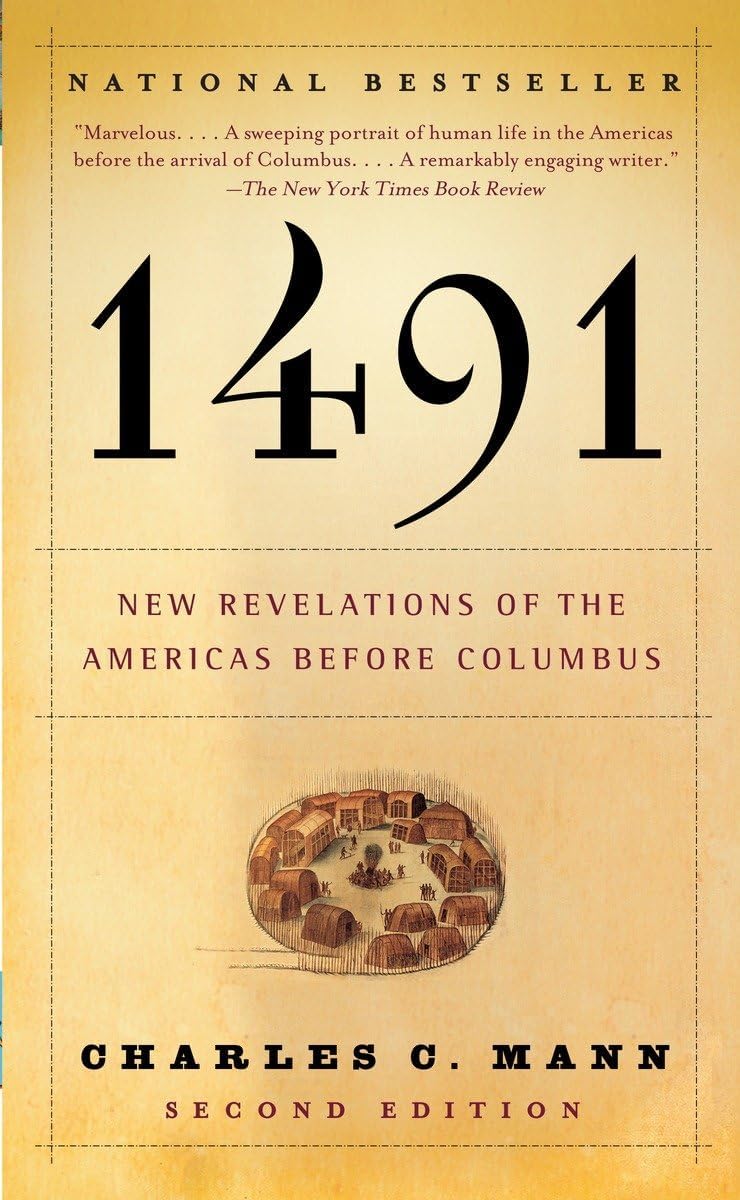
1491: New Revelations of the Americas Before Columbus
Product ID: 1274239
Buy anything from 5,000+ international stores. One checkout price. No surprise fees. Join 2M+ shoppers on Desertcart.
Desertcart purchases this item on your behalf and handles shipping, customs, and support to British Virgin Islands.
NATIONAL BESTSELLER • A groundbreaking work of science, history, and archaeology that radically alters our understanding of the Americas before the arrival of Columbus in 1492—from “a remarkably engaging writer” ( The New York Times Book Review). Contrary to what so many Americans learn in school, the pre-Columbian Indians were not sparsely settled in a pristine wilderness; rather, there were huge numbers of Indians who actively molded and influenced the land around them. The astonishing Aztec capital of Tenochtitlan had running water and immaculately clean streets, and was larger than any contemporary European city. Mexican cultures created corn in a specialized breeding process that it has been called man’s first feat of genetic engineering. Indeed, Indians were not living lightly on the land but were landscaping and manipulating their world in ways that we are only now beginning to understand. Challenging and surprising, this a transformative new look at a rich and fascinating world we only thought we knew.

| Dimensions | 5.2 x 1.15 x 7.98 inches |
| Edition | First Edition |
| Isbn 10 | 1400032059 |
| Isbn 13 | 978-1400032051 |
| Item Weight | 2.31 pounds |
| Language | English |
| Print Length | 541 pages |
| Publication Date | October 10, 2006 |
| Publisher | Vintage |
User
A Scientific Humanist review of Charles Mann's 1491
Highlights of the dark ages were the Spanish Arabs and the Byzantine. A people that were partly protected from the Germanic barbarians of the dark ages by the Byzantines was the Venitians. They'd go on to dominate the second half of the dark ages(from 1000 A.d to about 1500 A.D. Part of what happened was the Byzantine's were overrun by the Turks in the mid 1400s. Now, if you wanted to get silk and spices from the mysterious east, you needed to pay crazy amount of money or find another way. The Europeans found another way. - find the Aristotle quote and note it here - I think I've noted it in my finite and infinite write up.I've put up pictures of the Haglia Sophia before, but why not show it again?I'll just say watch John Romer's Testament episode 6 I do believe for good video of the inside and outside of the Haglia Sophia. He goes straight up the outside doors and knocks on them . . . and opens them up! It's like something out of the 'Lord of the Rings"!How about a Venice picture,When the Portuguese, Spanish, English and French went west, they found a world of riches. This wealth essentially made Venice a relic of the past. A measure of the fame and former power of the Venicians was when Gasper Corte-Real found Venician swords and jewelry on some of the Natives that he captured! This was in 1501, just a few years after Chritopher Columbuses successful voyages.Lots of things happened, lots of discoveries at this time of course. Even my writeup about rivers throughout human history doesn't cover it all! That kind of covers a good amount of the great voyages that happened back then. I can't help noting Tisquantum, Samoset and Massasoit. These three met what were called the Pilgrims around 1600 A.D.(a hundred years after lots of Spanish and Portuguese exploration had already been done). The Pilgrims first went to Denmark. But they left there because those people were too free thinking for their taste. So, they packed their bags and went all the way across the ocean to practice their Puritan religion. Their descendents went through the Salem witch trials.Tisquantum led a remarkable life. Tisquantum met other explorers after the Puritans. A Thomas Hunt captured him. Thomas Hunt was a kind of lieutenant of a John Smith, of Pocahontus fame. Thomas Hunt took Tisquantum all the way to Europe and back where he died of plague from the Europeans.As it turns out, plagues brought by the Europeans seem to be the major culprit for how the Europeans conquered the Americas comparatively easily. One recent remarkable revelation about this is the Native American's lack of immune system may be due to a cometary Impact tens of thousands of years ago. The impact removed lots of animals that would have carried and spread viruses.One remarkable story of some of the great Native American empires conquered supposedly by one man army Europeans was a Spaniard Francisco Pizarro. Pizarro reportedly conquered the Inca around 1533 A.D. Maybe he did; but, he conquered a substantially weakened Inca empire. Pizarro was killed in a political assassination and power struggle. But, natives buried his remains in a Roman Catholic church that still stands to this day.Here's the outside of the Cathedral of LimaToday, the scientific exploration of both the great European discoveries of the America and who and how the Native Americans got there is a rapidly shifting field. There's no firm conclusions to be drawn. Everyone has a theory . . . Asians, ten lost tribes of Israel(which helped found the Christian sect of Mormons; it's in their book of Mormon), Egyptians, the people from the lost city of Atlantis. One remarkable possibility though has been the boat conjecture.For the longest time, people assumed the Native Americans came across the Bering straight into North America. But, people argue that some of the 30,000 year old finds in South America suggest those people could not have gotten through all that wilderness in so fast a time. How could they have done it? The remarkable revelation here is by boat! Recently, I've posted about the remarkable Indonisian cave paintings to like 40,000 years ago. People would have had to boat from Asia to Indonesia, and as everyone knows, the Australians also would have had to boat to get there as well! So, the boat suggestion has plausibility, and in my opinion is a great revelation of contempory scientific understanding of Human history and of how Native Americans got to the Americas.Remarkably, when the Europeans found the Americas, it didn't dawn on them that this was a challenge to their religion. Does the bible mention anything about the Americas and Native Americans? That they know nothing of their religion. If they knew nothing of Christianity, wouldn't that suggest something to the Europeans? It never dawned on 99.99 percent of them. They just went about trying to convert them. The technologies and science that are similar and dissimilar to one another are some of the real revelations of the discovery of the Americas(the fact that Jesus Christ was not known to the Native Americans should have been, but anyways).Ecologists have argued that ecological diversity was of major importance of the founding of civilization. They argue that Mesopotamia was an ecologicaly diverse area. As Jared Diamond(through Charles Mann's "1491") says, "a wide ranger of altitudes and topographies within a short distance". The fertile crescent has mountains in Iran and the Dead Sea, and the lowest places on the Earth bracket the Tigris and Euphrates rivers. Another place is Peru, where going from mountain to sea has 20 of the the worlds 34 major types of environment. Down there arose a variety of cultures. They ultimately led to the Inca. Another interesting diverse area was Oaxica a little bit higher in contemporary Mexico. This area originated Maize, or corn.The area had a diversity of people who grew Maize in a great variety of colors.Maize appears to have been a genetic engineering effort of the peoples of the Oaxica. Today's scientific thinkers would initially recoil from such an idea. They'd note that Gregory Mendel in the mid 1800s came up with the idea of genetics. But, if you learn about what he did, you might think, hey? This is a simple experiment he did; why could't some cultures thousands of years ago have done such simple things? Well yea. This is kind of like why didn't Archimedes think of the place value system for numbers? Why didn't the Greeks think to apply their deductive logic to numbers and algebra like they did to Geometry? This really comes to show that the cultural upbringing of a person influences what he innovates, and that every theorem is a precious thing because people innovate based on what's in their heads at a given time. It also suggests that taking the general viewpoint, philosophicaly/spiritiually is valuable for figuring out nature(everything in it, including humanity). I've struggled to say this in this blog! So, the discovery of Maize in the America was a great discovery. It spread all up and down North and South America. All Native Americans cherished Maize. They made their religion say they were made from Maize. One of the most mysterious Native American cultures were the Olmecs. They arose shortly after Maize was created.The earliest we know of them so far is that of 1800 B.C. Within three centuries, San Lorenzo was built. San Lorenzo was destroyed around 1200 B.C. which is why all those gigantic heads are found dispersed all over the place. That's how far back in time those gigantic heads go! A La Venta and the last of the Olmecs was destroyed around 350 B.C. I'm not going to speculate too much on why the Olmecs fell. I've mentioned the reason those great heads are dispersed. Seeing those heads and realizing how far back they date is enough to suggest how great of a civilization they were. Charles Mann, in his 1491, says they figured out Venus and retrograde motion. I'm not sure how they know that.Everyone knows the great architecture of the Aztecs, Maya, and Inca. I don't want to dwell on that. The Inca had another most remarkable science/technology in their language. It consisted of ropes and knots in them. In fact, it was a binary number language. I had suggested early on in this blog that maybe language gets its ability to swap words around by mathematics. That mathematics came first before natural language. I later tried to laugh it off; but, remarkably, the recent scientific studies of Native Americans history shows the Inca language was mathematical! Unfortunately, they were a comparative late and fleeting(two hundred years) culture. Still, it's a tantalizing piece of empirical evidence.Another remarkable science/technology of the Native Americans was the use of fire. An ecological understanding of plants shows there's what's called 'succession plants.' Because of natural disasters, there's plants that have evolved to go into destroyed ecosystems to prepare the way for later plants to get the ecosystem going again. If there were no disasters, these plants would go extinct. Native Americans, and in particular the South American rain forest cultures(including the Maya), found that the use of fire allowed them to take advantage of this succession plants and shape the Rain forests . . . ! Instead of domesticating animals, they influenced where animals would go by the use of fire to shape ecosystems. This was done in the North Americas. In the South Americas, the use of fire was used to influence which fruiting plants they wanted to grow naturally. This is one major example of the great things we can learn about changing cultural lifestyles to be more ecologically friendly.Another remarkable technology that still hasn't been taken advantage of much is tension architecture. Much is made of how the Native Americans never innovated the wheel. This is kind of an example of what people innovate depends on their cultureal upbringing. But, this is more geological influence. The Native Americans knew about circles and wheels, but their environment generally had no practial use for it. The science/technologies innovated by the New and Old world wasn't because one was dumber than the other.In the old world(Europe, Africa and the Orient), the major architectural innovation was the arch.This Roman aqueduct is in SpainThe arch and even the post/lintel are compression archtecture based. There's some small examples of arches in Maya temples, but they were not extensive; you'd have to look hard to find the small examples. What the Native Americans appear to have innovated was tension technologies. I don't know of any extant example of this. They used rope and cotton to make their boats and houses and bridges and so on. But, this made me pull out an old Scientific American and finally read an article I always meant to read! It was the January 1998 issue, and Tensigrity was the cover page article.I don't want to get into all the biological insights that tensigrity reveals; just the definitions. Tensigrity has both tensional and compressional elements. Only the stress parts are separated from the compression components. The compression and tensional members are like dual to one another, the compressional members are compressed by the tensional members, and tensional members are pulled by the compressional members. So, if an elements is taken out, all structural members, whether compression or tensional take up the forces that former member once held. All the members feel all the forces all the others feel. All the forces are balanced out. I'm thinking this can be a new way of understanding self-organisation in both natural and technologies. How does something self-assemble when a member is taken out?I start out my write up with examples of Tensigrity pictures . . . !I end this with a great Native American quote!"He goes his way singing, offering flowers.And his words rain downLike jade and quetzal plumes.Is this what pleases the Giver of Life?Is that the only truth on earth?" - Ayocuan CuetzpaltzinThe Native Americans struggled with the same problems Plato did in understanding truth in a changing world. This piece of Native American poetry broke the philosphical problem. One can't understand it without knowing the cultural meaning of the words.Flowers and song meant poetry, the highest art. 'jade and quetzal feathers' meant 'gold and silver.' The song of the bird stood for aesthetic inspiration. The poetry suggests there's a time when mankind can touch truth of our fleeting lives; that time is the moment of creation. Here artistic creation.Right when Native Americans made this cultural breakthrough to valueing intellectual persuits, Christopher Columbus succeeded in finding lands west of the old world. This launched a rush of exploration from the Europeans. By historical accident, plagues affected them more than the Europeans. Well, there's still indians here.One Native American architecture Charles Mann fails to mention in his 1491 book is a Native American Stonehenge and the Anasazi of the Arizona, New Mexico . . . Chico Canyon in general.
User
Interesting on multiple levels
I came upon this book by accident, and it turned out to be one of the greats.First, this is packed with interesting history about events on the American continent prior to the arrival of Columbus (with some attention to the years soon after). I thought I had done pretty well keeping up with history, but who knew? A lot more civilizations rose and fell than I had ever heard of, and for those who like to think about the "normal" arc of a civilization, there's a lot here to think about.Second, while being enlightening as to human history, there's also a lot of insight about nature -- some of it extremely interesting to me. Put succinctly, the untapped wilderness that preceded European interference... turns out to be a misleading half truth. Very interesting information about both North and South America in this regard.Third, I found the book interesting in the light it shed on the way the commonly accepted history has been warped both by those with a conservative and those with liberal agendas.Finally, I admire the realistic account of the academic wars that occurred along the way to figuring out the facts, to the extent to which they are now known. I suppose that pro and anti science ideologues will read this differently and emphasize opposite aspects of the story, but a fair reader will come away with a three dimensional picture of how scientific disputes play out.Not really a light read, but not terribly difficult, either. It does not read as a continuous narrative though, it discusses different areas and topics separately rather than making for one long "story of what happened on the continent."
User
An eyeopener about Pre-Columbus American Indians!
Charles C. Mann’s book, 1491, provides us with an eye opener about the pre-Columbus populations of the North and South America. It is not an easy read: it is very detailed and well researched with references to critical scientific studies. It is not a chronological or systematic account, and this makes the book somewhat disjointed. Mann’s main intents were to examine Indian demography, Indian origins and Indian ecology.In my opinion, he is not successful in the first objective of describing Indian demography. However, I doubt there are enough research available to tackle this objective. They may never be enough research as there were multiple occupations of land by unknown populations throughout the period from the first arrivals of the peoples loosely described as Indians to the present day. Also, the populations were dynamic, growing and shrinking depending on the social and natural environments of various groups of Indians. The task may just be too difficult to build a record of Indian populations prior to the arrival of Christopher Columbus. Mann has tried to report the research faithfully but the Indian populations of Western United States and that of Argentina in my opinion, not well researched, and thus understated in this book. It is also possible that populations reported are also understated.Mann has been more successful in the second two objectives and particularly the third. I think the overriding theme of this book is that pre-Columbian inhabitants of the Americas shaped their environment to fit their needs, no more than we do today and certainly, no less. Where we think that that current forests are wild and untouched by man, in fact, they are the results of previous inhabitation of the lands. There is no more a representation of this than the forests in the vicinity of the Amazon River. However, after the demise of the inhabiting culture, what remains is an overgrowth of plant and animal life. And this is true in North and Central America as well! It can be said definitively based on research that the Indian populations did not live lightly on the land.I found the book at the first reading contradictory of what I had been taught of American Indians after growing up in Montana and having lived with Yupik Eskimos (technically, Eskimos are not Indians,) in Western Alaska. In the first Chapter, Mann indicates that I would have this experience. But I find the research he quotes valid and confirmatory of his arguments. In addition, he often provides alternative arguments. Mann is not the author of this research, but the reporter of the research.Before reading and finishing the book, I did not read reviews of it. Thus, as I read it, I was amazed at the information and oftentimes, skeptical. However, I read several of the research reports referenced. Then, on finishing the book, I read several reviews both positive and critical. The book is widely acclaimed. The critical reviews stem mainly from people who found the book too detailed for their tastes and too difficult to read. One of the critical reviews was from an interpreter of the Cahokia site in Illinois who questions Mann’s statements which originated from Professor Woods. However, this same interpreter does not provide alternative research to support his claims.There probably is nothing more understood in the United States, and perhaps the World, than the pre-Columbus North and South American cultures. There are many reasons for this.First and foremost, Columbus in his search for Asia did not know the Americas nor had he ever been to the coastlines of Asia. Therefore, on reaching America, he thought he had reached Asia and thought the peoples he witnessed where of India. Thus, he named them “Indians” and the name, despite the confusion, has remained to this day and is a global term for all of the pre-Columbus inhabitants even though there are major distinctions in their cultures and genetics. While a number of the various tribes and nations object to the use of the word “Indian,” no better term has emerged that all will accept. For a discussion of this, see Appendix A of 1491.Second, most of the pre-Columbus inhabitants of the Americas either did not have writing or not a form of writing recognized by the European explorers and invaders. The result was that much of the written information of the pre-Columbus inhabitants had been lost either through decay of whatever records there were or through the willful destruction of the records by the invaders. Where there were no known records, Europeans interested in pre-Columbus cultures had to rely on the inhabitants themselves who were often recent transplants to the regions.Third, the pre-Columbus population of the Americas has been estimated from the finds of various archeological sites to be as high as 125 million people. Yet when early European scholars arrived to study and record Indian cultures, they found only remnants of the populations. It is accepted that European diseases such as small pox, influenza, and others, killed the vast majority of the populations that existed and that this happened in a very short time after the arrival of the first Europeans. For example, De Soto records thousands of people living in current day Arkansas. When La Salle visited this area a century later, he could find almost no traces of man. The estimates that Charles Mann seems to believe that the population loss was 95%! While this is arguable, it is also creditable based on eye witness accounts of the effects of small pox on various indigenous peoples. Thus, many Europeans recorded for history the shell-shocked left overs of populations essentially no longer functional.For these reasons, the attempt to build a history of pre-Columbus cultures will be problematic. Also, the popular cultures we have today in the United States have built up fantasies around the Indian cultures which are also promulgated in our school systems. These have influenced past researchers trying to understand Indian cultures. And they made, now known, mistakes in their assumptions and conclusions. As Mann clearly shows, the research today using more modern techniques is building a much different picture. The archeology of the Americas shows that we need to question almost everything that we have been taught.It is taught that the Indians cross the land bridge at Beringia during the last ice age (13,000 years ago,) and then descended South using a narrow strip of land near the current Continental Divide which did not ice over some 12, 000 years ago. Then it would take another 1000 years to enter and populate South America. Yet, the evidence suggests something different also happened. The ice-free path proposed has yet to yield artifacts that would support such a theory. It is possible that perhaps the path was the Western seaboard of North America, though. The genetics of certain Indians in Amazonia are distinct from those of North America. An archaeological dig in Southern Chiles found human artifacts that predated the supposed Beringia crossing. There is evidence of culture at Painted Rock Cave near Santarem on the Amazon River that is contemporary with the Clovis culture which is the earliest found in North America. Thus, while Beringia may be part of the story, it not all of the story on how the Americas were populated. More research is still needed here.Another major point assumed was that the Indian cultures did not have the sophistication of European cultures in pre-Columbus societies. Research finds that the Olmec, who were inhabitants of Mexico approximately 1800 B.C., were using the number zero in its mathematical form well before it was invented in India a few centuries A.D. They created a 365-day calendar more accurate than the calendars in use in Europe. In addition, they were recording the Olmec history on folded books of bark paper, now called codices. Many of these were destroyed by the Spanish when they were found, so only a few remain extant. It can be said their cultures were different than those of the European but no less complex.Overall, this book while not easy to read, if a very worthwhile read. I feel this is a work in progress: new research will emerge on the Indian populations of the Americas. Mann has provided a current state of the art understanding of Indian cultures in the Americas based on known and referenced research. It is clear that what schools are teaching about Indian populations needs to change and acknowledge the results of this research.
User
Great stories, great research, and a good treatment of the topic
I'll be the first to admit that my interests in the historical have generally been Eurocentric, especially the Roman Republic and Empire. Recently, though, I found reason to pick up Charles C. Mann's "1491," and I have had a hard time putting it down since.The children's nursery rhyme reminds us that "In 1492, Columbus sailed the ocean blue." Just this last week we've celebrated Thanksgiving and the mythologized first meal shared by "Pilgrims" and Native Americans in the early years of Captain John Smith's Plymouth Colony in the 1620s. But what came before Europeans in the "New World" of North and South America? What was already here when they arrived? Was there much more than a few human sacrificing Aztecs (in South and Central America) andnomadic tribes in North America?Quite the contrary, says Mann. Rather, he says, the land was full of people, developed into complex cultures and polities. For example, and he expands on many, the Maya controlled an empire that was larger than any in the old world, both in size and population. The Mexica (pronounced Meh-shi-ka) had a literary culture full of metaphor and simile, and a rhetorical tradition that enabled them to meet Franciscan friars sent to convert them on equal ground. In North America, as far as the shores of New England, the coast was full hundreds of thousands of Native Americans-the nations of the Micmac, Passamoquoddy, Abenaki, Mahican, and the Massachusett, among others.Indeed, there were so many people in both North and South America that Mann wonders if settlement by European colonists would have been possible but for the effects of disease on the native population. So devastating were diseases such as small pox, influenza, and non-sexually transmitted hepatitis that civilizations such as the Maya may have been destroyed before Europeans even landed on the shores of South America. Similarly, the nations of New England, which had filled the land and had traded with early French and English merchants during the 16th century, almost disappeared over a period as short as two to five years.Why was disease so devastating? While not the central focus of the book, or even the examination of "what was here before 1492," Mann explains how the relatively limited genetic stock of Native Americans presented insufficient diversity for the native populations to survive the diseases that had been active in Europe and Africa for thousands of years. Native Americans were in no way inferior-they just came from fewer people and thus had less genetic diversity, had never faced diseases as the Europeans (and their pigs) carried and therefore fewer of them survived the introduction of the diseases to the American peoples. The result was that within a few years, entire nations and their cultures all but vanished from the Earth...leaving the appearance of a empty land with only a few roving tribes. Indeed, says Mann, the reason those tribes were roving may be because they had been cut down from populations levels necessary to support a stable and stationary settlement.Among some of the other interesting tales and studies that Mann shares in his book is the story of Tisquantum, who we know as Squanto. His name, which he may have given himself, meant something along the lines of "wrath of God," and Mann suggests that when he appeared in the Plymouth Colony, his intentions may not have been as benign as have been told to us in elementary school pageants. Born an original New Englander, he was kidnapped by Europeans as a souvenir and taken to Spain. Eventually, he ended up in England in the home of a rich merchant, again as an oddity to show to visitors. Learning English, he eventually convinced the merchant to send him back to America. However, in the time between his kidnapping and return, hepatitis ran rampant through his and the other nations living in what is not modern-day Massachusetts, New Hampshire, and Maine, wiping out his people and others. He returned to an empty land and was captured by a rival nation, who later used him and his ability to speak English to liaison with the Plymouth Colony. He, in return, may have tried to use the colonists as leverage to take over the rival nation.1491 is a fascinating book, and a fascinating piece of history, covering a period of history that we may have spent less time examining than is merited given the size and scope of the civilizations that preceded European colonization of the Americas. Containing cities that dwarfed Rome in its greatest day and Paris and London at the time, the Americas in 1491 were, by Mann's telling, a busy, populated and colorful place, and it deserves a place in our histories and archives alongside those of the other great civilizations of history.
User
A stunning synthesis of modern research
The book 1491, written by Charles Mann as a synthesis of the last 50 years of scholarship dealing with the populations of the Americas, is a book which should be read by students of both world history and American history. The very core of the book is a refutation, using modern archeological, anthropological, and other methods, of what the author refers to as "Holmberg's Mistake, "the supposition that Native Americans lived in an eternal, unhistoried state". It is this interdisciplinary approach to the subject matter, and the fact Mann is not trained in the fields which are being taken to task by his book, which makes his work so invaluable. Charles Mann takes on the established view of life in the Americas prior to 1492 and shows that, rather than a pristine wilderness similar to the garden of Eden, the Americas were, in fact, much more dynamic. "It was, in the current view, a thriving, stunningly diverse place, a tumult of languages, trade, and culture, a region where tens of millions of people loved and hated and worshipped as people do everywhere." Mann takes on the idea of the Indians as having lived in a "garden of Eden" and turns it on its' head.The best example of Mann's willingness to take on the conventional wisdom is his discussion of the size of the population inhabiting the Americas in 1491. As Betty Meggers of the Smithsonian Institute said, "I have seen no evidence that large numbers of people ever lived in the Beni," and she goes on to claim that thinking otherwise is wishful thinking. This quote exemplifies the difficulty the author has in overturning the conventional wisdom. This quote is troublesome on several levels, not the least of which is the improbability of Ms. Meggers having seen all evidence there is to see on this topic (as well as the fact she has a vested interest in promoting the status quo). Rather than engage with the evidence presented Meggers seems to be all to willing to simply dismiss it out of hand. Equally important is Mann's takes Meggers head on when he accuses her of possibly keeping new ideas about the history of Amazonia from the public. However, Mann does not take on Meggers alone. His greatest achievement is his ability to not personalize the dispute and his use of experts such as William Woods and Anna Roosevelt to counter mainstream claims (such as those expounded by Meggers).The problem with a book of this nature is one of its strengths, the fact it is not written by a specialist in the field(s) in question. While Mann does an excellent job of arguing his points and not making his attacks personal, one does wonder how the vested professional interests will react to his synthesis and his conclusions over the long term. Will we see a change in the way this subject matter is taught? Will professionals like Meggers continue to hold out or will they come around and help to form a new consensus? Only time will tell, but it appears those who argue for smaller numbers of Indians in North America prior to 1492 are loosing out as DNA evidence, computers and other modern techniques allow us to paint a more accurate picture of life in North America prior to the conquest.The obvious question is, what now? As the technology continues to increase and we continue to revise our thoughts on the past, will history books begin to present the new material, and will it do so in a skeptical way, or will this new material be discarded as irrelevant (or worse)? For a survey class such as ours, the implication is this is something which should be taught over a number of class periods in a freshman survey course, rather than simply mentioned for a few minutes during one day at the start of the semester (which it often is, if it is mentioned at all). Rather than treating history of the United States as starting with the English colonists, or with the discovery of the "New World" by the Europeans, it is apparent we should start with the people who lived here first. After all, they were living in this hemisphere for centuries, and as Mann points out the Haudenosaunee had the second oldest continuously existing parliament on earth.
User
A revolutionary new look at the history of the Americas and the American Indians
This is an outstanding book, and probably one of the most eye-opening books I have read in a long, long time.It is not an exaggeration to say that, having been indoctrinated in school with the standard history of the American Indians, reading this book was like discovering an alternative universe, one where nearly EVERYTHING I had learned before was either wrong or completely twisted around.The real history of Thanksgiving presented in this book is but one example. I remember first learning about the traditional version of Thanksgiving in fourth grade, and thinking that there was something odd about the whole story. Why had the Indians, who could have snuffed out or driven away the Pilgrims, not done so? We had learned about other failed colonies and many conflicts between the Indians and white invaders - the Lost Colony of Roanoke and Jamestown, for example. It was clear that by helping the Pilgrim colony to succeed, the Indians were allowing competitors in and planting the seeds for the destruction of their own world. Few vigorous and thriving human cultures would have failed to forsee that possibility. Why had these Indians reached out to help the Pilgrims?"1491" details the real truth behind the story of "Squanto" and the Pilgrims, and how the First Thanksgiving dinner came about. It turns the celebration of Thanksgiving on its head, from a time of thanks to God for saving the Pilgrims to realizing that the Pilgrims had in fact accidentally landed in the midst of an Indian holocaust, a part of Massachusetts recently depopulated of its original Indian inhabitants by accidental germ warfare brought in by earlier European contacts. Even the food that kept the Pilgrims alive in their first harsh winter came from the recently dead Indian villagers, stored in the ground and still edible.This book explains the reasons for the success of the Spanish conquistadors, how disease both paved the way for the Europeans to take over America and made necessary the importation of African slaves to provide cheap labor. It explains the massive herds of buffalo and giant flocks of passenger pigeons (a response to the sudden collapse of the thriving Indian population in North America, who had been hunting both species). It explains the mysterious Amazon, which has large swaths of fertile soil filled with charcoal and broken pottery. It explains how Indian maize came to be and how corn and other foods developed by the Indians came to feed the entire world. It explains how the principles of individual freedom and disdain for rigid hierarchies were learned by the American colonists from the Indians; these values continue to set American society apart from the rest of the world even today.It is, in summary, nothing short of a revolutionary new look at the pre-Columbian history of the Americas and the American Indians. The Indians were an immensely thriving human culture that filled all of the Americas and changed its landscape and lifeforms, and then were nearly wiped out in a few short years by European diseases. We are still trying to piece together the details of their world.This book should be standard reading for advanced high school and college level courses on American and World History. It's high time that our schools stopped teaching the wrong history of our continent
User
Observations about Cahokia
I have been a volunteer at Cahokia Mounds for about three years, leading guided tours of the Historic site. I have read extensively about Cahokia's history, attended a few conferences and had access to several of the principal archeologists at the site. I consider myself fairly well informed.Several visitors at Cahokia, and a few of my friends, recommended that I read 1491: New Revelations of the Americas Before Columbus, written in 2005, by Charles C. Mann.Mr. Mann relies heavily on the work of Dr William I. Woods, a geography professor at University of Kansas. I have found a book Envisioning Cahokia: a Landscape Perspective, co-authored by Dr. Woods. Not an easy read, but I am currently tackling it to see if I can learn more.I have recently finished 1491 (Vintage Books, second edition, July 2011) and I have a few observations. Some of the things the author states as "facts" about Cahokia are speculation. Some of the things he says are clearly incorrect.This makes me question the rest of the book.The best known landmark at Cahokia is Monks Mound. Standing 100 feet high, with four terraces and a base of 14 acres, Monks Mound is the largest earthen structure in the Americas.Mr. Mann tells us that "the elite revamped Monks Mound. By extending a low platform from one side, they created a stage for priests to perform ceremonies in full view of the public." (pg303)The first terrace of Monks Mound is a late addition and it very well may have been used as a stage to address large gatherings in the forty acre Grand Plaza. I mention this in my tours, but point out that it is speculation. Beyond the apparent acoustics in the Grand Plaza (some archeologist have noted that, in the early mornings, it is sometimes possible to clearly hear the voices of people ascending the mound) there isn't a whole lot of evidence to support the theory.The author tells us that one of the contributing factors to the demise of Cahokia was the diversion of Cahokia Creek. This provided additional water to the city and allowed logs to be floated downstream, but also caused flooding which destroyed the maize crop. This may well be true, but I have found no other sources that mention this diversion of Cahokia Creek. Most accounts of Cahokia's demise cite an extended drought and, perhaps, a shortened growing season.Mound 72, in my opinion, is the most interesting mound at Cahokia. Excavations in the late 1960s by Dr. Melvin Fowler revealed about 300 burials. The most spectacular was "the beaded burial" an early chief buried on a falcon shaped blanket of 20,000 sea shell beads from the gulf of Mexico. Archeologists estimate that 60% of the burials at mound 72 were ritual killings.Speaking of these Mr. Mann says "Among them were fifty young women who had been buried alive." (pg 298)He may be confusing two or more separate burials.There were about 100 young women who were likely garroted before their bodies were laid out in trenches in neat rows. I am not aware of any evidence that these victims were buried alive.On another occasion, 50 individuals, men and women, were executed, mainly clubbed to death, and haphazardly thrown into a pit. There is evidence that some of these people were still alive when the pit was filled.Sometime around 1150, the people at Cahokia constructed a palisade. Clearly a defensive structure, we do not know who the two mile long fence was intended to keep out.Mr. Mann tells us that the palisade "was also intended to welcome the citizenry - anyone could freely pass through its dozen or so wide gates." (pg 303)Actually, the "gates" into the palisade were narrow, L shaped entryways, situated between bastions, where archers easily could hold off unwanted intruders.We are told "A catastrophic earthquake razed Cahokia in the beginning of the thirteenth century, knocking down the entire western side of Monks Mound." (pg 303)I have a couple of problems with this statement.The first relates to the second terrace of Monks Mound. The official literature at the Interpretative Center states that Monks Mound had four terraces. Some researchers, including Dr. Woods believes that what we now call the second terrace was the result of a massive slumpage along the western side of the mound. They may be correct, but this is still open to debate.If Dr. Woods is correct, might the second terrace of Monks Mound be the result of an earthquake? Perhaps.In 1811/1812, quakes along the New Madrid fault in southern Missouri caused the Mississippi River to run backwards and rang church bells in New York and Boston. Archeologists do speculate whether earthquakes had anything to do with the abandonment of Cahokia. The problem has to do with timing.This summer I attended a Mississippian conference at Cahokia. One of the presentations dealt with this topic. There is evidence that there was a major quake along the New Madrid fault around 1450. Unfortunately this is at least 200 years too late to fit into Mr. Mann's narrative."The Cahokia earthquake .. must have splintered many of the city's wood-and plaster buildings; fallen torches and scattered cooking fires would have ignited the debris, burning down most surviving structures. Water from the rivers, shaken by the quake, would have sloshed into the land in a mini-tsunami. ... Meanwhile the social unrest turned violent; many houses went up in flames. There was civil war, ... fighting in the streets. The whole polity turned in on itself and tore itself apart." (pg 304)If this scenario played out, one would expect ample archeological evidence. If it exists, I have missed it.Finally, there are two statements in 1491 I find particularly strange."Monks Mound opens into a plaza a thousand feet long. In it southwest corner is a pair of mounds, one conical, one square. One day I climbed up their grassy sides at sunset." (pg 289)You are not allowed to climb on any of the mounds except Monks Mound. There are signs posted throughout the site. Perhaps the author had special."A friend and I first visited Cahokia in 2002 ... The site is now a state park with a small museum." (pg 302)Has Mr. Mann ever actually been to Cahokia? The Historic Site ceased being a state park in 1977. The "small museum" was replaced in 1989 by a 33,000 ft interpretative center that receives hundreds of thousands of visitors each year.
User
Ill be reading this many times over!!
1491: New Revelations of the Americas Before Columbus is a breathtaking paradigm shift. Charles C. Mann doesn't just recount the history of the Aztecs and Incas; he unveils a forgotten hemisphere teeming with countless sophisticated civilizations. This book introduced me to the mound-builders of Cahokia, the ingenious terra preta farmers of the Amazon, the complex societies of the Mississippian and Pueblo peoples. It masterfully synthesizes decades of cutting-edge archaeology, genetics, and climatology to argue that the Americas were not a pristine wilderness, but a profoundly shaped and managed landscape, home to tens of millions more people than we were ever taught. It satisfied my deepest curiosity about the "before" and left me in awe of the ongoing research that continues to rewrite our understanding of human history.
User
Buen artículo
Muy buen libro y el paquete llegó en tiempo y buenas condiciones
User
Great read
Well researched, insightful at all times
User
Interesting
Very interesting history of Native Americans and Inka Empire.
User
A haunting, resonant reminder of a tremendous lost society
As someone who enjoys sociology and the various human myths across history, I couldn't put it down. Granted, this was very much my first foray into South American History. I'm not a scholar, and you'll find my review doesn't delve into the nuts and bolts; even though the nuts and bolts are the driving force of the book. As he reveals the various landscapes with highly technical detail; the historical landscapes, the social landscapes, the physical landscapes; the details are merely the pixels to the larger picture.As the author sprinkles stories of massively complex societies across the continent like seeds, the whole lost world seems to be called back from the dead and come alive. The cultures that were (masterfully) revealed were so completely different and yet they worked, and impressively so! Huge, intricate societies were founded on such radically different ideas that it almost seems impossible. They could never work today. Magic. And yet no one seems to know about this lost world. Far from being popular culture, it's like a huge swath of the world's culture was wiped clean off the map in 1492 and no one has since looked back. That's how the book sinks it's teeth into you, you feel privileged to be able to read the stories. And even just how some of the research was salvaged through long winding adventures is in itself compelling enough.These people and their myths were so beautiful, original, radical and different, so strong, ingenious and clever, at times ruthless and crushing... That new and strange spirit is what uplifted me most; I feel like it is almost exactly what is lacking in our society. Like as though humans have been living, amputated from this particular arm of the human spirit, oblivious that we're missing something, that we aren't whole. I suppose it can be said that we're amputated from many other cultures that have been wiped from the world, but this story is somehow different, special. I felt rekindled.I read the book almost a year ago and since then I have read countless other books about pre-colombian history and I've found that 1491 really was a great introduction to the spirit, passion, and tragedy of the old continent. There were some slower parts in the book that some may find stalling, but I was riveted from start to finish and it sparked something in me that has been gleaning ever since.I'm haunted and beckoned to this day by the tragedy and magnitude of the loss. Highly recommended.
User
1491
what was expected
Trustpilot
1 day ago
2 weeks ago