A Confederacy of Dunces
Product ID: 1238527
Buy anything from 5,000+ international stores. One checkout price. No surprise fees. Join 2M+ shoppers on Desertcart.
Desertcart purchases this item on your behalf and handles shipping, customs, and support to British Virgin Islands.
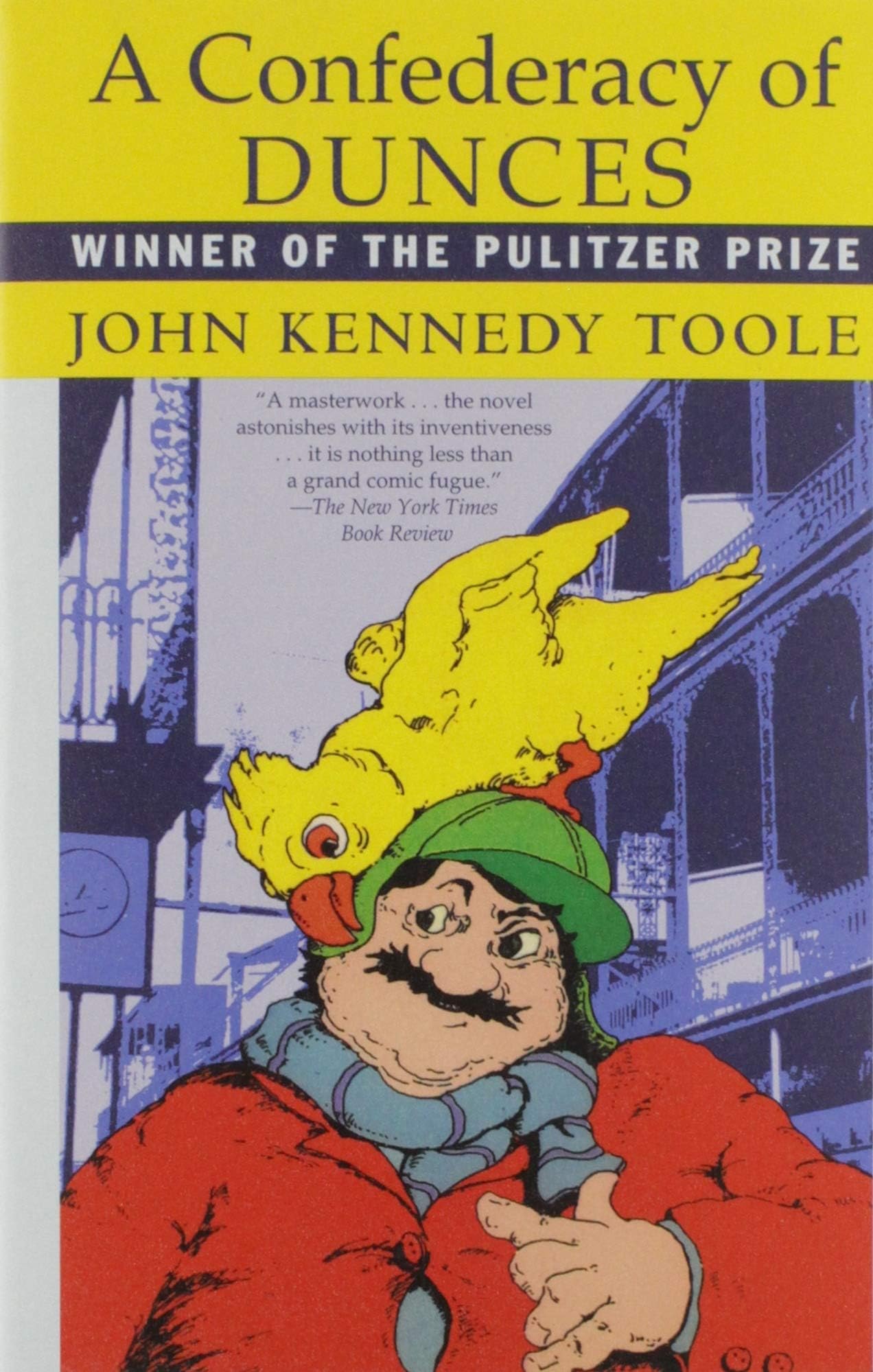
Winner of the Pulitzer Prize “A masterwork . . . the novel astonishes with its inventiveness . . . it is nothing less than a grand comic fugue.” The New York Times Book Review A Confederacy of Dunces is an American comic masterpiece. John Kennedy Toole's hero, one Ignatius J. Reilly, is "huge, obese, fractious, fastidious, a latter-day Gargantua, a Don Quixote of the French Quarter. His story bursts with wholly original characters, denizens of New Orleans' lower depths, incredibly true-to-life dialogue, and the zaniest series of high and low comic adventures" (Henry Kisor, Chicago Sun-Times ). Review: As close to a perfect novel as you're likely to find - by is funny, wise, and as close to a perfect novel as you’re likely to find. Protagonist Ignatius C. Reilly is a bloated buffoon, a man-baby who lives with his mother, has a troubled digestive valve that causes him to burp and fart with great frequency, and possesses one of the most “unique” worldviews you’re likely to find. Ignatius is loaf completely at ease with his loafishness: “I dust a bit,” Ignatius told the policeman. “In addition, I am at the moment writing a lengthy indictment against our century. When my brain begins to reel from my literary labors, I make an occasional cheese dip.” Ignatius is like a giant child when he considers his career options and argues with his mother: I suspect that something like a newspaper route would be rather agreeable. “I dare you to come out in that shredded nightgown and get me!” Ignatius answered defiantly and stuck out his massive pink tongue. Above all, A Confederacy of Dunces is funny. Laugh out loud is an overused phrase, but COD will make you LOL for realz, yo. The situations are so absurd, the characters so odd, and the dialogue veers between biting satire punctuated by unexpected blasts of pee-your-pants profanity. “Go dangle your withered parts over the toilet!” Ignatius screamed savagely. Miss Trixie shuffled away. No mater what the problem, Ignatius always finds a way to blame others. “Employers sense in me a denial of their values.” He rolled over onto his back. “They fear me. I suspect that they can see that I am forced to function in a century which I loathe. You must realize the fear and hatred which my weltanschauung instills in people. He twisted his face into a mask of suffering. There was no use fighting Fortuna until the cycle was over. “You realize, of course, that this is all your fault. “You’re full of bulls***.” “I? The incident is sociologically valid. The blame rests upon our society.” Sometimes COD goes for screwball comedy and slapstick. Taken as a whole, COD is the mother of all farces. When he’s not avoiding work or fighting with his mother, Ignatius plots against Myrna, a radical student he once attended classes with. The romantic ending of COD is anticipated but still manages to be unexpectedly satisfying. Dr. Talc idly wondered if they (Iggy and Myrna) had married each other. Each certainly deserved the other. Through Myrna’s letters we see she has true insight into Ignatius’ personality: This “automobile accident” is a new crutch to help you make excuses for your meaningless, impotent existence. A good, explosive orgasm would cleanse your being and bring you out of the shadows. Great Oedipus bonds are encircling your brain and destroying you Ignatius, a very bad crack-up is on the way. You must do something. Even volunteer work at a hospital would snap you out of your apathy, The valve closes because it thinks it is living in a dead organism. Open your heart, Ignatius, and you will open your valve. Behind his absurdity, Ignatius is sad and lonely, a sorrow that stems from his isolationism: We both exist outside the inner realm of American society. Myrna was, you see, terribly engaged in her society; I, on the other hand, older and wiser, was terribly dis-engaged. I really have had little to do with them, for I mingle with my peers or no one, and since I have no peers, I mingle with no one. I don’t dance. I never dance. I have never danced in my life. COD is also a love letter to Toole’s native New Orleans: Patrolman Mancuso inhaled the moldy scent of the oaks and thought, in a romantic aside, that St. Charles Avenue must be the loveliest place in the world. New Orleans is, on the other hand, a comfortable metropolis which has a certain apathy and stagnation which I find inoffensive. At least its climate is mild. The balconies of the old buildings hung over my head like dark branches in an allegorical forest of evil. I won’t get into the tragic personal history of author John Kenndy Toole. The story behind his career and the publication of COD is itself an impossible tale of heartbreaking genius. But the toxic mother-son relationship at the heart of this novel certainly is rife with autobiographical elements. Ms. Reilly laments Ignatius’ weak work ethic. “My heart’s broke.” “Ain’t he writing something?” “Some foolishness nobody never gonna feel like reading.” Fortunately, the real-life Thelma Toole felt differently about her son’s work. -30- Review: A Well Written Book By A Very Talented Author - However - Not Sure It's Worthy Of A Nobel Prize - This is a well written book with some zany characters; not the least of whom is its main character, Ignatius Reilly. This book could have been hilarious in the way that Joseph Heller's Catch 22 was, except that Tool attempted to make his characters a little too dark. After all, this book is comedic fiction, so there should have been a lightheartedness to it which I found all but absent. Moreover, while author Toole does a credible job of developing his characters, the book itself is held back by its overtly depressing nature. Toole for all of his brilliance as an academic and teacher, just did not seem to be able embody enough humor in his characters to overcome their darkness. And this is unfortunate, because much of this book reveals just how creative and talented a writer John Toole was. However, unlike Catch 22 - which to this day remains my benchmark for comedic novels - I found that I had to force myself to read A Confederacy Of Dunces. Whereas, Catch 22 has such a natural flow to it which made it impossible to put down. Joseph Heller's characters may have had their dark sides, however, they were so funny that it was easy to overlook them. In fact, they were more like cartoon characters that Heller brought to life, while Toole's characters start off in a similar way, yet become so depressing, that much of the humor in this book is overshadowed by this depression. Moreover, as a reader you begin to sense the weight of this depression, and it can make reading the book a chore at times. Furthermore, while it is at times injected with the author's dry sense of humor and considerable wit, A Confederacy Of Dunces is in fact a very dark comedy, which was obviously written from the darkest recesses of a tortured soul. Toole's own mind. Given that this book was first published more than a decade after John Kennedy Toole committed suicide, one must wonder if it was the very darkness within his own psyche that he could not overcome; which resulted in his taking his own life at the age of 31; just as his characters, as humorous as they are at times, can't seem to overcome their own demons. A Confederacy Of Dunces is certainly a worthwhile read, written by a very talented man who is hopefully now at peace. However, how it won a Noble Prize for comedic fiction is as much of a mystery to this reader as is why Catch 22 didn't win a Noble Prize for this literary genre. Recommended with the aforesaid caveats.



| Best Sellers Rank | #2,991 in Books ( See Top 100 in Books ) #2 in Absurdist Fiction (Books) #21 in Dark Humor #22 in Fiction Satire |
| Customer Reviews | 4.2 out of 5 stars 16,564 Reviews |
P**R
As close to a perfect novel as you're likely to find
<em> <a style="font-style: italic;" href=[...]</a> </em>by <a href="[...]</a> is funny, wise, and as close to a perfect novel as you’re likely to find. Protagonist Ignatius C. Reilly is a bloated buffoon, a man-baby who lives with his mother, has a troubled digestive valve that causes him to burp and fart with great frequency, and possesses one of the most “unique” worldviews you’re likely to find. Ignatius is loaf completely at ease with his loafishness: <blockquote><em>“I dust a bit,” Ignatius told the policeman. “In addition, I am at the moment writing a lengthy indictment against our century. When my brain begins to reel from my literary labors, I make an occasional cheese dip.”</em></blockquote> Ignatius is like a giant child when he considers his career options and argues with his mother: <blockquote><em>I suspect that something like a newspaper route would be rather agreeable.</em></blockquote> <blockquote><em> “I dare you to come out in that shredded nightgown and get me!” Ignatius answered defiantly and stuck out his massive pink tongue.</em></blockquote> Above all, <em>A Confederacy of Dunces</em> is <em>funny</em>. Laugh out loud is an overused phrase, but <em>COD</em> will make you LOL for realz, yo. The situations are so absurd, the characters so odd, and the dialogue veers between biting satire punctuated by unexpected blasts of pee-your-pants profanity. <blockquote><em>“Go dangle your withered parts over the toilet!” Ignatius screamed savagely. Miss Trixie shuffled away.</em></blockquote> No mater what the problem, Ignatius always finds a way to blame others. <blockquote><em>“Employers sense in me a denial of their values.” He rolled over onto his back. “They fear me. I suspect that they can see that I am forced to function in a century which I loathe.</em></blockquote> <blockquote><em>You must realize the fear and hatred which my </em>weltanschauung<em> instills in people.</em></blockquote> <blockquote><em>He twisted his face into a mask of suffering. There was no use fighting Fortuna until the cycle was over. “You realize, of course, that this is all your fault.</em><em> </em></blockquote> <blockquote><em> “You’re full of bulls***.” </em> <em>“I? The incident is sociologically valid. The blame rests upon our society.”</em></blockquote> Sometimes <em>COD</em> goes for screwball comedy and slapstick. Taken as a whole, <em>COD</em> is the mother of all farces. When he’s not avoiding work or fighting with his mother, Ignatius plots against Myrna, a radical student he once attended classes with. The romantic ending of <em>COD</em> is anticipated but still manages to be unexpectedly satisfying. <blockquote><em>Dr. Talc idly wondered if they (</em>Iggy and Myrna)<em> had married each other. Each certainly deserved the other.</em></blockquote> Through Myrna’s letters we see she has true insight into Ignatius’ personality: <blockquote><em>This “automobile accident” is a new crutch to help you make excuses for your meaningless, impotent existence.</em></blockquote> <blockquote><em>A good, explosive orgasm would cleanse your being and bring you out of the shadows.</em></blockquote> <blockquote><em>Great Oedipus bonds are encircling your brain and destroying you</em></blockquote> <blockquote><em>Ignatius, a very bad crack-up is on the way. You must do something. Even volunteer work at a hospital would snap you out of your apathy,</em> <em>The valve closes because it thinks it is living in a dead organism. Open your heart, Ignatius, and you will open your valve. </em></blockquote> <em> </em> Behind his absurdity, Ignatius is sad and lonely, a sorrow that stems from his isolationism: <blockquote><em>We both exist outside the inner realm of American society. Myrna was, you see, terribly engaged in her society; I, on the other hand, older and wiser, was terribly dis-engaged.</em></blockquote> <blockquote><em>I really have had little to do with them, for I mingle with my peers or no one, and since I have no peers, I mingle with no one.</em></blockquote> <blockquote><em>I don’t dance. I never dance. I have never danced in my life.</em></blockquote> <em>COD</em> is also a love letter to Toole’s native New Orleans: <blockquote><em>Patrolman Mancuso inhaled the moldy scent of the oaks and thought, in a romantic aside, that St. Charles Avenue must be the loveliest place in the world.</em></blockquote> <blockquote><em>New Orleans is, on the other hand, a comfortable metropolis which has a certain apathy and stagnation which I find inoffensive. At least its climate is mild.</em> <em>The balconies of the old buildings hung over my head like dark branches in an allegorical forest of evil.</em></blockquote> I won’t get into the tragic personal history of author John Kenndy Toole. The story behind his career and the publication of <em>COD</em> is itself an impossible tale of heartbreaking genius. But the toxic mother-son relationship at the heart of this novel certainly is rife with autobiographical elements. Ms. Reilly laments Ignatius’ weak work ethic. <blockquote><em> “My heart’s broke.”</em> <em>“Ain’t he writing something?” </em> <em>“Some foolishness nobody never gonna feel like reading.”</em></blockquote> Fortunately, the real-life Thelma Toole felt differently about her son’s work. -30-
J**S
A Well Written Book By A Very Talented Author - However - Not Sure It's Worthy Of A Nobel Prize
This is a well written book with some zany characters; not the least of whom is its main character, Ignatius Reilly. This book could have been hilarious in the way that Joseph Heller's Catch 22 was, except that Tool attempted to make his characters a little too dark. After all, this book is comedic fiction, so there should have been a lightheartedness to it which I found all but absent. Moreover, while author Toole does a credible job of developing his characters, the book itself is held back by its overtly depressing nature. Toole for all of his brilliance as an academic and teacher, just did not seem to be able embody enough humor in his characters to overcome their darkness. And this is unfortunate, because much of this book reveals just how creative and talented a writer John Toole was. However, unlike Catch 22 - which to this day remains my benchmark for comedic novels - I found that I had to force myself to read A Confederacy Of Dunces. Whereas, Catch 22 has such a natural flow to it which made it impossible to put down. Joseph Heller's characters may have had their dark sides, however, they were so funny that it was easy to overlook them. In fact, they were more like cartoon characters that Heller brought to life, while Toole's characters start off in a similar way, yet become so depressing, that much of the humor in this book is overshadowed by this depression. Moreover, as a reader you begin to sense the weight of this depression, and it can make reading the book a chore at times. Furthermore, while it is at times injected with the author's dry sense of humor and considerable wit, A Confederacy Of Dunces is in fact a very dark comedy, which was obviously written from the darkest recesses of a tortured soul. Toole's own mind. Given that this book was first published more than a decade after John Kennedy Toole committed suicide, one must wonder if it was the very darkness within his own psyche that he could not overcome; which resulted in his taking his own life at the age of 31; just as his characters, as humorous as they are at times, can't seem to overcome their own demons. A Confederacy Of Dunces is certainly a worthwhile read, written by a very talented man who is hopefully now at peace. However, how it won a Noble Prize for comedic fiction is as much of a mystery to this reader as is why Catch 22 didn't win a Noble Prize for this literary genre. Recommended with the aforesaid caveats.
R**S
uniquely American and New Orleanian
You’ve got to read A Confederacy of Dunces to believe it. Ignatius J. Reilly, the novel’s unique and utterly repugnant protagonist, is a slovenly, self-aggrandizing genius who lumbers through life with a mix of delusional grandeur and caustic wit. He’s a spectacle of excess—physically, intellectually, and emotionally—whose every misadventure, from his hot-dog-vending schemes to his tirades against modernity, is a masterclass in cringe-inducing absurdity. You can’t look away, turning pages to see what outrageous, self-inflicted disaster he’ll stumble into next. This book is the wretched refuse and psychotic reflection of Catcher in the Rye, a darkly comedic, unapologetically unhinged cousin that takes J.D. Salinger’s blueprint and douses it in New Orleans sweat and grease. Where Holden Caulfield is a brooding, alienated teenager wrestling with the phoniness of the world, Ignatius is a grotesque, overgrown man-child, waging war against a society he deems beneath his medievalist ideals. Holden’s rebellion is introspective, laced with vulnerability and a yearning for connection; Ignatius’s is bombastic, fueled by arrogance and a perverse glee in his own chaos. If Catcher is a melancholic lament for lost innocence, Dunces is a raucous, satirical assault on propriety, reveling in its protagonist’s refusal to conform—or bathe. Yet both novels share a core of defiance, capturing misfits who rail against a world they can’t (or won’t) fit into, making Ignatius a kind of warped, funhouse-mirror reflection of Holden. John Kennedy Toole’s masterpiece weaves this larger-than-life antihero through a chaotic tapestry of New Orleans’ underbelly, where a cast of misfits—hapless cops, scheming barflies, and exasperated employers—collide in gloriously disastrous ways. It’s a satirical gut-punch, equal parts hilarious and unsettling, that thrives on its grotesque brilliance. You’ll laugh, you’ll grimace, and you’ll never forget it.
T**O
OK but not up to the hype the critics have heaped on it. Interesting characters.
Funny, but I don’t understand why this book is so highly rated as it is.
H**N
A brilliant, belatedly recognized masterpiece
I sat at a diner in Harrisburg, PA last week, discussing books with the patron next to me (at the bar). It wasn’t long before she spoke effusively of this novel, of its hilarity, depth, and brilliant grasp of the “commoner’s” culture in New Orleans. I bought it on my smart phone at the bar (after a Virgin Bloody Mary & poached eggs with grits done in chicken stock). What a page turner, with time after time splitting with laughter. Well described in the introduction as both comedy and tragedy, I blazed through it in record time, purchasing also the audible version, which I now treasure for its entertaining replication of New Orleans’ dialects, both black and white. This is a novel that should turn the most narcissistic of us into philanthropists, though that is a tall order. This book probably won’t strike a cord with those of us who are “straight-laced,” but will bring both a smile and a certain reverent contemplation to those of us perplexed by the paradox of the human condition. To echo the prologue to the book, what a tragedy to have lost the author at such an early age to suicide, but then again, only those who suffer deeply are able to feel deeply. RIP you brilliant SOB! And shame on the intellectual snobs who objected to its publication in the author’s lifetime. Only Mark Twain suffered a similar fate in his lifetime, his brilliance mistaken for blatant racism instead of a condemnation of contemporary prejudice. At least he survived to old age.
E**R
amazing book
This was a recommend from a friend who couldn’t make heads or tails out of what this book was about. I just know it was incredibly well written, laugh out loud funny in 100 places, and very subtle and its directional movement toward a beautiful ending. I’m very happy I was steered to this book, the mystery of its origin and the author’s life will be on my mind for years to come
S**E
A TRAGICOMEDY TO THINK ABOUT AND ENJOY
“A Confederacy of Dunces,” John Kennedy Toole’s bizarre novel about an outlandish character stumbling around New Orleans provokes much controversy in the publishing world. The author, almost as unsettled as his protagonist, Ignatius Reilly, never lived to see his work become published. It was first printed eleven years after his suicide and won the Pulitzer Prize the year after, in 1981. It has since become almost an icon of both comical and tragic modern literature. Toole’s mother was the book’s flag waver, never stopping her relentless campaign to have it published. She finally convinced novelist Walker Percy, then teaching at Loyola, to read through the immense and ragged manuscript who saw the promise. Earlier attempts by Toole had failed to gain support because, in the words of one famous publisher, “It isn’t really about anything.” Toole told friends that his book had been praised as “wildly funny” and “full of ‘wonderfulness’ and ‘excitements’ and ’glories’ “. Indeed it is and one can only question the wisdom of such rejection. But Toole never overcame his disheartenment, killing himself at age thirty-two. Reilly is an educated slob of a man, living with his mother, and half-heartedly trying to find a job. His dress is outlandish, his immense size is subject to much abuse, and his stomach troubles are very public and magnified by his choice of unhealthy food and drink. He has many adventures among the wildly eccentric characters of early-1960s New Orleans but he may be the most off-center of them all. These escapades form the storyline of the novel. The book is, indeed, comical. But there is an undercurrent of sadness and suffering. One feels guilty laughing at the antics that is almost akin to chortling at mentally or physically handicapped individuals. That, to me, is the curious appeal I find in the book. Toole does a masterful job at presenting this enigma, whether or not that is his intention. The dialect is often mentioned as being true art, and the characterizations are products of a writing virtuoso. An indicator of the book’s struggle with acceptance is its unfortunate travels through the motion picture industry. Repeated efforts at turning it into film, with many stars targeted for Reilly’s character, including John Belushi, John Candy, John Goodman, and Will Ferrell, have failed. Toole only wrote the one book, which is unfortunate for readers. I encourage a careful study of his story, keeping in mind that, while the humor never stops, neither does embarrassment of being amused go away. Schuyler T Wallace Author of TIN LIZARD TALES
D**D
favorite comic novel of all-time
If I'm being sent to Angola (the prison or the nation) and get to bring just two books? As of today, I go with Confederacy and an ESV Bible (we'll make it the Reformation Study Bible in black leather). After 805 reviews here, I have nothing new to add. Just joining my voice to the recommendation list, and sharing my own small experience with this wonderful book. I was up til 4:30am reading it last night and only got to p. 39, between the laughter, and wanting to re-read a well crafted paragraph over and over. Kind of like the very first time you popped R.E.M. 'Murmur' into your CD player -- you just had to listen to each sng a hundred times. The interesting part to this experience last night -- I had just heard a talk by Anne Lamott about her Xian faith and being an artists. Wonderful stuff. Met her afterwards and bought her new acclaimed book, Plan B. Well, I didn't even crack the cover of the (certainly amazing) Lamott book all night, because that would require pulling me away from Confederacy. Take David Brooks' DNA and splice its best parts with Flannery O'Connor's. Add in some Jaques Maritain and P.J. O'Rourke. Take the child that results and drop him into Uptown New Orleans -- when science can achieve this we may finally get another comic novel approaching this. Until then, we have Confederacy, and nothing else. As has been noted in several of these reviews, Toole was a college instructor in New Orleans in the late 60s. He wrote this novel and saw it rejected by all the major publishers. He killed himself in response, age 32. So his mother took the manuscript and forced it upon Walker Percy in 1976, who thought she was silly, but gave a look to the first page only because he rashly promised her he would. He said he knew quickly he was reading the best comic novel of the 20th century. Through his intervention it was finally published in 1980, more than ten years after Toole's death. It immediately won the Pulitzer. Its main character Ignatius Reilly is a New Orleanian freak through and through (his sole bus ride to Baton Rouge made him vomit). He may be the only 300 pound sloth in history to wear an undersized lumberjack shirt on Canal St. Percy has called him a mad Thomas Hardy, a fat Don Quixote, a perverse Thomas Aquinas, all rolled into one. Disclaimer: It is roughly R-rated. Not good for many homeschooled 13 year olds.
A**R
Großartig!
Großartig geschriebenes Buch. Unterhaltsame humorvolle Story. Gut beschriebene und intelligent-überlegte Charaktere. Fesselnde und witzige Prosa.
R**S
Livro confederacy of dunces em bom estado
Um pouco manchado nas laterais, afinal, é um livro já antigo, mas sem cheiro de velho, sem rasuras, sem rasgados
N**C
A CONFEDERACY OF DUNCES, A SAD BUT WORTHY LEGACY
'When a true genius appears in the world, you may know him by this sign, that the dunces are all in confederacy against him.' This quote from Jonathan Swift provides the memorable title of this accomplished and bizarre novel by the hapless John Kennedy Toole, a suicide at the age of thirty-one. There has been considerable speculation since Toole's untimely demise in 1969 about how much his difficulties in publishing his novel contributed to his death. The unconventional relationship between him and his domineering mother has also been closely examined, with many readers perceiving paralells with Ignatius Reilly (the novel's protaganist) and his fictive mother. It is known that Toole's mother obsessively pestered the publishing house to get her son's book into print posthumously. It is less well known that she was equally determined to suppress publication of his only other work, 'The Neon Bible' but neither fact has any bearing on this review, which positively reacts to this young writer's interesting and impressive novel. The story unfolds across fourteen chapters rich in prose and dialogue delivered in authentically reproduced dialects of the time (the 1960s) and the place (New Orleans, US). Toole presents the reader with an arena of offbeat characters, a world teeming with bigoted and blinkered eccentrics, each with their own axe to grind. Throughout the amusingly related shenanigans of these lowlife misfits, Ignatius Reilly is a central presence. He lives with his mother who is lonely and past her best in a cocoon of self-importance unpunctured by her repeated efforts to nag him into assuming an occupation. Her anxiety is fuelled by her fears of lifelong debt, which she feels might result from threatened legal proceedings against her following an accident in which she and Ignatius were involved. The jobs Ignatius gets provide abundant humour and irony, introducing fresh characters with their idiosyncratic weirdness of being and outlook. With his talent for self-alienation and losing jobs, Mrs. Reilly, in desperation, considers having her son committed. But help is at hand for our pompous hero in the form of Myrna Minkoff, the mysterious correspondent we meet early on in the book leading us to read more into their odd relationship than is spelled out for us. This book is original writing from a talent whose development had he survived may have astounded us. If, as seems likely, this title stands alone as his most famous achievement it will not be too bad a thing. Most writers are grateful to be remembered for pretty well any of their books, irrespective of the size of their output and to be remembered for a classic is an honour aqrguably sufficient to offset the tragedy of an author's premature death.
M**O
Muy recomendable
Un libro extraordinario
B**N
Une pépite de roman.
A la suite d'un héros hors norme on découvert une galerie de portraits savoureux. Le style est brillant donnant voix à chacun des personnage dans une langue dont le vocabulaire la syntaxe et l'orthographe varient pour suivre leurs émotions et nous plonger dans leur psychisme. C'est pathétique hilarant effrayanr en un mot brillant.
Trustpilot
4 days ago
1 month ago