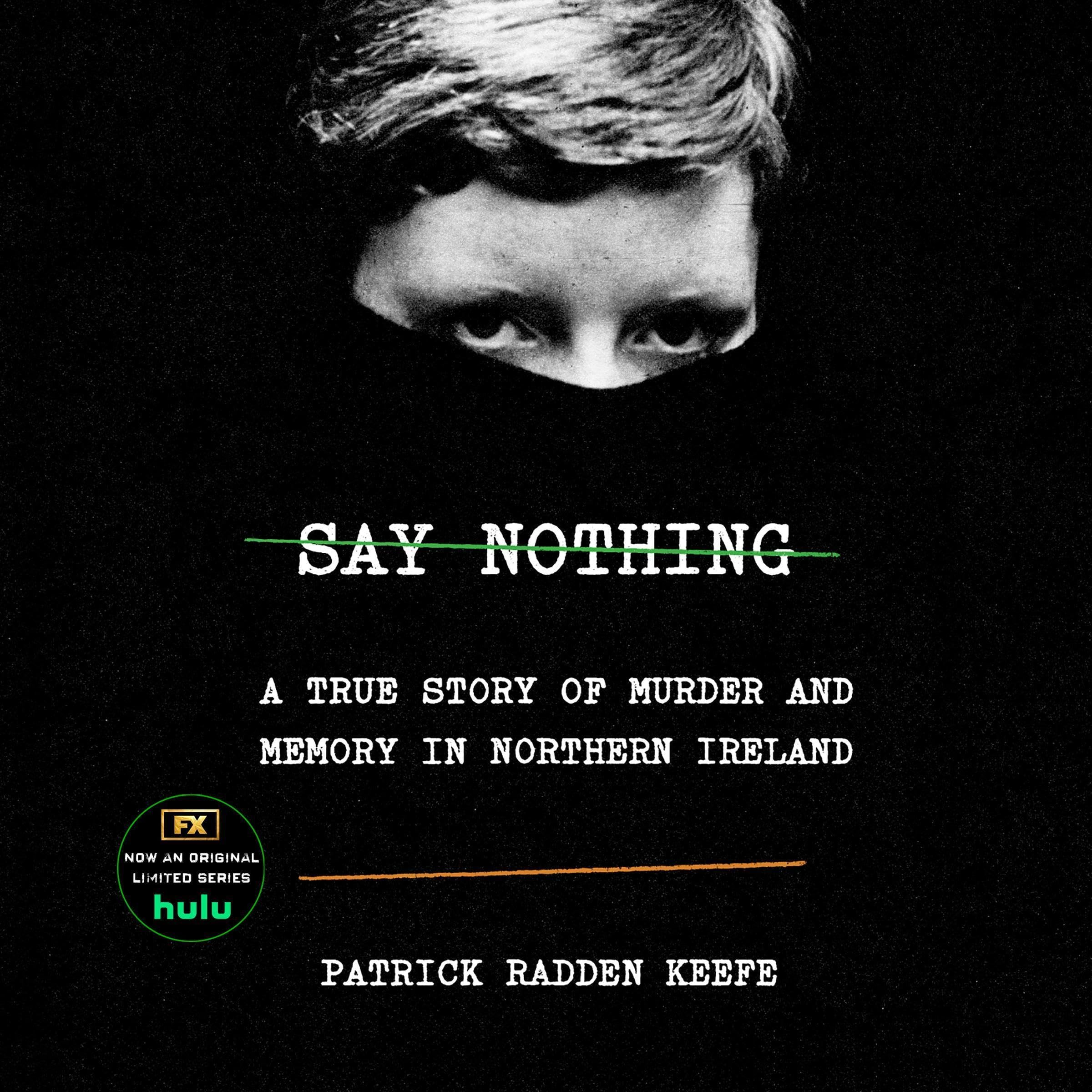
Say Nothing: A True Story of Murder and Memory in Northern Ireland
Product ID: 115911136
Desertcart purchases this item on your behalf and handles shipping, customs, and support to British Virgin Islands.
NEW YORK TIMES BESTSELLER NOW AN FX LIMITED SERIES STREAMING ON HULU NATIONAL BOOK CRITICS CIRCLE AWARD WINNER From the author of London Falling— a stunning, intricate narrative about a notorious killing in Northern Ireland and its devastating repercussions. One of The New York Times ’s 20 Best Books of the 21st Century A Kirkus Reviews Best Nonfiction Book of the Century A Los Angeles Times Best Nonfiction Book of the Last 30 Years "Masked intruders dragged Jean McConville, a 38-year-old widow and mother of 10, from her Belfast home in 1972. In this meticulously reported book—as finely paced as a novel—Keefe uses McConville's murder as a prism to tell the history of the Troubles in Northern Ireland. Interviewing people on both sides of the conflict, he transforms the tragic damage and waste of the era into a searing, utterly gripping saga." — New York Times Book Review " Reads like a novel. . . . Keefe is . . . a master of narrative nonfiction. . . . An incredible story. "—Rolling Stone A Best Book of the Year: The New York Times, The Washington Post, The Wall Street Journal, TIME, NPR, and more! Jean McConville's abduction was one of the most notorious episodes of the vicious conflict known as The Troubles. Everyone in the neighborhood knew the I.R.A. was responsible. But in a climate of fear and paranoia, no one would speak of it. In 2003, five years after an accord brought an uneasy peace to Northern Ireland, a set of human bones was discovered on a beach. McConville's children knew it was their mother when they were told a blue safety pin was attached to the dress--with so many kids, she had always kept it handy for diapers or ripped clothes. Patrick Radden Keefe's mesmerizing book on the bitter conflict in Northern Ireland and its aftermath uses the McConville case as a starting point for the tale of a society wracked by a violent guerrilla war, a war whose consequences have never been reckoned with. The brutal violence seared not only people like the McConville children, but also I.R.A. members embittered by a peace that fell far short of the goal of a united Ireland, and left them wondering whether the killings they committed were not justified acts of war, but simple murders. From radical and impetuous I.R.A. terrorists such as Dolours Price, who, when she was barely out of her teens, was already planting bombs in London and targeting informers for execution, to the ferocious I.R.A. mastermind known as The Dark, to the spy games and dirty schemes of the British Army, to Gerry Adams, who negotiated the peace but betrayed his hardcore comrades by denying his I.R.A. past-- Say Nothing conjures a world of passion, betrayal, vengeance, and anguish. Review: The Madness of the Troubles: A Nation Lost in Violence and Memory - Patrick Radden Keefe’s Say Nothing: A True Story of Murder and Memory in Northern Ireland is one of the most powerful works of nonfiction ever written about political violence, memory, and the human cost of a divided society. It is far more than a history of the Troubles; it is a haunting examination of how ideology, revenge, and fear can consume generations. Keefe takes the reader into a world where the boundaries between freedom fighter and terrorist, patriot and murderer, justice and vengeance become increasingly blurred. At the center of the book is the tragic disappearance of Jean McConville, a widowed mother of ten who was abducted from her Belfast home in 1972 and secretly murdered by the IRA. Her story becomes the doorway into a much larger exploration of the Irish Republican Army, British security forces, political leaders, and the countless families trapped in the nightmare of the Troubles. The mystery of what happened to McConville is compelling, but the true power of the book lies in its portrayal of a society where violence became normalized and where truth itself became another casualty of war. Keefe masterfully captures the madness and confusion that engulfed Northern Ireland. It was a place where neighbors watched neighbors, where suspicion was everywhere, and where a person could be branded a traitor one day and a hero the next depending on who was telling the story. Young men and women were drawn into underground movements that demanded absolute loyalty and often required them to commit acts of brutality that would haunt them forever. Retaliation followed retaliation until the original grievances were buried beneath decades of bloodshed. The book also examines the role of Gerry Adams, one of the most influential and controversial figures of the Northern Ireland conflict. Keefe presents Adams as a complex figure: a leader who helped guide Sinn Féin from an armed struggle toward a political solution, but also a man whose relationship with the IRA and its violent campaign has been the subject of intense debate and controversy. The book explores allegations from former IRA members and others who claimed Adams held significant influence within the movement while publicly maintaining distance from its military operations. Whether viewed as a political strategist, a peacemaker, or a figure who carried unresolved contradictions from the era of violence, Adams represents the complicated moral landscape that defines the Troubles. One of the greatest strengths of Say Nothing is that Keefe refuses to reduce the conflict into a simple story of good versus evil. He does not excuse murder or terrorism, but he also shows how ordinary people can become trapped inside systems of hatred, fear, and loyalty. The result is a deeply human account of how political causes can transform into cycles of violence that are nearly impossible to escape. Keefe’s writing is exceptional. He combines the suspense of a great thriller with the depth of investigative journalism and historical analysis. The book moves with remarkable pace while never losing sight of the human suffering behind the events. Ultimately, Say Nothing is a devastating meditation on memory and truth. Even after the guns went silent, the questions remained: Who was responsible? Who should be forgiven? Can a society heal when so many secrets remain buried? This is a masterpiece of nonfiction—brilliantly researched, beautifully written, and deeply unsettling. It is a powerful reminder that political violence rarely produces the victories people imagine, but instead leaves behind grief, bitterness, and generations struggling to understand the cost. Review: Great book, should have bought new - The book’s content on its own would get 5 stars but I bought a used copy that smells faintly of tobacco and triggers my asthma when I read. Book shipped quickly and otherwise was in great shape. I don’t know how this hasn’t been optioned as a limited series or film. It’s an important history and the writing is so engrossing I’m almost done after starting just last night.
T**R
The Madness of the Troubles: A Nation Lost in Violence and Memory
Patrick Radden Keefe’s Say Nothing: A True Story of Murder and Memory in Northern Ireland is one of the most powerful works of nonfiction ever written about political violence, memory, and the human cost of a divided society. It is far more than a history of the Troubles; it is a haunting examination of how ideology, revenge, and fear can consume generations. Keefe takes the reader into a world where the boundaries between freedom fighter and terrorist, patriot and murderer, justice and vengeance become increasingly blurred. At the center of the book is the tragic disappearance of Jean McConville, a widowed mother of ten who was abducted from her Belfast home in 1972 and secretly murdered by the IRA. Her story becomes the doorway into a much larger exploration of the Irish Republican Army, British security forces, political leaders, and the countless families trapped in the nightmare of the Troubles. The mystery of what happened to McConville is compelling, but the true power of the book lies in its portrayal of a society where violence became normalized and where truth itself became another casualty of war. Keefe masterfully captures the madness and confusion that engulfed Northern Ireland. It was a place where neighbors watched neighbors, where suspicion was everywhere, and where a person could be branded a traitor one day and a hero the next depending on who was telling the story. Young men and women were drawn into underground movements that demanded absolute loyalty and often required them to commit acts of brutality that would haunt them forever. Retaliation followed retaliation until the original grievances were buried beneath decades of bloodshed. The book also examines the role of Gerry Adams, one of the most influential and controversial figures of the Northern Ireland conflict. Keefe presents Adams as a complex figure: a leader who helped guide Sinn Féin from an armed struggle toward a political solution, but also a man whose relationship with the IRA and its violent campaign has been the subject of intense debate and controversy. The book explores allegations from former IRA members and others who claimed Adams held significant influence within the movement while publicly maintaining distance from its military operations. Whether viewed as a political strategist, a peacemaker, or a figure who carried unresolved contradictions from the era of violence, Adams represents the complicated moral landscape that defines the Troubles. One of the greatest strengths of Say Nothing is that Keefe refuses to reduce the conflict into a simple story of good versus evil. He does not excuse murder or terrorism, but he also shows how ordinary people can become trapped inside systems of hatred, fear, and loyalty. The result is a deeply human account of how political causes can transform into cycles of violence that are nearly impossible to escape. Keefe’s writing is exceptional. He combines the suspense of a great thriller with the depth of investigative journalism and historical analysis. The book moves with remarkable pace while never losing sight of the human suffering behind the events. Ultimately, Say Nothing is a devastating meditation on memory and truth. Even after the guns went silent, the questions remained: Who was responsible? Who should be forgiven? Can a society heal when so many secrets remain buried? This is a masterpiece of nonfiction—brilliantly researched, beautifully written, and deeply unsettling. It is a powerful reminder that political violence rarely produces the victories people imagine, but instead leaves behind grief, bitterness, and generations struggling to understand the cost.
R**E
Great book, should have bought new
The book’s content on its own would get 5 stars but I bought a used copy that smells faintly of tobacco and triggers my asthma when I read. Book shipped quickly and otherwise was in great shape. I don’t know how this hasn’t been optioned as a limited series or film. It’s an important history and the writing is so engrossing I’m almost done after starting just last night.
P**L
Be Prepared for a Riveting Book You Can't Put Down
Say Nothing by Patrick Radden Keefe is subtitled A True Story of Murder and Memory in Northern Ireland. It is very rare for me to ignore everything around me and become completely immersed in a book, no matter how great or suspenseful it is, but that is exactly what happened with this one. Being across the ocean, I really didn’t know that much about life in Northern Ireland during The Troubles, which stretched from 1968 to 1998, at the time events were happening. I first became aware of the deep divisions only after I began researching my ancestry, which led to Ballygawley, County Tyrone, Northern Ireland. During trips there, I visited Belfast and took the bus tours which included much about The Troubles and brought me past the Peace Walls and art commemorating both sides. In fact, one of the last British soldiers to be killed had the same last name as my ancestors (Neely), who was killed in an IRA bomb attack outside Ballygawley. So when I came across the story of Jean McConville, a 38-year-old mother of 10 children who was abducted and murdered by the IRA, I was intrigued. Who would burst into someone’s home, knowing the father had died of cancer, and remove the mother of children as young as six years of age right in front of them, take her to a remote location and murder her? They had to have known the children would be left on their own, perhaps even to die without adult care. And why would anyone be that inhumane? Patrick Radden Keefe’s book, Say Nothing, answers those questions in a very balanced way. Being a journalist by trade—a New Yorker Magazine award-winning journalist—I immediately knew from the level of detail that he had painstakingly researched not only Jean McConville and her family but also each of the individuals that had some level of participation in her abduction and murder. The result is an absolutely riveting story that delves deep into what causes people to become terrorists, the changes that occur in a person’s mind when they are raised among extreme levels of hatred and the extent to which they will go because they believe in a cause larger than themselves. What was particularly striking was the revelation that many of the people involved in acts of terror—the bombing of London and Northern Ireland and the killing of innocent civilians—suffered abnormally high rates of drug dependency, alcoholism and PTSD after The Troubles had officially ended with the Good Friday Peace Agreement of 1998. The agreement caused the IRA to stand down, the British to release political prisoners held without trial or conviction, but it fell short of turning Northern Ireland over to the Irish Republicans. Because that was the goal of the IRA, members were left wondering what the killing and maiming was all about if their leaders were willing to simply give up the goal and work with the British politically through Sinn Fein. In Jean McConville’s case—the central subject of this book—she was a Protestant that had taken work as a domestic in a Catholic household, subsequently falling in love with her boss’ Catholic son. In America, this would not have been perceived as a problem at all. In Northern Ireland, it led to the kiss of death and a generation of children traumatized by their father’s death, their mother’s murder and their subsequent separation and hellish time in abusive, Catholic-run children’s homes that seem right out of a Charles Dickens novel. The investigations into Jean McConville’s disappearance would lead to Dolours and Marian Price—it is Dolours’ picture that appears on the front cover, her face partially hidden consistent with IRA terrorists of the time. The damning evidence was in the form of Dolours’ own voice as she participated in a Boston College project in which she admitted on audiotape that she drove McConville across the border to Dundalk in the Republic of Ireland. Later, when the men instructed to kill her did not want to do that because McConville was a widowed mother of ten, Dolours drove back to Dundalk with two others, assumed to be her sister Marian and Ivor Bell, and murdered McConville, burying her in an unmarked grave. It would take decades and particularly strong storms to erode the ground in which she’d been hastily buried, for her body to be found. By that time, her children were grown and had families of their own. We do find out who fired the fatal shot that killed Jean McConville. But the story is far larger than that. It is the story of a country that had been invaded by foreign forces more than 700 years ago and divided in the early 20th century so that one part of the country became the free and independent Republic of Ireland while the other part remained a colony controlled by Great Britain. It is the story of those loyal to the United Kingdom as well as those carrying on a tradition of a free Ireland for which their ancestors fought for hundreds of years. It is also the story of supposed men of God—priests and ministers—who fueled the hatred within their communities, leading to spiraling violence and extremism on both sides. With Brexit, tensions have once again increased between the two factions and ultimately, it will be London who will decide its fate. I highly recommend this book. Be prepared for a riveting tale and a book you can’t put down.
L**E
A must read
This book will be indispensable when History has enough distance to tackle the Troubles. Spotlessly researched and yet highly readable. As someone in the book says, some of the people involved committed slow suicide, haunted by their past actions. It is a consolation for me that those who remain unrepentant and in denial have been exposed before their death.
M**S
Invisible Sun
With over 100 pages of notes backing up every scrap of narrative, Say Nothing is a remarkable account of “The Troubles” in Northern Ireland intertwined with the disappearance of Jean McConville, a 38-year-old—and widowed—mother of ten. Intertwined isn’t quite the right word—the book uses McConville’s broad-daylight abduction (in 1972) as a jumping-off point. The vast majority of Say Nothing concerns itself with The Troubles—though, again, McConville’s disappearance and death create a perfectly murky case study for the whole, protracted, decades-long mess. The Troubles took the lives of some 4,000 people. On one side, Catholic republicans seeking unification of Northern Ireland and the Republic of Ireland. On the other, Protestant paramilitaries, police, and British army forces. Only 20 individuals were “disappeared.” McConville’s body wasn’t found until 2003, five years after the 1998 agreement that brought three decades of violence to a close. As Keefe’s acknowledgements and those lengthy notes make clear, Keefe drew heavily on an oral history archive at Boston College. Two interviews in that history were with Brendan Hughes and Dolours Prices—former members of the Irish Republican Army. They provided plenty of detail about McConville’s murder. The thick wedge of backstory that forms the heart of Say Nothing is critical to understanding what happened to McConville but the book is hardly a detailed prosecution of her murder, allegedly over her role as a tout (informer). As many others have pointed out, Say Nothing has no heroes. Both sides committed horrific acts of violence that ended the lives of many innocent civilians. Keefe’s narrative covers all the key figures on both sides along with the tricks, the lies, the ambushes, the terrorism, the traps, the the violence, Bloody Sunday, Bloody Friday, hunger strikes, the hazy legal fallout from the Jane McConville case itself, and the personal fallout on McConville’s offspring. You will come to understand the importance of, well, saying nothing. Keefe covers Gerry Adams’ conversion from leader of the armed struggle to his role as a political deal-maker—and Keefe credits Adams for an end to the outright violence (while acknowledging that ample tension remains). “Whatever callous motivations Adams might have possessed, and whatever deceptive machinations he might have employed, he steered the IRA out of a bloody and intractable conflict and into a brittle but enduring peace,” writes Keefe. Say Nothing—A True Story of Murder and Memory in Northern Ireland is recounted in calm, clear-eyed fashion. Keefe’s dogged research is evident and his journalistic approach is solid (read those acknowledgements for a good explanation of how he went about corroborating interviews and checking facts). But McGonville’s disappearance drops far to the background as Keefe takes us deep into the “The Troubles” and all the protracted, violent quagmire.
C**E
Read this story
Really good book. What a story.
L**Z
Insightful
Interesting and easy read. Puts into perspective the Northern Irish history of The Troubles.
B**R
The reductionism of the problem to 'sectarian' problem rather that a much deeper problem.
What is there is good but there are a lot of missing material. Perhaps it was not shared or he did not hear it. He makes sure the anti-Catholic; anti-Irish elite won't accuse of bias. Yet there seems to be the usual canonical ant-Catholic -anti Irish bias. He explains some of the background but skips the most important events that led up the current way of defining the division along religious lines (Not sectarian: the Irish belong to one of the ancient churches, the Latin church of the Catholic church. The ancient churches (Catholic, Orthodox and independents) are divided into churches (based on their founding not sects) Sectarianism refers Protestant which separate when they disagree about something. Anyway, The most important historical and its consequences is the betraying of the Irish by the Scotch settlers in fighting William of Orange for Irish freedom. The Scottish settlers switched and joined William of orange to defeat the Irish. The consequence of Willam's occupation of Ireland was heat passed a law that only members of the Church Ireland, a branch of the Church of England would be citizens of Ireland, able to own property and work gainfully. The Scotch settlers handled the edict by designating one family member to be Church of England with the rest of the family working for him. The Irish choose to remain Catholic. Thus, the current division in Northern Ireland. Added to this is the Anti Catholic venom which was nurtured in the England and Scotland. He refers to Scottish settlers at times as Scottish but only once makes a mention of the Catholic as Irish when Dolour says that the Irish wants to all the Englis and Scots out of Ireland. The simple point is that the division is not rooted in religion but only aggravated by religious beliefs. The division is between colonialists who have systematically oppressed the native people especially since Elizabeth I up to the Irish war independence and the division of into the free State (A Commonwealth country under the king)-, now a republic completely separate from UK, and the Northern Ireland which remained part of UK. What resulted for the Irish in Northern Ireland was similar to what happened to the freed African American slaves in US. The Irish remained discriminated against like African Americans in US. Using the model of the nonviolent civil rights moment in US they began protests which like the civil rights movant in the South was greeted with violence. This presented but not adequately explained. He does document the British response but not clearly noting that Irish were again subjected horrendous military occupation. Throughout there is the reductionism of the problem as religious with no understanding about root and history of the oppression that underlies the ongoing discrimination to the Irish in Northern Ireland. He falls into the canonical of the; problem af religious rather than one rooted in colonialism. In any other country we speak of native peoples and oppressive colonialists. This is not just a critic of Keene but a general way in which media skew history of the English colonists of the Irish people to favor the British. Keene talks about the perusing of Adams for membership in the IRA for prosecution. For the Irish the IRA is a legitimate representative of the people like Americal Revolutionary under Washing to n supported the people of the American colonies. Odd how they sought to imprison Adams but Thacher's policies of upping the military oppression is not considered a crime. The horrendous military occupation sounds like something that should have considered at least civil rights offensives. Speak to any Irish who lived through the military occupation, and you will get some idea of the horrors of it. The point is that he seems to satisfy the usual pro English pro colonist point of view and the reductionistic view that it is just those Catholics again doing mischief.
P**R
Nail biting and well written
Very gripping book
C**A
Great
Great book in perfect condition.
G**E
amazing read. I could not put it down
I left Belfast in 1973 to go to London as young woman barely 19 years old to train as a nurse like many before me. I kept abreast of the news from Northern Ireland and was always very doubtful of Gerry Adam’s and his motivations but the detail in this book is phenomenal. The death of Jean McConville and her story has fascinated me since her disappearance but I was unaware of the consequences for her children and my heart goes out to them. I am so glad to have come across this book and will recommend it to my family as an incredible historical account of the troubles and the people who were integral to the continuance of the deaths and destruction during those years.
C**E
Interesting, well written and entertaining
A book to add to my top list of recommendations. The characters and facts are well explained with all the nuances required for an immersion in the human drama and thus the personal misery to which a process of violent radicalisation leads. Entertaining to read to boot
A**S
Best book on IRA fighters and Ulster war ! ( Spoiler alert)
This was the first book I read on the terrible war in Northern Ireland . The book is a non fiction book, but it is readable and exciting as a novel . It is one of the best book you will find that shows the human and moral side of war and IRA fighters . The book chronicles the history of some Ulster Catholics who, after having been mistreated by the English soldiers and the Protestant English citizens of user, decide to fight back . They become part of Ira, the Catholic guerrilla group which fight with terror attacks thé English occupiers . They accept the idea to die and kill for the freedom of Ulster and the Catholic freedom, but all the Irish protagonists become disillusioned . Some of the Irish protagonists become politicians and start negotiations with the British occupiers, in order to have a democracratic process and build peace between protestants and Catholics. Other protagonists become hardened fighters of the Ira, who fight against British soldiers and execute spies of the British intelligence. The problem is that these spies of the British are actually innocent people or people of the IRA who have broken certain rules of the terror group. The protagonists rationalize the guilt of having executed innocent people believing that they have killed informers of the British army, but probably the victims were only poor people who were caught in the war and were killed only for some stupid suspicion. This fact is a terrible burden for the IRA fighters and the book also expose how they dealt with the guilt of having killed innocent people during the war: some will remain silent about the crimes made by ira, other will speak about them. The end of the book is very sad and I felt very sad for all the terrible events this poor people lived only some decades ago . The author has written this book in a very engaging way and explains clearly the origins, political and psychological aspects of the Irish troubles and how people can find peace after a terrible war . I found disappointing only the fact that no British soldiers or officers, involved in the counter insurgency operations against Ira, were interviewed for the book. A British prospective about the events would have given more depth to the book .
Trustpilot
5 days ago
2 weeks ago