We remain fully operational. Our teams are working around the clock to ensure your deliveries continue safely.

Descargar la aplicación


Servicios al cliente
Sobre nosotros
Copyright © 2025 Desertcart Holdings Limited
Descargar la aplicación

Buy anything from 5,000+ international stores. One checkout price. No surprise fees. Join 2M+ shoppers on Desertcart.
Desertcart purchases this item on your behalf and handles shipping, customs, and support to British Virgin Islands.
📘 Elevate your codebase with the blueprint of enterprise success!
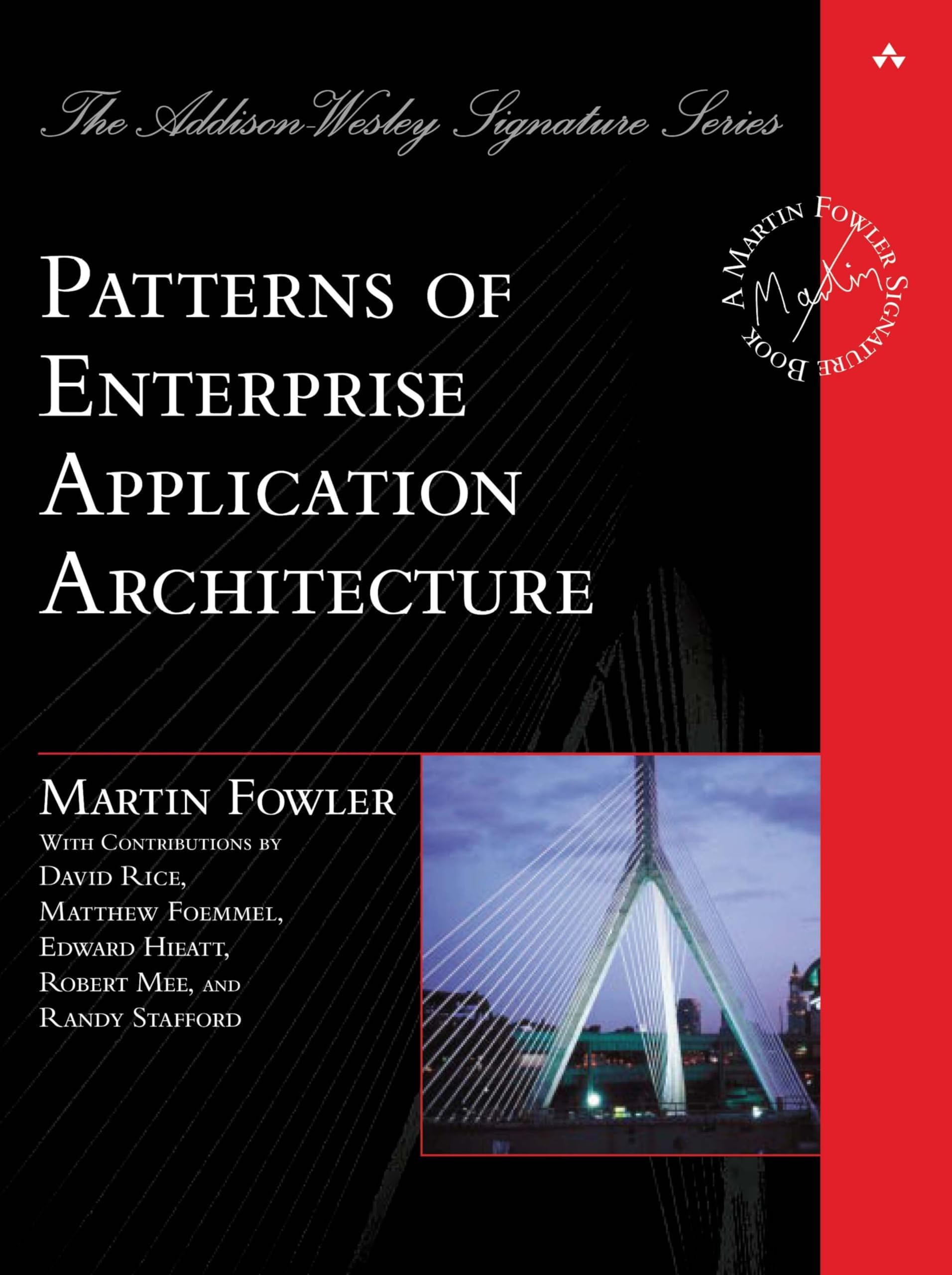
Patterns of Enterprise Application Architecture by Martin Fowler is a definitive guide offering rigorous, language-neutral architectural patterns for building scalable, maintainable enterprise software. Highly rated and widely referenced, it empowers developers and architects to solve complex design challenges with strategic insight and practical examples.




| Best Sellers Rank | 175,515 in Books ( See Top 100 in Books ) 35 in Computer Databases (Books) 76 in Computer Architecture & Microprocessors 376 in Software Design & Development |
| Customer reviews | 4.5 4.5 out of 5 stars (820) |
| Dimensions | 19.69 x 3.61 x 24.38 cm |
| Edition | First Edition |
| ISBN-10 | 0321127420 |
| ISBN-13 | 978-0321127426 |
| Item weight | 1.02 kg |
| Language | English |
| Part of series | Addison-Wesley Signatures (Fowler) |
| Print length | 560 pages |
| Publication date | 22 Nov. 2002 |
| Publisher | Addison-Wesley Professional |
P**E
One of these books that make you feel confident with your skills
I consider this one as a basic reference on my bookshelf. While I found GoF very useful as one of this books that make you think and show you the way to your programmer's career when you are not very experienced, Fowler's book adds the enterprise touch in a way I enjoy each time I get back to the book. I tells you about those many things in real life applications that you may have not come across yet and you need to develop carefully when you are working in a big project. The enterprise approach to patterns is light but described in a rigorous manner. I must confess I enjoy these books that are not tied to a given version of a given language much more than the rest. The information you get is more open and you get a better understanding of the big picture. If this one doesn't become a timeless reference (the way our profession changes I wouldn't dare to say so from any book), it will sure stand as a classic of its era.
N**N
Excellent descriptions of common architectural patterns
Martinn Fowler describes in turn many of the common software architectural patterns using a combination of high-level description, code samples (mostly in Java) and suggestions about when to use and when not to use each pattern. The text of the book is consistent and logical in its presentation with plenty of cross-referencing between the patterns. The book is developer-oriented and focuses on principals more than the detailed implementations. As the author states, this is not a software cookbook, The book helps the developer to approach architectural problems with a range of concepts and strategies to solve design problems. It describes the architectural frameworks that can be used to implement systems of different sizes. It is a useful reference book too. I expect I will be referring to it a lot when I am looking for ideas. Only downside was the occasional grammatical error which meant I had to re-read parts of it to understand the text properly. Only a minor issue but surprising in a book of this quality.
N**I
Good guide to patterns in application development
Gang of four is a classic reference to this material but it it done at a lower level. This is more of a definitive reference on patterns in application development. A must read of developers working with patterns.
M**N
All Developers should read this
With the increasing usage of higher level languages, the importance of design patterns is also increasing and this book is an excellent compendium of the patterns that you need the most. While there are a lot of patterns here that can be found among those proposed by the Gang of Four or found at Sun's BluePrints website, the explanations of the significance of the pattern and when and where it should be used makes it invaluable to programmers. The patterns covered are almost perfect in that they cover the most commonly used patterns as well as the patterns that can make the biggest difference. It's not perfect though as there are a couple of patterns that you feel were included to make up the numbers ('Money' being the most obvious offender). Incidentally, it's also a great source for disambiguation of terms too where disparate teams can use terms from this book as a common reference. Very useful when dealing with remote teams.
M**.
A must-have book for all Enterprise Architects - developer or not!
Firstly, from comments about the paperweight of the pages, I was expecting to receive something that resembles the pages of a missal, which are very thin. Worry not! I am a non-developer and have found this an easy read, and dare I say compelling! I don't understand all of it, but it has certainly enhanced my understanding to be better able to comprehend the architecture behind the code I am reviewing.
T**I
it's still useful to know how things work
I try to keep it close by, and reference it as much as it makes sense. Really a must have for any serious developer, even if most of the patterns are obsolete these days, it's still useful to know how things work, or how most frameworks are built underneath. Although the languages used are Java, C++ and C# in the book, all the principles apply. It's only up to the reader to know how mature a language is to determine if there is something already available in the framework that they're using or if they need to implement something on their own.
J**Y
Mandatory Reading for All Developers
Even tho this book is now 20 years old, every developer working on a web or mobile application or service should read it. Most of the implementation details (mostly Java, some C#) are somewhat dated, but the philosophies and abstract approaches are generally timeless. I just wish I'd read it 15 years ago!
S**Y
Required Reference
If you are involved in designing robust, maintainable and highly flexible systems then you have to know these patterns. Other books may go further with patterns now (SOA Patterns for example) but this is the first book every aspiring IT designer should read. It's about clarity and a common understanding in what is still an incredibly young industry. If you want a stimulating and rewarding career in IT and to understand what IT architects are talking about half the time then read and digest this book for a start! Highly recommended.
U**8
iyi ürün
J**E
En este libro se encuentra una colección de patrones o soluciones que se han usado, se usan y se usarán en las aplicaciones empresariales, o sea, aquellas comúnmente llamadas "gestión comercial" o "gestión empresarial" y que ahora tienen nombres impronunciables formados por interminables siglas. La mayoría de este material está en Internet y es conocido por cualquier programador con experiencia en aplicaciones de gestión. Pero sorprendentemente aquí, en estas páginas, está todo estructurado y condensado de un modo magistral. El libro está dividido en dos partes: un tutorial extraordinariamente asequible y ameno, incluso con buen sentido del humor, y un catálogo bien pensado y bien desarrollado. La redacción es excelente y accesible (especialmente para Hispanohablantes). Desde aprender hasta confirmar, refrescar o contrastar lo que ya se sabe, cualquier programador, analista o estudiante debería comprar y leer este libro. Los ejemplos están escritos en Java y C#, aunque no hay código fuente disponible pues no es necesario; el código solo se necesita para mostrar algún concepto, no para su ejecución.
I**O
It is a great book with many used patterns on a lot of frameworks and libraries nowadays. Also a negative point is some of those patterns are outdated.
D**O
Es un libro que incluye diversos patrones que se usan en el día a día en diversas herramientas de la industria. Por ejemplo, el patrón DTO, el patrón Lazy Load, el patrón Repository, etc. El libro llegó en buen estado, dentro de una bolsa. Las hojas no son tan delgadas cómo en otro comentario leí, pero tampoco son tan gruesas como en otros libros, más bien parecen hojas de periódico, ligeramente más gruesas. Lo que más me gustó es que el índice de cada patrón viene marcado cómo si fuera un directorio telefónico como los de antes. Una chulada de libro.
I**Y
A basic book that helps understanding the foundations of the construction of enterprise systems. It is not the ultimate source of truth though, and requires further reading on the trending topics and concepts that are gaining momentum and have been proven to work.
Trustpilot
Hace 2 días
Hace 3 semanas