We remain fully operational. Our teams are working around the clock to ensure your deliveries continue safely.

Descargar la aplicación


Servicios al cliente
Sobre nosotros
Copyright © 2025 Desertcart Holdings Limited
Descargar la aplicación
Buy anything from 5,000+ international stores. One checkout price. No surprise fees. Join 2M+ shoppers on Desertcart.
Desertcart purchases this item on your behalf and handles shipping, customs, and support to British Virgin Islands.
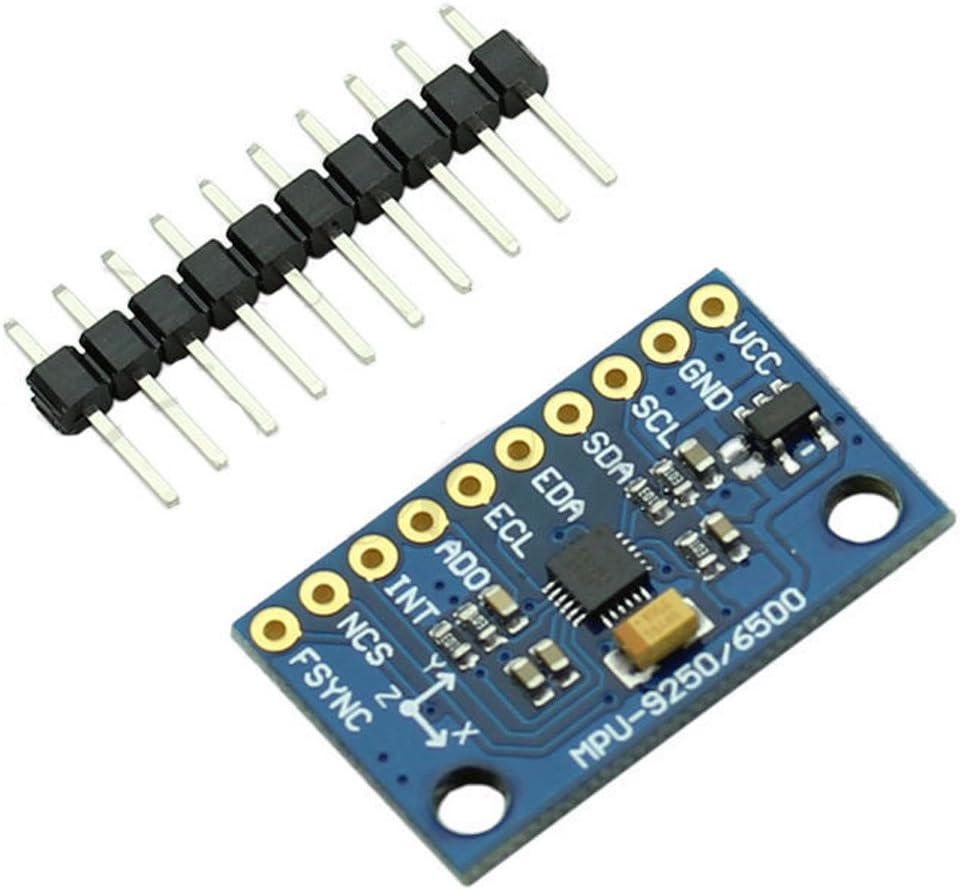
🛰️ Unlock next-level motion tracking — because your projects deserve precision!
The HiLetgo MPU9250 is a compact 9-axis sensor module integrating a 3-axis gyroscope, accelerometer, and magnetometer with 16-bit resolution. Designed for Arduino and similar platforms, it supports I2C and SPI communication, operates on 3.3-5V power, and features a high-quality Immersion Gold PCB. Ideal for robotics, drones, and wearable tech, it offers professional-grade motion tracking with extensive community and customer support, making it a top choice for millennial makers and engineers seeking precision and reliability.
| ASIN | B01I1J0Z7Y |
| Brand Name | HiLetgo |
| Customer Reviews | 4.0 4.0 out of 5 stars (257) |
| Manufacturer | HiLetgo |
| Material Type | FR4 |
| Maximum Supply Voltage | 6.5 Volts |
| Measurement Accuracy | ±250°/S (Gyroscope), ±2g (Accelerator) |
| Measuring Range | ± 16 g, ± 2000 deg/sec, ± 4800 μT |
| Model | 3-01-0876 |
| Mounting Type | PCB Mount |
| Output Type | digital |
| Specific Uses For Product | robotics, drones, wearable devices, DIY projects, industrial applications |
N**S
I order this piece thinking it will piece of cake loading a library in Arduino IDE and get precise position/orientation. First the unit I got was labeled MPU-92/65 which made look for specific libraries. After several tries I gave up and wrote to hiletgo support. The replied in less than 12 hours with a library which was useful. I was able to verify that the unit was working. But some of the examples provided did not work. It made reference to a library in github that was unmaintained. But there, I was able to see that the unit works with the same library as the 9250. So I searched arduino IDE library management and found MPU9250 by hideakitai. Which worked fine and the example got all info from the unit. So, I should have tried that first. Second, there is no easy way to get positions/orientation. You need to do a bit of research on what position really means, so you know what you really want, maybe do some calibrations, take into account that electronics and magnets nearby can change magnetometer readings (really!!), and so you probably will need some way to discard some fluctuations. So if you want to learn look up for a wiki page in github by the user kriswiner regarding MPU6050 and Affordable 9 DoF Sensor. There is a catch, the SPI interface uses most of the same pins as I2C which means that pins are not clearly labeled for SPI. In summary, it works, it have response from customer support and it is cheap... It looks like a good learning experience if you want that. If not, look for some more expensive unit that gives you the results. Adafruit have one absolute position unit that seems really good out of the box.
M**J
I've bought this MPU module together with HiLetgo® TCA9548A I2C IIC Multiplexer Breakout Board 8 Channel Expansion Board for Arduino . Similar to other reviewers, the unit I have received was MPU9255 instead of MPU9250, even though it was marked on the silkscreen as the latter. There is little information on the internet about MPU9255 besides the list of registers, but for the most part it works exactly as MPU9250. You only need to change the value read from WHO_AM_I register to 0x73 from 0x71 (this one's for MPU9250). I have run the same example sketches on both Arduino Nano V3.0 and ESP8285 (nodeMCU, running Arduino sketch). With ESP8285 I have tested the module with both 5V and 3.3V and it worked flawless in both cases. When using ESP8285 you will need to specify which pins you are using for SDA and SCL when calling Wire.Begin. On the photo you can see my test setup - as the OLED screen and MPU have different I2C addresses, I was able to hook them to the same pins. One issue was that OLED library is memory hungry, so when I added it to the MPU test sketch, I've run out of RAM (on Arduino). I had to comment out certain parts of the sketch to make its data fit in 2K, but after that it worked OK. This is an advanced module with lots of sophisticated functionality, so to make full use you will need to spend some time learning it. I recommend reading Kris Winer's posts on sensor fusion and calibration and then carefully reading his example code. Overall I am very happy with this module, but I still have lots to learn to make most out of it.
D**E
good value
F**X
This is a genuine MPU9250 module with magnitude sensor, self-calibration works great. It's really hard to find real 9250 chips nowadays.
T**.
I purchased one of these to test. I thought it would be great to have an accelerometer, gyroscope, and magnetometer all in one. When I received the first one, I tried every library I could get my hands on, and most of them couldn't even detect the chip. I finally found a couple that could detect it, but the only telemetry I received was the temperature sensor, which I don't care about at all. I contacted HiLetgo, and they gave me information that just confirmed that I had gotten a bad board. Well, I sent it back, and Amazon got a new board delivered the next day. I hooked it up, loaded the sketch on the arduino, and hoped I was going to see everything. This time, while I did get accelerometer, gyroscope, and temperature data, I didn't get magnetometer data. Checking with the other library that seems to communicate with this board, it had the same issue. One bad board is an accident. Two bad boards suggests to me that they have a bad batch, and are just selling them anyway. There is no way they don't know. Maybe this is a problem with the MPU-9250 chip itself, and that's why they are marked as obsolete at Digikey. I've dealt with Hiletgo's products on many occasions, and this is the first time I have had any trouble with their stuff. I will likely still buy other things they sell, but that doesn't make this less aggravating.
Trustpilot
Hace 1 mes
Hace 2 meses